
Sexual Harassment
In 1994, Paula Jones filed a lawsuit accusing Clinton of sexual harassment when he was governor of Arkansas.

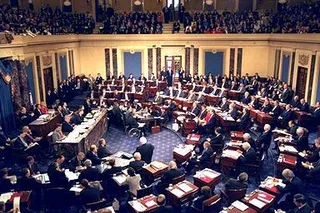
Saturday Dec 19, 1998 to Friday Feb 12, 1999
Washington, D.C., United States
The impeachment of Bill Clinton was initiated on October 8, 1998, when the United States House of Representatives voted to commence impeachment proceedings against Bill Clinton, the 42nd president of the United States, for "high crimes and misdemeanors". The specific charges against Clinton were lying under oath and obstruction of justice. The charges stemmed from a sexual harassment lawsuit filed against Clinton by Paula Jones and from Clinton's testimony denying that he had engaged in a sexual relationship with White House intern Monica Lewinsky. The catalyst for the president's impeachment was the Starr Report, a September 1998 report prepared by Independent Counsel Ken Starr for the House Judiciary Committee.
In 1994, Paula Jones filed a lawsuit accusing Clinton of sexual harassment when he was governor of Arkansas.
In May 1997 the Supreme Court ordered the case to proceed and shortly thereafter the pre-trial discovery process commenced. Jones's attorneys wanted to prove that Clinton had engaged in a pattern of behavior with women that supported her claims.
In those recordings, Lewinsky divulged that she had had a sexual relationship with Clinton. Tripp shared this information with Jones's lawyers, who added Lewinsky to their witness list in December 1997.
In late 1997, Linda Tripp began secretly recording conversations with her friend Monica Lewinsky, a former intern and Department of Defense employee.
According to the Starr Report, a U.S. federal government report written by appointed Independent Counsel Ken Starr on his investigation of President Clinton, after Lewinsky appeared on the witness list Clinton began taking steps to conceal their relationship.
On January 12, 1998, Linda Tripp, who had been working with Jones' lawyers, informed Starr that Lewinsky was preparing to commit perjury in the Jones case and had asked Tripp to do the same. She also said Clinton's friend Vernon Jordan was assisting Lewinsky. Based on the connection to Jordan, who was under scrutiny in the Whitewater probe, Starr obtained approval from Reno to expand his investigation into whether Lewinsky and others were breaking the law.
The judge in the Jones case later ruled the Lewinsky matter immaterial, and threw out the case in April 1998 on the grounds that Jones had failed to show any damages.
The Republican controlled House of Representatives voted 258-176 to commence impeachment proceedings against Clinton on October 8, 1998. Since Ken Starr had already completed an extensive investigation, the House Judiciary Committee conducted no investigations of its own into Clinton's alleged wrongdoing and held no serious impeachment-related hearings before the 1998 midterm elections. Impeachment was one of the major issues in those elections.
After Jones appealed, Clinton agreed in November 1998 to settle the case for $850,000 while still admitting no wrongdoing.
In the November 1998 House elections, the Democrats picked up five seats in the House, but the Republicans still maintained majority control. The results went against what House Speaker Newt Gingrich predicted, who, before the election, had been reassured by private polling that Clinton's scandal would result in Republican gains of up to thirty House seats.
Eventually, the court dismissed the Paula Jones harassment lawsuit, before trial, on the grounds that Jones failed to demonstrate any damages. However, while the dismissal was on appeal, Clinton entered into an out-of-court settlement by agreeing to pay Jones $850,000.
In a January 17, 1998 sworn deposition, Clinton denied having a "sexual relationship," "sexual affair," or "sexual relations" with Lewinsky, and even that he was ever alone with her. His lawyer, Robert S. Bennett, stated with Clinton present that Lewinsky's affidavit showed that there was no sex in any manner, shape or form between Clinton and Lewinsky.
On December 11, 1998, the House Judiciary Committee voted on whether to present the three articles of impeachment to the full House of Representatives. On the first and second articles of impeachment, grand jury perjury and obstruction of justice, the Committee voted 21-to-17 to impeach, strictly on party lines; on the third article of impeachment, perjury, the Committee voted 20-to-18 to impeach, with Republican Lindsey Graham joining Democratic Committee Members in order to give President Clinton "the legal benefit of the doubt".
The next day, December 12, 1998, the House Judiciary Committee voted on the fourth and final article of impeachment, for making false statements, again strictly along party lines.
After rumors of the scandal reached the news, Clinton publicly stated, "I did not have sexual relations with that woman, Miss Lewinsky" .
Months later, Clinton admitted that his relationship with Lewinsky was "wrong" and "not appropriate". Lewinsky engaged in oral sex with Clinton several times.
Based on the president's conflicting testimony, Starr concluded that Clinton had committed perjury. Starr submitted his findings to Congress in a lengthy document, the Starr Report, which was released to the public via the Internet a few days later and included descriptions of encounters between Clinton and Lewinsky.
Two other articles of impeachment failed – a second count of perjury in the Jones case (by a 205–229 vote) and one accusing Clinton of abuse of power (by a 148–285 vote). Clinton thus became the second U.S. president to be impeached. He is also the third president against whom articles of impeachment have been brought before the full House (the second having been Richard Nixon in 1974).
Although proceedings were delayed due to the bombing of Iraq, on the passage of H. Res. 611, Clinton was impeached by the House of Representatives on December 19, 1998 on grounds of perjury to a grand jury (by a 228–206 vote; 223-5 R, 5-200 D, 0-1 independent) and obstruction of justice (by a 221–212 vote; 216-12 R, 5-199 D, 0-1 independent).
Article I charged that Clinton lied to the grand jury concerning: - the nature and details of his relationship with Lewinsky - prior false statements he made in the Jones deposition - prior false statements he allowed his lawyer to make characterizing Lewinsky's affidavit - his attempts to tamper with witnesses
Article II charged Clinton with attempting to obstruct justice in the Jones case by: 1- encouraging Lewinsky to file a false affidavit 2- encouraging Lewinsky to give false testimony if and when she was called to testify 3- concealing gifts he had given to Lewinsky that had been subpoenaed 4- attempting to secure a job for Lewinsky to influence her testimony 5- permitting his lawyer to make false statements characterizing Lewinsky's affidavit 6- attempting to tamper with the possible testimony of his secretary Betty Currie 7- making false and misleading statements to potential grand jury witnesses
Shortly after the elections, Gingrich, who had been one of the leading advocates for impeachment, announced he would resign from Congress as soon as he was able to find somebody to fill his vacant seat; Gingrich fulfilled this pledge, and officially resigned from Congress on January 3, 1999.
The Senate trial began on January 7, 1999, with Chief Justice of the United States William Rehnquist presiding. The first day consisted of formal presentation of the charges against Clinton, and of Rehnquist swearing in all arguants in the trial.
A resolution on rules and procedure for the trial was adopted unanimously on the following day; however, senators tabled the question of whether to call witnesses in the trial.
Briefs were filed by the House on January 11, 1999.
briefs were filed by Clinton on January 13, 1999.
The Speaker-designate, Representative Bob Livingston, chosen by the Republican Party Conference to replace Gingrich as House Speaker, announced the end of his candidacy for Speaker and his resignation from Congress from the floor of the House after his own marital infidelity came to light. In the same speech, Livingston also encouraged Clinton to resign. Clinton chose to remain in office and urged Livingston to reconsider his resignation.
Impeachment proceedings were held during the post-election, "lame duck" session of the outgoing 105th United States Congress. The committee hearings were perfunctory but the floor debate in the whole House was spirited on both sides.
The managers presented their case over three days, from January 14 to 16, with discussion of the facts and background of the case; detailed cases for both articles of impeachment (including excerpts from videotaped grand jury testimony that Clinton had made the previous August); matters of interpretation and application of the laws governing perjury and obstruction of justice; and argument that the evidence and precedents justified removal of the President from office by virtue of "willful, premeditated, deliberate corruption of the nation's system of justice through perjury and obstruction of justice.".
The defense presentation took place from January 19–21. Clinton's defense counsel argued that Clinton's grand jury testimony had too many inconsistencies to be a clear case of perjury, that the investigation and impeachment had been tainted by partisan political bias, that the President's approval rating of more than 70 percent indicated that his ability to govern had not been impaired by the scandal, and that the managers had ultimately presented "an unsubstantiated, circumstantial case that does not meet the constitutional standard to remove the President from office".
January 22 and 23 were devoted to questions from members of the Senate to the House managers and Clinton's defense counsel. Under the rules, all questions (over 150) were to be written down and given to Rehnquist to read to the party being questioned.
On January 25, Senator Robert Byrd moved for dismissals of both articles of impeachment for lack of merit.
On the following day, Rep. Bryant moved to call witnesses to the trial, a question that the Senate had scrupulously avoided to that point. In both cases, the Senate voted to deliberate on the question in private session, rather than public, televised procedure.
On January 27, the Senate voted on both motions in public session; the motion to dismiss failed on a nearly party line vote of 56–44, while the motion to depose witnesses passed by the same margin.
A day later, the Senate voted down motions to move directly to a vote on the articles of impeachment and to suppress videotaped depositions of the witnesses from public release, Senator Russ Feingold voting with the Republicans.
Over three days, February 1–3, House managers took videotaped closed-door depositions from Monica Lewinsky, Clinton's friend Vernon Jordan, and White House aide Sidney Blumenthal.
On February 4, however, the Senate voted 70–30 that excerpting these videotapes would suffice as testimony, rather than calling live witnesses to appear at trial.
The videos were played in the Senate on February 6, featuring 30 excerpts of Lewinsky discussing her affidavit in the Paula Jones case, the hiding of small gifts Clinton had given her, and his involvement in procurement of a job for Lewinsky.
On February 8, closing arguments were presented with each side allotted a three-hour time slot.
On February 9, after voting against a public deliberation on the verdict, the Senate began closed-door deliberations instead.
On February 12, the Senate emerged from its closed deliberations and voted on the articles of impeachment. A two-thirds vote, 67 votes, would have been necessary to convict and remove the President from office.
All Democrats voted not guilty (45 Votes), the majority of Republicans voted guilty (45 votes) and 10 Republicans voted not guilty.
All Democrats voted not guilty (45 Votes), the majority of Republicans voted guilty (50 votes) and 5 Republicans voted not guilty.
In April 1999, about two months after being acquitted by the Senate, Clinton was cited by Federal District Judge Susan Webber Wright for civil contempt of court for his "willful failure" to obey her repeated orders to testify truthfully in the Paula Jones sexual harassment lawsuit. For this citation, Clinton was assessed a $90,000 fine, and the matter was referred to the Arkansas Supreme Court to see if disciplinary action would be appropriate.
On the day before leaving office in January 2001, Clinton, in what amounted to a plea bargain, agreed to a five-year suspension of his Arkansas law license and to pay a $25,000 fine as part of an agreement with the independent counsel Robert Ray to end his investigation without filing any criminal charges for perjury or obstruction of justice.