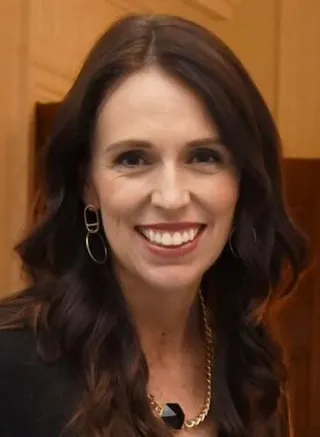
Jacinda Kate Laurell Ardern (born 26 July 1980) is a New Zealand politician who has served as the 40th prime minister of New Zealand and leader of the Labour Party since 2017. She has been the member of Parliament (MP) for Mount Albert since March 2017, having first been elected to the House of Representatives as a list MP in 2008.
eventSunday Jul 27, 1980placeHamilton, Waikato, New Zealand
Jacinda was born in Hamilton, New Zealand, Ardern grew up as a Mormon in Morrinsville and Murupara, where her father, Ross Ardern, worked as a police officer, and her mother, Laurell Ardern (née Bottomley), worked as a school catering assistant.
Jacinda studied at Morrinsville College, where she was the student representative on the school's Board of Trustees. Whilst still at school she found her first job, working at a local fish-and-chip shop.
Ardern was brought into politics by her aunt, Marie Ardern, a longstanding member of the Labour Party, who recruited the teenaged Ardern to help her with campaigning for New Plymouth MP Harry Duynhoven during his re-election campaign at the 1999 general election.
Ardern served in British Prime Minister Tony Blair's cabinet office for two and a half years, working as an associate director for Better Regulation Executive, with primary responsibility for changing the way local authorities deal with small businesses.
In early 2008, Ardern was elected as the president of the International Union of Socialist Youth, a role which saw her spend time in several countries, including Jordan, Israel, Algeria, and China.
Ahead of the 2008 election, Ardern was ranked 20th on Labour's party list. This was a very high placement for someone who was not already a sitting MP, She became Labour's candidate for the safe National electorate of Waikato. Ardern was unsuccessful in the electorate vote, but her high placement on Labour's party list allowed her to enter Parliament as a list MP. Upon election, she became the youngest sitting MP in Parliament, succeeding fellow Labour MP Darren Hughes, and remained the youngest MP until the election of Gareth Hughes on 11 February 2010.
Losing elections and becomiing MP for Auckland Central
eventSaturday Nov 26, 2011placeAuckland Central, Auckland, New Zealand
Ardern contested the seat of Auckland Central for Labour in the 2011 general election, standing against incumbent National MP Nikki Kaye for National and Greens candidate Denise Roche. Despite targeting Green voters to vote strategically for her, she lost to Kaye by 717 votes. However, she returned to Parliament via the party list, on which she was ranked 13th. Ardern maintained an office within the electorate while she was a list MP based in Auckland Central.
After Goff resigned from the Party leadership following his defeat at the 2011 election, Ardern supported David Shearer over David Cunliffe. She was elevated to the fourth-ranking position in the Shadow Cabinet on 19 December 2011, becoming a spokesperson for social development under new leader David Shearer.
eventSaturday Sep 20, 2014placeAuckland Central, Auckland, New Zealand
Ardern stood again in Auckland Central at the 2014 general election. She again finished second though increased her own vote and reduced Kaye's majority from 717 to 600. Ranked 5th on Labour's list Ardern was still returned to Parliament where she became Shadow spokesperson for Justice, Children, Small Business, and Arts & Culture under new leader Andrew Little.
eventThursday Jan 12, 2017placeMount Albert, Auckland, New Zealand
Ardern put forward her name for the Labour nomination for the Mount Albert by-election to be held in February 2017 following the resignation of David Shearer on 8 December 2016. When nominations for the Labour Party closed on 12 January 2017, Ardern was the only nominee and was elected unopposed.
On 21 January, Ardern participated in the 2017 Women's March, a worldwide protest in opposition to Donald Trump, the newly inaugurated president of the United States. She was confirmed as Labour's candidate at a meeting on 22 January. Ardern won a landslide victory, gaining 77 percent of votes cast in the preliminary results.
Following her win in the by-election, Ardern was unanimously elected as deputy leader of the Labour Party on 7 March 2017, following the resignation of Annette King who was intending to retire at the next election. Ardern's vacant list seat was taken by Raymond Huo.
In mid-August 2017, Ardern stated that a Labour government would establish a tax working group to explore the possibility of introducing a capital gains tax but ruled out taxing family homes. In response to negative publicity, Ardern abandoned plans to introduce a capital gains tax during the first term of a Labour government.
On 19 October 2017, New Zealand First leader Winston Peters agreed to form a coalition with Labour, making Ardern the next prime minister. This coalition receives confidence and supply from the Green Party. Ardern named Peters as Deputy Prime Minister and Minister of Foreign Affairs. She also gave New Zealand First five posts in her government, with Peters and three other ministers serving in Cabinet.
On 5 November 2017, Ardern made her first official overseas trip to Australia, where she met Australian Prime Minister Malcolm Turnbull for the first time.
In December 2017, Ardern voiced support for the UN resolution criticizing US President Donald Trump's decision to recognize Jerusalem as the capital of Israel, saying that some decisions "that we saw by international actors like the United States recently ... took us backward, not forwards."
eventFriday Feb 2, 2018placeWaitangi Treaty Grounds, New Zealand
On 2 February 2018, Ardern traveled to Waitangi for the annual Waitangi Day commemoration; she stayed in Waitangi for five days, an unprecedented length. Ardern became the first female prime minister to speak from the top marae. Her visit was largely well-received by Māori leaders, with commentators noting a sharp contrast with the acrimonious responses received by several of her predecessors.
eventFriday Apr 20, 2018placeLondon, England, United Kingdom
On 20 April 2018, Ardern attended the Commonwealth Heads of Government Meeting 2018 in London, where she was selected to deliver a toast to the Commonwealth at a state banquet of world leaders. She also had her first private audience with Queen Elizabeth II.
eventThursday Jun 21, 2018placeWellington, New Zealand
On 19 January 2018, Ardern announced that she was pregnant and that Winston Peters would take the role of acting prime minister for six weeks after the birth. Following the birth of a daughter, she took her maternity leave from 21 June to 2 August 2018.
In July 2018, Ardern announced the start of her government's flagship Families Package. Among its provisions, the package gradually increased paid parental leave to 26 weeks and paid $60-a-week to low and middle-income families with young children.
eventFriday Mar 15, 2019placeChristchurch, Canterbury, New Zealand
On 15 March 2019, 51 people were fatally shot and 49 injured in two mosques in Christchurch. In a statement broadcast on television, Ardern offered condolences and stated that the shootings had been carried out by suspects with "extremist views" that have no place in New Zealand, or anywhere else in the world. She also described it as a well-planned terrorist attack.
On 24 September, Ardern became the first female head of government to attend the United Nations General Assembly meeting with her infant present. Her address to the General Assembly on 27 September praised the United Nations for its multilateralism, expressed support for the world's youth, and called for immediate attention to the effects and causes of climate change, for the equality of women, and for kindness as the basis for action.
On 14 March 2020, Ardern announced in response to the COVID-19 pandemic in New Zealand that the government would be requiring anyone entering the country from midnight 15 March to isolate themselves for 14 days. She said the new rules will mean New Zealand has the "widest ranging and toughest border restrictions of any country in the world".
On 19 March, Ardern stated that New Zealand's borders would be closed to all non-citizens and non-permanent residents, after 11:59 pm on 20 March (NZDT). Ardern announced that New Zealand would move to alert level 4, including a nationwide lockdown, at 11:59 pm on 25 March
On 19 March, Ardern stated that New Zealand's borders would be closed to all non-citizens and non-permanent residents, after 11:59 pm on 20 March (NZDT). Ardern announced that New Zealand would move to alert level 4, including a nationwide lockdown, at 11:59 pm on 25 March.