
Born
Alan Turing was born on 23 June 1912, in Maida Vale, London, England.

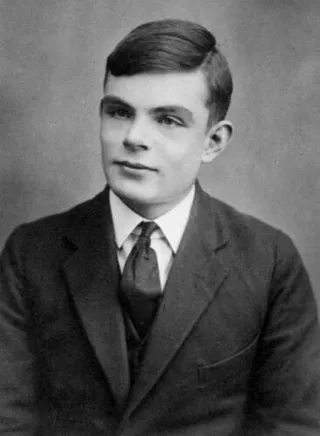
Sunday Jun 23, 1912 to Monday Jun 7, 1954
England
Alan Mathison Turing was an English mathematician, computer scientist, logician, cryptanalyst, philosopher and theoretical biologist. Turing was highly influential in the development of theoretical computer science, providing a formalisation of the concepts of algorithm and computation with the Turing machine, which can be considered a model of a general-purpose computer. Turing is widely considered to be the father of theoretical computer science and artificial intelligence. Despite these accomplishments, he was never fully recognised in his home country during his lifetime, due to his homosexuality, which was then a crime in the UK, and because his work was covered by the Official Secrets Act.
Alan Turing was born on 23 June 1912, in Maida Vale, London, England.
Between January 1922 and 1926, Turing was educated at Hazelhurst Preparatory School, an independent school in the village of Frant in Sussex (now East Sussex). In 1926, at the age of 13, he went on to Sherborne School, a boarding independent school in the market town of Sherborne in Dorset.
In 1928, aged 16, Turing encountered Albert Einstein's work; not only did he grasp it, but it is possible that he managed to deduce Einstein's questioning of Newton's laws of motion from a text in which this was never made explicit.
At Sherborne, Turing formed a significant friendship with fellow pupil Christopher Morcom (1911 – 1930), who has been described as Turing's "first love". Their relationship provided inspiration in Turing's future endeavours, but it was cut short by Morcom's death, in February 1930, from complications of bovine tuberculosis, contracted after drinking infected cow's milk some years previously.
After Sherborne, Turing studied as an undergraduate from 1931 to 1934 at King's College, Cambridge, where he was awarded first-class honors in mathematics.
In 1935, at the age of 22, he was elected a fellow of King's on the strength of a dissertation in which he proved the central limit theorem. Unknown to the committee, the theorem had already been proven, in 1922, by Jarl Waldemar Lindeberg.
From September 1936 to July 1938, Turing spent most of his time studying under Alonzo Church at Princeton University, in the second year as a Jane Eliza Procter Visiting Fellow. In addition to his purely mathematical work, he studied cryptology and also built three of four stages of an electro-mechanical binary multiplier.
In 1936, Turing published his paper "On Computable Numbers, with an Application to the Entscheidungsproblem". It was published in the Proceedings of the London Mathematical Society journal in two parts, the first on 30 November and the second on 23 December.
In June 1938, he obtained his PhD from the Department of Mathematics at Princeton; his dissertation, Systems of Logic Based on Ordinals, introduced the concept of ordinal logic and the notion of relative computing, where Turing machines are augmented with so-called oracles, allowing the study of problems that cannot be solved by Turing machines. John von Neumann wanted to hire him as his postdoctoral assistant, but he went back to the United Kingdom.
From September 1938, Turing had been working part-time with the Government Code and Cypher School (GC&CS), the British codebreaking organisation. He concentrated on cryptanalysis of the Enigma with Dilly Knox, a senior GC&CS codebreaker.
When Turing returned to Cambridge, he attended lectures given in 1939 by Ludwig Wittgenstein about the foundations of mathematics. The lectures have been reconstructed verbatim, including interjections from Turing and other students, from students' notes. Turing and Wittgenstein argued and disagreed, with Turing defending formalism and Wittgenstein propounding his view that mathematics does not discover any absolute truths, but rather invents them.
After the July 1939 Warsaw meeting at which the Polish Cipher Bureau had provided the British and French with the details of the wiring of Enigma rotors and their method of decrypting Enigma code messages, Turing and Knox started to work on a less fragile approach to the problem. Their approach was more general, using crib-based decryption for which he produced the functional specification of the bombe (an improvement of the Polish Bomba).
On 4 September 1939, the day after the UK declared war on Germany, Turing reported to Bletchley Park, the wartime station of GC&CS.
Turing decided to tackle the particularly difficult problem of German naval Enigma "because no one else was doing anything about it and I could have it to myself". In December 1939, Turing solved the essential part of the naval indicator system, which was more complex than the indicator systems used by the other services.That same night, he also conceived of the idea of Banburismus, a sequential statistical technique to assist in breaking the naval Enigma.
Within weeks of arriving at Bletchley Park, Turing had specified an electromechanical machine called the bombe, which could break Enigma more effectively than the Polish bomba kryptologiczna, from which its name was derived. The first bombe was installed on 18 March 1940.
By late 1941, Turing and his fellow cryptanalysts Gordon Welchman, Hugh Alexander and Stuart Milner-Barry were frustrated. Building on the work of the Poles, they had set up a good working system for decrypting Enigma signals, but their limited staff and bombes meant they could not translate all the signals. In the summer, they had considerable success, and shipping losses had fallen to under 100,000 tons a month; however, they badly needed more resources to keep abreast of German adjustments. They had tried to get more people and fund more bombes through the proper channels, but had failed.
In 1941, Turing proposed marriage to Hut 8 colleague Joan Clarke, a fellow mathematician and cryptanalyst, but their engagement was short-lived. After admitting his homosexuality to his fiancée, who was reportedly "unfazed" by the revelation, Turing decided that he could not go through with the marriage.
On 28 October they wrote directly to Winston Churchill explaining their difficulties, with Turing as the first named. They emphasised how small their need was compared with the vast expenditure of men and money by the forces and compared with the level of assistance they could offer to the forces.
On 18 November, the chief of the secret service reported that every possible measure was being taken. The cryptographers at Bletchley Park did not know of the Prime Minister's response, but as Milner-Barry recalled, "All that we did notice was that almost from that day the rough ways began miraculously to be made smooth." More than two hundred bombes were in operation by the end of the war.
In July 1942, Turing devised a technique termed Turingery (or jokingly Turingismus) for use against the Lorenz cipher messages produced by the Germans' new Geheimschreiber (secret writer) machine.
Turing traveled to the United States in November 1942 and worked with US Navy cryptanalysts on the naval Enigma and bombe construction in Washington DC; he also visited their Computing Machine Laboratory in Dayton, Ohio.
Turing returned to Bletchley Park in March 1943. During his absence, Hugh Alexander had officially assumed the position of head of Hut 8, although Alexander had been de facto head for some time (Turing having little interest in the day-to-day running of the section). Turing became a general consultant for cryptanalysis at Bletchley Park.
Between 1945 and 1947, Turing lived in Hampton, London, while he worked on the design of the ACE (Automatic Computing Engine) at the National Physical Laboratory (NPL).
In 1946, Turing was appointed an Officer of the Order of the British Empire (OBE) by King George VI for his wartime services, but his work remained secret for many years.
Turing presented a paper on 19 February 1946, which was the first detailed design of a stored-program computer.
In late 1947 he returned to Cambridge for a sabbatical year during which he produced a seminal work on Intelligent Machinery that was not published in his lifetime.
In 1948, Turing was appointed reader in the Mathematics Department at the Victoria University of Manchester.
In 1948 Turing, working with his former undergraduate colleague, D.G. Champernowne, began writing a chess program for a computer that did not yet exist.
In 1949, he became Deputy Director of the Computing Machine Laboratory, where he worked on software for one of the earliest stored-program computers—the Manchester Mark 1.
By 1950, the chess program was completed and dubbed the Turbochamp.
While he was at Cambridge, the Pilot ACE was being built in his absence. It executed its first program on 10 May 1950, and a number of later computers around the world owe much to it, including the English Electric DEUCE and the American Bendix G-15. The full version of Turing's ACE was not built until after his death.
In "Computing Machinery and Intelligence" (Mind, October 1950), Turing addressed the problem of artificial intelligence, and proposed an experiment that became known as the Turing test, an attempt to define a standard for a machine to be called "intelligent". The idea was that a computer could be said to "think" if a human interrogator could not tell it apart, through conversation, from a human being.
In 1952, he tried to implement it on a Ferranti Mark 1, but lacking enough power, the computer was unable to execute the program. Instead, Turing "ran" the program by flipping through the pages of the algorithm and carrying out its instructions on a chessboard, taking about half an hour per move.
When Turing was 39 years old in 1951, he turned to mathematical biology, finally publishing his masterpiece "The Chemical Basis of Morphogenesis" in January 1952.
In January 1952, Turing was 39 when he started a relationship with Arnold Murray, a 19-year-old unemployed man. Just before Christmas, Turing was walking along Manchester's Oxford Road when he met Murray just outside the Regal Cinema and invited him to lunch.
On 23 January, Turing's house was burgled. Murray told Turing that he and the burglar were acquainted, and Turing reported the crime to the police. During the investigation, he acknowledged a sexual relationship with Murray. Homosexual acts were criminal offences in the United Kingdom at that time, and both men were charged with "gross indecency" under Section 11 of the Criminal Law Amendment Act 1885.
Initial committal proceedings for the trial were held on 27 February during which Turing's solicitor "reserved his defence", i.e., did not argue or provide evidence against the allegations.
Turing was later convinced by the advice of his brother and his own solicitor, and he entered a plea of guilty. The case, Regina v. Turing and Murray, was brought to trial on 31 March 1952. Turing was convicted and given a choice between imprisonment and probation. His probation would be conditional on his agreement to undergo hormonal physical changes designed to reduce libido. He accepted the option of injections of what was then called stilboestrol (now known as diethylstilbestrol or DES), a synthetic oestrogen; this feminization of his body was continued for the course of one year.
On 8 June 1954, Turing's housekeeper found him dead at the age of 41; he had died the previous day. Cyanide poisoning was established as the cause of death.
Turing's remains were cremated at Woking Crematorium on 12 June 1954 and his ashes were scattered in the gardens of the crematorium, just as his father's had been.
On 1 April 2003, Turing's work at Bletchley Park was named an IEEE Milestone.
A blue plaque at the college was unveiled on the centenary of his birth on 23 June 2012 and is now installed at the college's Keynes Building on King's Parade.
On 24 December 2013, Queen Elizabeth II signed a pardon for Turing's conviction for "gross indecency", with immediate effect.
The Queen officially pronounced Turing pardoned in August 2014.