
Born
Ayman al-Zawahiri was born in 1951 in the neighborhood of Maadi, Cairo, in the then Kingdom of Egypt, to Mohammed Rabie al-Zawahiri and Umayma Azzam.

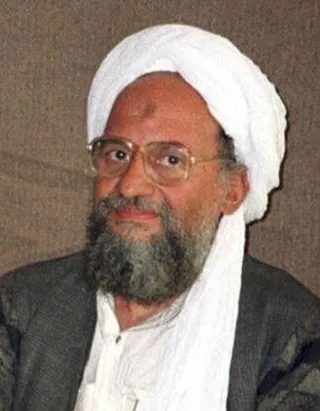
Tuesday Jun 19, 1951 to Present
Egypt-Afghanistan-Pakistan
Ayman Mohammed Rabie al-Zawahiri is the current leader of al-Qaeda and a current or former member and senior official of Islamist organizations which have orchestrated and carried out attacks in Asia, Africa, and the Middle East and also some in North America and Europe. In 2012, he called on Muslims to kidnap Western tourists in Muslim countries.
Ayman al-Zawahiri was born in 1951 in the neighborhood of Maadi, Cairo, in the then Kingdom of Egypt, to Mohammed Rabie al-Zawahiri and Umayma Azzam.
By the age of 14, al-Zawahiri had joined the Muslim Brotherhood. al-Zawahiri, along with four other secondary school students, helped form an "underground cell devoted to overthrowing the government and establishing an Islamist state." It was at this early age that al-Zawahiri developed a mission in life, "to put Qutb's vision into action."His cell eventually merged with others to form al-Jihad or Egyptian Islamic Jihad.
Ayman al-Zawahiri was reportedly a studious youth. Ayman excelled in school, loved poetry, and "hated violent sports" — which he thought were "inhumane." Al-Zawahiri studied medicine at Cairo University and graduated in 1974 with gayyid giddan, then earned a master's degree in surgery In 1978.
In 1978, al-Zawahiri married his first wife, Azza Ahmed Nowari, a student at Cairo University who was studying philosophy. Their wedding, which was held at the Continental Hotel in Opera Square, was very conservative, with separate areas for both men and women, and no music, photographs, or light-hearted humour.
In 1981, Al-Zawahiri was one of hundreds arrested following the assassination of President Anwar Sadat.
Ayman al-Zawahiri had first met bin Laden in Jeddah in 1986, as a reportedly qualified surgeon, when his organization merged with bin Laden's al-Qaeda, he became bin Laden's personal advisor and physician.
Al-Zawahiri began reconstituting the Egyptian Islamic Jihad (EIJ) along with other exiled militants. The group had "very loose ties to their nominal imprisoned leader, Abud al-Zumur." In 1991, EIJ broke with al-Zumur, and al-Zawahiri grabbed "the reins of power" to become EIJ leader.
The 1995 attack on the Egyptian embassy in Islamabad, Pakistan, was the Egyptian Islamic Jihad's first success under Zawahiri's leadership, but Bin Laden had disapproved of the operation. The bombing alienated Pakistan, which was "the best route into Afghanistan".
On December 1, 1996, Ahmad Salama Mabruk and Mahmud Hisham al-Hennawi – both carrying false passports – accompanied al-Zawahiri on a trip to Chechnya, where they hoped to re-establish the faltering Jihad. Their leader was traveling under the pseudonym Abdullah Imam Mohammed Amin, and trading on his medical credentials for legitimacy. The group switched vehicles three times, but were arrested within hours of entering Russian territory and spent five months in a Makhachkala prison awaiting trial.
In April 1997, the trio (Ahmad Salama Mabruk - Mahmud Hisham al-Hennawi - al-Zawahiri) were sentenced to six months, and were subsequently released a month later and ran off without paying their court-appointed attorney Abulkhalik Abdusalamov his $1,800 legal fee citing their "poverty".
While there Zawahiri learned of a "Nonviolence Initiative" being organized in Egypt to end the terror campaign that had killed hundreds and resulting government crackdown that had imprisoned thousands. Zawahiri angrily opposed this "surrender" in letters to the London newspaper Al-Sharq al-Awsat. Together with members of al-Gama'a al-Islamiyya, he helped organize a massive attack on tourists at the Temple of Hatshepsut to sabotage the initiative by provoking the government into repression. The attack by six men dressed in police uniforms succeeded in machine-gunning and hacking to death 58 foreign tourists and four Egyptians.
In 1998, al-Zawahiri formally merged the Egyptian Islamic Jihad into al-Qaeda. According to reports by a former al-Qaeda member, he has worked in the al-Qaeda organization since its inception and was a senior member of the group's shura council. He was often described as a "lieutenant" to Osama bin Laden, though bin Laden's chosen biographer has referred to him as the "real brains" of al-Qaeda.
On February 23, 1998, al-Zawahiri issued a joint fatwa with Osama bin Laden under the title "World Islamic Front Against Jews and Crusaders". Zawahiri, not bin Laden, is thought to have been the actual author of the fatwa.
Bin Laden and al-Zawahiri organized an al-Qaeda congress on June 24, 1998. A week prior to the beginning of the conference, a group of well-armed assistants to al-Zawahiri had left by jeeps in the direction of Herat. Following the instructions of their patron, in the town of Koh-i-Doshakh, they met three unknown Slavic-looking men who had arrived from Russia via Iran. After their arrival in Kandahar, they split up. One of the Russians was directly escorted to al-Zawahiri and he did not participate in the conference.
In 1998, Ayman al-Zawahiri was listed as under indictment in the United States for his role in the 1998 U.S. embassy bombings, a series of attacks that occurred on August 7, 1998, in which hundreds of people were killed in simultaneous truck bomb explosions at the United States embassies in the major East African cities of Dar es Salaam, Tanzania and Nairobi, Kenya. The attacks brought Osama bin Laden and Ayman al-Zawahiri to international attention.
The Luxor massacre was so unpopular that no terror attacks occurred in Egypt for several years thereafter. Zawahiri was sentenced to death in absentia in 1999 by an Egyptian military tribunal.
For their leading role in anti-Egyptian Government attacks in the 1990s, al-Zawahiri and his brother Muhammad al-Zawahiri were sentenced to death in the 1999 Egyptian case of the Returnees from Albania.
On 12 October 2000, the USS Cole bombing encouraged several members to depart. Mohammed Atef went to escape Kandahar, Zawahiri to Kabul, and Bin Laden fled to Kabul, later joining Atef when he realised no American reprisal attacks were forthcoming.
Following the U.S. invasion of Afghanistan, al-Zawahiri's whereabouts are unknown, but he is generally thought to be in tribal Pakistan. Although he releases videos of himself frequently (see Messages of Ayman al-Zawahiri), al-Zawahiri did not appear alongside bin Laden in any of them after 2003. However, despite a series of operations, they were unable to capture him.
On October 10, 2001, al-Zawahiri appeared on the initial list of the U.S. Federal Bureau of Investigation's top 22 Most Wanted Terrorists, which was released to the public by U.S. President George W. Bush.
In early November 2001, the Taliban government announced they were bestowing official Afghan citizenship on him, as well as Bin Laden, Mohammed Atef, Saif al-Adl, and Shaykh Asim Abdulrahman.
Ayman al-Zawahiri's first wife Azza and two of their six children, Mohammad and Aisha, were killed in an air strike on Afghanistan by US forces in late December 2001, following the September 11 attacks on the U.S. After an American aerial bombardment of a Taliban-controlled building at Gardez, Azza was pinned under debris of a guesthouse roof.
On January 13, 2006, the Central Intelligence Agency, aided by Pakistan's ISI, launched an airstrike on Damadola, a Pakistani village near the Afghan border where they believed al-Zawahiri was located. The airstrike was supposed to kill al-Zawahiri and this was reported in international news over the following days. Many victims of the airstrike were buried without being identified. Anonymous U.S. government officials claimed that some terrorists were killed and the Bajaur tribal area government confirmed that at least four terrorists were among the dead.
Anti-American protests broke out around the country and the Pakistani government condemned the U.S. attack and the loss of innocent life. On January 30, a new video was released showing al-Zawahiri unhurt. The video discussed the airstrike, but did not reveal if al-Zawahiri was present in the village at that time.
In July 2007, Al-Zawahiri supplied direction for the Lal Masjid siege, codename Operation Silence. This was the first confirmed time that Al-Zawahiri was taking militant steps against the Pakistan Government and guiding Islamic militants against the State of Pakistan. The Pakistan Army troops and Special Service Group taking control of the Lal Masjid ("Red Mosque") in Islamabad found letters from al-Zawahiri directing Islamic militants Abdul Rashid Ghazi and Abdul Aziz Ghazi, who ran the mosque and adjacent madrasah. This conflict resulted in 100 deaths.
On December 27, 2007, al-Zawahiri was also implicated in the assassination of former Pakistani Prime Minister Benazir Bhutto.
On April 30, 2009, the U.S. State Department reported that al-Zawahiri had emerged as al-Qaeda's operational and strategic commander and that Osama bin Laden was now only the ideological figurehead of the organization. However, after the 2011 death of bin Laden, a senior U.S. intelligence official was quoted as saying intelligence gathered in the raid showed that bin Laden remained deeply involved in planning: "This compound (where bin Laden was killed) in Abbottabad was an active command-and-control center for al-Qaeda's leader. He was active in operational planning and in driving tactical decisions within al-Qaeda."
On June 8, 2011, al-Zawahiri released his first video since the death of Osama bin Laden, praising bin Laden and warning the U.S. of reprisal attacks, but without staking a claim on the leadership of al-Qaeda.
As of 2 May 2011, he became the leader of al-Qaeda following the death of Osama bin Laden. This was confirmed by a press release from al-Qaeda's general command on June 16. Al-Zawahiri's succession to command of al-Qaeda was announced on several of their websites on June 16, 2011. On the same day, al-Qaeda renewed its position that Israel was an illegitimate state and that it wouldn't accept any compromise on Palestine.
On September 3, 2014, In a 55-minute-long video, al-Zawahiri announced the formation of a new wing called al-Qaeda in the Indian Subcontinent (AQIS), which would wage jihad "to liberate its land, to restore its sovereignty, and to revive its Caliphate." Reaction amongst Muslims in India to the formation of the new wing was one of fury.