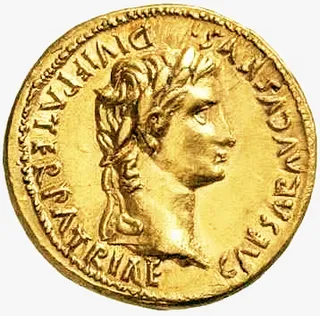
Rome, Mediterranean Sea in Europe, Northern Africa, and Western Asia
The Roman Empire was the post-Republican period of ancient Rome. As a polity, it included large territorial holdings around the Mediterranean Sea in Europe, Northern Africa, and Western Asia ruled by emperors.
eventSep, 9placeOsnabrück County, Lower Saxony (Present-Day in Germany)
The Illyrian tribes revolted and had to be crushed, and three full legions under the command of Publius Quinctilius Varus were ambushed and destroyed at the Battle of the Teutoburg Forest in AD 9 by Germanic tribes led by Arminius.
Law was passed which extended Augustus' powers over the provinces to Tiberius
event13placeRome
In AD 13, a law was passed which extended Augustus' powers over the provinces to Tiberius, so that Tiberius' legal powers were equivalent to, and independent from, those of Augustus.
The early years of Tiberius's reign were relatively peaceful. Tiberius secured the overall power of Rome and enriched its treasury. However, his rule soon became characterized by paranoia.
He began a series of treason trials and executions, which continued until his death in 37.
Tiberius left power in the hands of Lucius Aelius Sejanus
event26placeCapri, Italy
He left power in the hands of the commander of the guard, Lucius Aelius Sejanus. Tiberius himself retired to live at his villa on the island of Capri in 26, leaving the administration in the hands of Sejanus, who carried on the persecutions with contentment.
At the time of Tiberius's death, most of the people who might have succeeded him had been killed. The logical successor (and Tiberius' own choice) was his 24-year-old grandnephew, Gaius, better known as "Caligula" ("little boots").
The Caligula that emerged in late 37 demonstrated features of mental instability that led modern commentators to diagnose him with such illnesses as encephalitis, which can cause mental derangement, hyperthyroidism, or even a nervous breakdown (perhaps brought on by the stress of his position).
eventThursday Jan 24, 41placePalatine Hill, Rome, Italy, Roman Empire
In 41, Caligula was assassinated by the commander of the guard Cassius Chaerea. Also killed were his fourth wife Caesonia and their daughter Julia Drusilla. For two days following his assassination, the senate debated the merits of restoring the Republic.
Claudius was a younger brother of Germanicus and had long been considered a weakling and a fool by the rest of his family.
The Praetorian Guard, however, acclaimed him as emperor. Claudius was neither paranoid like his uncle Tiberius, nor insane like his nephew Caligula, and was, therefore, able to administer the Empire with reasonable ability.
In 43, Claudius resumed the Roman conquest of Britannia that Julius Caesar had begun in the 50s BC, and incorporated more Eastern provinces into the empire.
event48placeGardens of Lucullus, Rome, Italy, Roman Empire
In his own family life, Claudius was less successful. His wife Messalina cuckolded him; when he found out, he had her executed and married his niece, Agrippina the Younger.
event59placeItaly, Roman Empire (Probably in Misenum, Italy)
However, he was egotistical and had severe troubles with his mother, who he felt was controlling and overbearing. After several attempts to kill her, he finally had her stabbed to death.
He believed himself a god and decided to build an opulent palace for himself. The so-called Domus Aurea, meaning golden house in Latin, was constructed atop the burnt remains of Rome after the Great Fire of Rome (64). Nero was ultimately responsible for the fire.
By this time Nero was hugely unpopular despite his attempts to blame the Christians for most of his regime's problems.
Servius Sulpicius Galba, born as Lucius Livius Ocella Sulpicius Galba, was a Roman emperor who ruled from AD 68 to 69. He was the first emperor in the Year of the Four Emperors and assumed the position following Emperor Nero's suicide.
Galba's physical weakness and general apathy led to him being selected over by favorites. Unable to gain popularity with the people or maintain the support of the Praetorian Guard, Galba was murdered by Otho, who became emperor in his place.
A military coup drove Nero into hiding. Facing execution at the hands of the Roman Senate, he reportedly committed suicide in 68. According to Cassius Dio, Nero's last words were "Jupiter, what an artist perishes in me!".
Marcus Otho was Roman emperor for three months, from 15 January to 16 April 69. He was the second emperor of the Year of the Four Emperors.
Inheriting the problem of the rebellion of Vitellius, commander of the army in Germania Inferior, Otho led a sizeable force that met Vitellius' army at the Battle of Bedriacum. After initial fighting resulted in 40,000 casualties, and a retreat of his forces, Otho committed suicide rather than fight on, and Vitellius was proclaimed emperor.
Aulus Vitellius was Roman Emperor for eight months, from 19 April to 20 December AD 69. Vitellius was proclaimed emperor following the quick succession of the previous emperors Galba and Otho, in a year of civil war known as the Year of the Four Emperors.
His claim to the throne was soon challenged by legions stationed in the eastern provinces, who proclaimed their commander Vespasian emperor instead. War ensued, leading to a crushing defeat for Vitellius at the Second Battle of Bedriacum in northern Italy.
Once he realized his support was wavering, Vitellius prepared to abdicate in favor of Vespasian. He was not allowed to do so by his supporters, resulting in a brutal battle for Rome between Vitellius' forces and the armies of Vespasian.
He was executed in Rome by Vespasian's soldiers on 20 December 69.
As a result of the Second Battle of Bedriacum, Vespasian became the fourth and last emperor who reigned in the Year of the Four Emperors, he founded the Flavian dynasty that ruled the Empire for 27 years.
The Revolt of the Batavi took place in the Roman province of Germania Inferior between AD 69 and 70. It was an uprising against the Roman Empire started by the Batavi, a small but militarily powerful Germanic tribe that inhabited Batavia, on the delta of the river Rhine. They were soon joined by the Celtic tribes from Gallia Belgica and some Germanic tribes.
Titus, Vespasian's successor, quickly proved his merit, although his short reign was marked by disaster, including the eruption of Mount Vesuvius in Pompeii. He held the opening ceremonies in the still unfinished Colosseum but died in 81.
On 18 September 96, Domitian was assassinated in a palace conspiracy involving members of the Praetorian Guard and several of his freedmen. On the same day, Nerva was declared emperor by the Roman Senate. As the new ruler of the Roman Empire, he vowed to restore liberties that had been curtailed during the autocratic government of Domitian.
Nerva's brief reign was marred by financial difficulties and his inability to assert his authority over the Roman army. A revolt by the Praetorian Guard in October 97 essentially forced him to adopt an heir. After some deliberation, Nerva adopted Trajan, a young and popular general, as his successor.
Upon his accession to the throne, Trajan prepared and launched a carefully planned military invasion in Dacia, a region north of the lower Danube whose inhabitants the Dacians had long been an opponent to Rome. In 101, Trajan personally crossed the Danube and defeated the armies of the Dacian king Decebalus at the Battle of Tapae.
event105placeSarmizegetusa Regia (Present-Day in Grădiștea de Munte, Hunedoara County, Romania)
Decebalus complied with the terms for a time, but before long he began inciting revolt. In 105 Trajan once again invaded and after a yearlong invasion ultimately defeated the Dacians by conquering their capital, Sarmizegetusa Regia.
King Decebalus, cornered by the Roman cavalry, eventually committed suicide rather than being captured and humiliated in Rome.
The conquest of Dacia was a major accomplishment for Trajan, who ordered 123 days of celebration throughout the empire. He also constructed Trajan's Column in the middle of Trajan's Forum in Rome to glorify the victory.
Failure to nominate an heir could invite chaotic, destructive wresting of power by a succession of competing claimants – a civil war. Too early a nomination could be seen as an abdication, and reduce the chance for an orderly transmission of power.
As Trajan lay dying, nursed by his wife, Plotina, and closely watched by Perfect Attianus, he could have lawfully adopted Hadrian as heir, by means of a simple deathbed wish, expressed before witnesses; but when an adoption document was eventually presented, it was signed not by Trajan but by Plotina, and was dated the day after Trajan's death.
eventWednesday Aug 11, 117placeSelinus, Cilicia (Present-Day in Turkey)
Early in 117, Trajan grew ill and set out to sail back to Italy. His health declined throughout the spring and summer of 117, something publicly acknowledged by the fact that a bronze bust displayed at the time in the public baths of Ancyra showed him clearly aged and emaciated.
After reaching Selinus (modern Gazipaşa) in Cilicia, which was afterward called Trajanopolis, he suddenly died from edema, probably on 11 August.
Despite his own excellence as a military administrator, Hadrian's reign was marked more by the defense of the empire's vast territories, rather than major military conflicts.
Hadrian relieved Judea's governor, the outstanding Moorish general Lusius Quietus, of his personal guard of Moorish auxiliaries; then he moved on to quell disturbances along the Danube frontier.
There was no public trial for the four – they were tried in absentia, hunted down, and killed. Hadrian claimed that Attianus had acted on his own initiative, and rewarded him with senatorial status and consular rank; then pensioned him off, no later than 120.
Hadrian assured the senate that henceforth their ancient right to prosecute and judge their own would be respected.
In Rome, Hadrian's former guardian and current Praetorian Prefect, Attianus, claimed to have uncovered a conspiracy involving Lusius Quietus and three other leading senators, Lucius Publilius Celsus, Aulus Cornelius Palma Frontonianus, and Gaius Avidius Nigrinus.
Prior to Hadrian's arrival in Britannia, the province had suffered a major rebellion, from 119 to 121.
Inscriptions tell of an expeditio Britannica that involved major troop movements, including the dispatch of a detachment (vexillatio), comprising some 3,000 soldiers. Fronto writes about military losses in Britannia at the time.
Having filled the offices of quaestor and praetor with more than usual success, Antoninus Pius obtained the consulship in 120 having as his colleague Lucius Catilius Severus.
Hadrian surrendered Trajan's conquests in Mesopotamia, considering them to be indefensible. There was almost a war with Vologases III of Parthia around 121, but the threat was averted when Hadrian succeeded in negotiating a peace.
A shrine was erected in York to Britannia as the divine personification of Britain; coins were struck, bearing her image, identified as BRITANNIA.
By the end of 122, Hadrian had concluded his visit to Britannia. He never saw the finished wall that bears his name.
Coin legends of 119–120 attest that Quintus Pompeius Falco was sent to restore order. In 122 Hadrian initiated the construction of a wall, "to separate Romans from barbarians".
The idea that the wall was built in order to deal with an actual threat or its resurgence, however, is probable but nevertheless conjectural.
In 123, Hadrian crossed the Mediterranean to Mauretania, where he personally led a minor campaign against local rebels. The visit was cut short by reports of war preparations by Parthia; Hadrian quickly headed eastwards.
At some point, he visited Cyrene, where he personally funded the training of young men from well-bred families for the Roman military. Cyrene had benefited earlier (in 119) from his restoration of public buildings destroyed during the earlier Jewish revolt.
Hadrian appointed Quintus Marcius Turbo as his Praetorian Prefect
event125placeRoman Empire
Soon after, in 125, Hadrian appointed Quintus Marcius Turbo as his Praetorian Prefect. Turbo was his close friend, a leading figure of the equestrian order, a senior court judge, and a procurator.
Antoninus Pius was next appointed by Emperor Hadrian as one of the four proconsuls to administer Italia, his district including Etruria, where he had estates. He then greatly increased his reputation by his conduct as proconsul of Asia, probably during 134–135.
Antoninus Pius acquired much favor with Hadrian, who adopted him as his son and successor on 25 February 138, after the death of his first adopted son Lucius Aelius, on the condition that Antoninus would, in turn, adopt Marcus Annius Verus, the son of his wife's brother, and Lucius, son of Lucius Aelius, who afterward became the emperors, Marcus Aurelius and Lucius Verus.
Antoninus Pius's reign was comparatively peaceful; there were several military disturbances throughout the Empire in his time, in Mauretania, Judaea, and amongst the Brigantes in Britain, but none of them are considered serious.
Marcus Aurelius had already been created consul with Antoninus
event140placeRoman Empire
Marcus Aurelius had already been created consul with Antoninus in 140, receiving the title of Caesar, i.e., heir apparent. As Antoninus aged, Marcus took on more administrative duties.
It was however in Britain that Antoninus decided to follow a new, more aggressive path, with the appointment of a new governor in 139, Quintus Lollius Urbicus, a native of Numidia and previously governor of Germania Inferior as well as a new man.
Under instructions from the emperor, Lollius undertook an invasion of southern Scotland, winning some significant victories, and constructing the Antonine Wall from the Firth of Forth to the Firth of Clyde. The wall, however, was soon gradually decommissioned during the mid-150s and eventually abandoned late during the reign (early 160s), for reasons that are still not quite clear.
Marcus was effectively the sole ruler of the Empire. The formalities of the position would follow. The senate would soon grant him the name Augustus and the title imperator, and he would soon be formally elected as Pontifex Maximus, chief priest of the official cults. Marcus made some show of resistance: the biographer writes that he was 'compelled' to take imperial power.
It is possible that an alleged Roman embassy from "Daqin" that arrived in Eastern Han China in 166 via a Roman maritime route into the South China Sea, landing at Jiaozhou (northern Vietnam) and bearing gifts for the Emperor Huan of Han (r. 146–168), was sent by Marcus Aurelius, or his predecessor Antoninus Pius (the confusion stems from the transliteration of their names as "Andun", Chinese: 安敦).
In the spring of 168 war broke out on the Danubian border when the Marcomanni invaded the Roman territory. This war would last until 180, but Verus did not see the end of it.
In 168, as Verus and Marcus Aurelius returned to Rome from the field, Verus fell ill with symptoms attributed to food poisoning, dying after a few days (169).
In the last years of his life Marcus, a philosopher as well as an emperor, wrote his book of Stoic philosophy known as the Meditations. The book has since been hailed as Marcus' great contribution to philosophy.
The first crisis of the reign came in 182 when Lucilla engineered a conspiracy against her brother. Her motive is alleged to have been the envy of Empress Crispina. Her husband, Pompeianus, was not involved, but two men alleged to have been her lovers, Marcus Ummidius Quadratus Annianus (the consul of 167, who was also her first cousin) and Appius Claudius Quintianus, attempted to murder Commodus as he entered a theater. They bungled the job and were seized by the emperor's bodyguard.
On 31 December, Marcia poisoned Commodus' food, but he vomited up the poison, so the conspirators sent his wrestling partner Narcissus to strangle him in his bath.
On 28 March 193, Pertinax was at his palace when a contingent of some three hundred soldiers of the Praetorian Guard rushed the gates (two hundred according to Cassius Dio). Sources suggest that they had received only half their promised pay. Neither the guards on duty nor the palace officials chose to resist them. Pertinax sent Laetus to meet them, but he chose to side with the insurgents instead and deserted the emperor.
After the murder of Pertinax on 28 March 193, the Praetorian guard announced that the throne was to be sold to the man who would pay the highest price. Titus Flavius Claudius Sulpicianus, prefect of Rome and Pertinax's father-in-law, who was in the Praetorian camp ostensibly to calm the troops, began making offers for the throne. Meanwhile, Julianus also arrived at the camp, and since his entrance was barred, shouted out offers to the guard.
After hours of bidding, Sulpicianus promised 20,000 sesterces to every soldier; Julianus, fearing that Sulpicianus would gain the throne, then offered 25,000. The guards closed with the offer of Julianus, threw open the gates, and proclaimed him emperor. Threatened by the military, the senate also declared him emperor. His wife and his daughter both received the title Augusta.
Because Julianus bought his position rather than acquiring it conventionally through succession or conquest, he was a deeply unpopular emperor. When Julianus appeared in public, he frequently was greeted with groans and shouts of "robber and parricide." Once, a mob even obstructed his progress to the Capitol by pelting him with large stones.
Proclaimed emperor in 193 by his legionaries in Noricum during the political unrest that followed the death of Commodus, he secured sole rule over the empire in 197 after defeating his last rival, Clodius Albinus, at the Battle of Lugdunum. In securing his position as emperor, he founded the Severan dynasty.
eventMonday Feb 4, 211placeEboracum, Roman Empire (Present-Day in York, England, United Kingdom)
Severus is famously said to have given the advice to his sons: "Be harmonious, enrich the soldiers, scorn all others" before he died on 4 February 211. On his death, Severus was deified by the Senate and succeeded by his sons, Caracalla and Geta, who were advised by his wife Julia Domna. Severus was buried in the Mausoleum of Hadrian in Rome. His remains are now lost.
The current stability of their joint government was only through the mediation and leadership of their mother, Julia Domna, accompanied by other senior courtiers and generals in the military.
The historian Herodian asserted that the brothers decided to split the empire into two halves, but with the strong opposition of their mother, the idea was rejected, when, by the end of 211, the situation had become unbearable. Caracalla tried unsuccessfully to murder Geta during the festival of Saturnalia (17 December).
Finally, the next week, Caracalla had his mother arrange a peace meeting with his brother in his mother's apartments, thus depriving Geta of his bodyguards, and then had him murdered in her arms by centurions.
On April 8, 217, Caracalla was assassinated traveling to Carrhae. Three days later, Macrinus was declared Augustus. Diadumenian was the son of Macrinus, born in 208. He was given the title Caesar in 217, when his father became augustus, and raised to co-Augustus the following year.
eventMonday Jun 8, 218placeCappadocia (Present-Day in Turkey)
However, his downfall was his refusal to award the pay and privileges promised to the eastern troops by Caracalla. He also kept those forces wintered in Syria, where they became attracted to the young Elagabalus. After months of mild rebellion by the bulk of the army in Syria, Macrinus took his loyal troops to meet the army of Elagabalus near Antioch.
Despite a good fight by the Praetorian Guard, his soldiers were defeated. Macrinus managed to escape to Chalcedon but his authority was lost: he was betrayed and executed after a short reign of just 14 months. After his father's defeat outside Antioch, Diadumenian tried to escape east to Parthia, but was captured and killed.
Elagabalus was proclaimed emperor by the troops of Emesa, his hometown, who were instigated to do so by Elagabalus's grandmother, Julia Maesa. She spread a rumor that Elagabalus was the secret son of Caracalla.
Alexander Severus was adopted as son and caesar by his slightly older and very unpopular cousin, the emperor Elagabalus at the urging of the influential and powerful Julia Maesa — who was the grandmother of both cousins and who had arranged for the emperor's acclamation by the Third Legion.
On March 6, 222, when Alexander was just fourteen, a rumor went around the city troops that Alexander had been killed, triggering a revolt of the guards that had sworn his safety from Elegabalus and his accession as emperor.
The running of the Empire during this time was mainly left to his grandmother and mother (Julia Soaemias). Seeing that her grandson's outrageous behavior could mean the loss of power, Julia Maesa persuaded Elagabalus to accept his cousin Alexander Severus as caesar (and thus the nominal emperor-to-be).
However, Alexander was popular with the troops, who viewed their new emperor with dislike: when Elagabalus, jealous of this popularity, removed the title of caesar from his nephew, the enraged Praetorian Guard swore to protect him.
Elagabalus and his mother were murdered in a Praetorian Guard camp mutiny.
eventThursday Mar 19, 235placeMoguntiacum, Germania Superior (Present-Day Mainz, Germany)
His prosecution of the war against a German invasion of Gaul led to his overthrow by the troops he was leading, whose regard the twenty-seven-year-old had lost during the campaign.
Alexander was forced to face his German enemies in the early months of 235. By the time he and his mother arrived, the situation had settled, and so his mother convinced him that to avoid violence, trying to bribe the German army to surrender was the more sensible course of action.
According to historians, it was this tactic combined with insubordination from his own men that destroyed his reputation and popularity.
Alexander was thus assassinated together with his mother in a mutiny of the Legio XXII Primigenia at Moguntiacum (Mainz) while at a meeting with his generals.
These assassinations secured the throne for Maximinus. He died after a rule of 13 years.
The emperor at the beginning of the year was Maximinus Thrax, who had ruled since 235. Later sources claim he was a cruel tyrant, and in January of 238, a revolt erupted in North Africa.
Some young aristocrats in Africa murdered the imperial tax-collector then approached the regional governor, Gordian, and insisted that he proclaim himself emperor. Gordian agreed reluctantly, but as he was almost 80 years old, he decided to make his son joint emperor, with equal power. The Senate recognized father and son as emperors Gordian I and Gordian II, respectively.
Their reign, however, lasted for only 20 days. Capelianus, the governor of the neighboring province of Numidia, held a grudge against the Gordians. He led an army to fight them and defeated them decisively at Carthage. Gordian II was killed in the battle, and on hearing this news, Gordian I hanged himself.
Gordian I and II were deified by the senate.
Meanwhile, Maximinus, now declared a public enemy, had already begun to march on Rome with another army.
The senate's previous candidates, the Gordians, had failed to defeat him, and knowing that they stood to die if he succeeded, the senate needed a new emperor to defeat him.
With no other candidates in view, on 22 April 238, they elected two elderly senators, Pupienus and Balbinus (who had both been part of a special senatorial commission to deal with Maximinus), as joint emperors.
Therefore, Marcus Antonius Gordianus Pius, the thirteen-year-old grandson of Gordian I, was nominated as emperor Gordian III, holding power only nominally in order to appease the population of the capital, which was still loyal to the Gordian family.
eventThursday May 10, 238placeAquileia, Italy, Roman Empire
In May 238, soldiers of the II Parthica in his camp assassinated him, his son, and his chief ministers. Their heads were cut off, placed on poles, and carried to Rome by cavalrymen.
The situation for Pupienus and Balbinus, despite Maximinus' death, was doomed from the start with popular riots, military discontent and enormous fire that consumed Rome in June 238. On July 29, Pupienus and Balbinus were killed by the Praetorian Guard and Gordian was proclaimed sole emperor.
eventSunday Feb 11, 244placeMesopotamia (Present-Day in Iraq)
Gaius Julius Priscus and, later on, his own brother Marcus Julius Philippus, also known as Philip the Arab, stepped in at this moment as the new Praetorian Prefects Gordian would then start a second campaign. Around February 244, the Sasanians fought back fiercely to halt the Roman advance to Ctesiphon.
The eventual fate of Gordian after the battle is unclear. Sasanian sources claim that a battle occurred (Battle of Misiche) near modern Fallujah (Iraq) and resulted in a major Roman defeat and the death of Gordian III.
In an attempt to shore up his regime, Philip put a great deal of effort into maintaining good relations with the Senate, and from the beginning of his reign, he reaffirmed the old Roman virtues and traditions.
The Carpi moved through Dacia, crossed the Danube, and emerged in Moesia where they threatened the Balkans. Establishing his headquarters in Philippopolis in Thrace, he pushed the Carpi across the Danube and chased them back into Dacia, so that by the summer of 246, he claimed victory against them, along with the title "Carpicus Maximus".
Overwhelmed by the number of invasions and usurpers, Philip offered to resign, but the Senate decided to throw its support behind the emperor, with a certain Gaius Messius Quintus Decius most vocal of all the senators.
Philip was so impressed by his support that he dispatched Decius to the region with a special command encompassing all of the Pannonian and Moesian provinces. This had a dual purpose of both quelling the rebellion of Pacatianus as well as dealing with the barbarian incursions.
Although Decius managed to quell the revolt, discontent in the legions was growing. Decius was proclaimed emperor by the Danubian armies in the spring of 249 and immediately marched on Rome.
Although Decius tried to come to terms with Philip, Philip's army met the usurper near modern Verona that summer.
Decius easily won the battle and Philip was killed sometime in September 249, either in the fighting or assassinated by his own soldiers who were eager to please the new ruler.
Philip's eleven-year-old son and heir may have been killed with his father and Priscus disappeared without a trace.
Battle of Abritus was fought between the Romans and a federation of Gothic and Scythian tribesmen under the Gothic king Cniva. The Roman army of three legions was soundly defeated, and Roman emperors Decius and his son Herennius Etruscus were both killed in battle.
In June 251, Decius and his co-emperor and son Herennius Etruscus died in the Battle of Abrittus at the hands of the Goths they were supposed to punish for raids into the empire.
According to rumors supported by Dexippus (a contemporary Greek historian) and the thirteenth Sibylline Oracle, Decius' failure was largely owing to Gallus, who had conspired with the invaders. In any case, when the army heard the news, the soldiers proclaimed Gallus emperor, despite Hostilian, Decius' surviving son, ascending the imperial throne in Rome.
This action of the army, and the fact that Gallus seems to have been on good terms with Decius' family, makes Dexippus' allegation improbable.
Gallus did not back down from his intention to become emperor, but accepted Hostilian as co-emperor, perhaps to avoid the damage of another civil war.
Gallus ordered his troops to attack the Persians, but Persian Emperor Shapur I invaded Armenia and destroyed a large Roman army, taking it by surprise at Barbalissos in 252.
Since the army was no longer pleased with the Emperor, the soldiers proclaimed Aemilianus emperor. With a usurper, supported by Pauloctus, threatening the throne, Gallus prepared for a fight.
He recalled several legions and ordered reinforcements to return to Rome from Gaul under the command of the future emperor Publius Licinius Valerianus. Despite these dispositions, Aemilianus marched onto Italy ready to fight for his claim and caught Gallus at Interamna (modern Terni) before the arrival of Valerianus. What exactly happened is not clear.
Later sources claim that after an initial defeat, Gallus and Volusianus were murdered by their own troops; or Gallus did not have the chance to face Aemilianus at all because his army went over to the usurper. In any case, both Gallus and Volusianus were killed in August 253.
Aemilian continued towards Rome. The Roman senate, after a short opposition, decided to recognize him as emperor. According to some sources, Aemilian then wrote to the Senate, promising to fight for the Empire in Thrace and against Persia and to relinquish his power to the Senate, of which he considered himself a general.
Valerian, governor of the Rhine provinces, was on his way south with an army which, according to Zosimus, had been called in as reinforcement by Gallus.
But modern historians believe this army, possibly mobilized for an incumbent campaign in the East, moved only after Gallus' death to support Valerian's bid for power.
Emperor Aemilian's men, fearful of civil war and Valerian's larger force, mutinied.
They killed Aemilian at Spoletium or at the Sanguinarium bridge, between Oriculum and Narnia (halfway between Spoletium and Rome), and recognized Valerian as the new emperor.
Valerian's first act as emperor on October 22, 253, was to appoint his son Gallienus caesar. Early in his reign, affairs in Europe went from bad to worse, and the whole West fell into disorder.
In the East, Antioch had fallen into the hands of a Sassanid vassal and Armenia was occupied by Shapur I (Sapor).
On the Danube, Scythian tribes were once again on the loose, despite the peace treaty signed in 251. They invaded Asia Minor by sea, burned the great Temple of Artemis at Ephesus, and returned home with the plunder. Lower Moesia was also invaded in early 253.
Aemilianus, governor of Moesia Superior and Pannonia, took the initiative and defeated the invaders.
Gallienus proclaimed his elder son Valerian II caesar
event256placeDanube region
During his Danube sojourn (Drinkwater suggests in 255 or 256), he proclaimed his elder son Valerian II caesar and thus official heir to himself and Valerian I; the boy probably joined Gallienus on the campaign at that time, and when Gallienus moved west to the Rhine provinces in 257, he remained behind on the Danube as the personification of Imperial authority.
Sometime between 258 and 260 (the exact date is unclear), while Valerian was distracted with the ongoing invasion of Shapur I in the East, and Gallienus was preoccupied with his problems in the West, Ingenuus, governor of at least one of the Pannonian provinces, took advantage and declared himself emperor. Valerian II had apparently died on the Danube, most likely in 258.
Ingenuus may have been responsible for Valerian II's death. Alternatively, the defeat and capture of Valerian at the battle of Edessa may have been the trigger for the subsequent revolts of Ingenuus, Regalianus, and Postumus.
In any case, Gallienus reacted with great speed. He left his son Saloninus as caesar at Cologne, under the supervision of Albanus (or Silvanus) and the military leadership of Postumus.
He then hastily crossed the Balkans, taking with him the new cavalry corps (comitatus) under the command of Aureolus and defeated Ingenuus at Mursa or Sirmium. Ingenuus was killed by his own guards or committed suicide by drowning himself after the fall of his capital, Sirmium.
event260placeEdessa, Osroene (Present-Day in Turkey)
In 254, 255, and 257, Valerian again became Consul Ordinarius. By 257, he had recovered Antioch and returned the province of Syria to Roman control. The following year, the Goths ravaged Asia Minor.
In 259, Valerian moved on to Edessa, but an outbreak of plague killed a critical number of legionaries, weakening the Roman position, and the town was besieged by the Persians.
At the beginning of 260, Valerian was decisively defeated in the Battle of Edessa and held prisoner for the remainder of his life. Valerian's capture was a tremendous defeat for the Romans.
In the years 267–269, Goths and other barbarians invaded the empire in great numbers. Sources are extremely confused on the dating of these invasions, the participants, and their targets.
Modern historians are not even able to discern with certainty whether there were two or more of these invasions or a single prolonged one. It seems that, at first, a major naval expedition was led by the Heruli starting from north of the Black Sea and leading to the ravaging of many cities of Greece (among them, Athens and Sparta).
Then another, even more numerous army of invaders started a second naval invasion of the empire. The Romans defeated the barbarians on sea first. Gallienus' army then won a battle in Thrace, and the emperor pursued the invaders.
According to some historians, he was the leader of the army who won the great Battle of Naissus, while the majority believes that the victory must be attributed to his successor, Claudius II.
In 268, at some time before or soon after the battle of Naissus, the authority of Gallienus was challenged by Aureolus, commander of the cavalry stationed in Mediolanum (Milan), who was supposed to keep an eye on Postumus. Instead, he acted as deputy to Postumus until the very last days of his revolt, when he seems to have claimed the throne for himself.
The decisive battle took place at what is now Pontirolo Nuovo near Milan; Aureolus was clearly defeated and driven back to Milan. Gallienus laid siege to the city but was murdered during the siege. There are differing accounts of the murder, but the sources agree that most of Gallienus' officials wanted him dead.
Cecropius, commander of the Dalmatians, spread the word that the forces of Aureolus were leaving the city, and Gallienus left his tent without his bodyguard, only to be struck down by Cecropius.
According to Aurelius Victor and Zonaras, on hearing the news that Gallienus was dead, the Senate in Rome ordered the execution of his family (including his brother Valerianus and son Marinianus) and their supporters, just before receiving a message from Claudius to spare their lives and deify his predecessor.
Whichever story is true, Gallienus was killed in the summer of 268, and Claudius was chosen by the army outside of Milan to succeed him.
Accounts tell of people hearing the news of the new emperor and reacting by murdering Gallienus' family members until Claudius declared he would respect the memory of his predecessor.
Claudius had the deceased emperor deified and buried in a family tomb on the Appian Way. The traitor Aureolus was not treated with the same reverence, as he was killed by his besiegers after a failed attempt to surrender.
However, he fell victim to the Plague of Cyprian (possibly smallpox) and died early in January 270. Before his death, he is thought to have named Aurelian as his successor, though Claudius' brother Quintillus briefly seized power.
Quintillus was declared emperor either by the Senate or by his brother's soldiers upon the latter's death in 270.
Eutropius reports Quintillus to have been elected by soldiers of the Roman army immediately following the death of his brother; the choice was reportedly approved by the Roman Senate.
The few records of Quintillus' reign are contradictory. They disagree on the length of his reign, variously reported to have lasted as few as 17 days and as many as 177 days (about six months). Records also disagree on the cause of his death.
When Claudius died, his brother Quintillus seized power with the support of the Senate. With an act typical of the Crisis of the Third Century, the army refused to recognize the new Emperor, preferring to support one of its own commanders: Aurelian was proclaimed emperor about May 270 by the legions in Sirmium.
The first actions of the new Emperor were aimed at strengthening his own position in his territories. Late in 270, Aurelian campaigned in northern Italia against the Vandals, Juthungi, and Sarmatians, expelling them from Roman territory. To celebrate these victories, Aurelian was granted the title of Germanicus Maximus.
Aurelian turned his attention to the lost eastern provinces of the empire
event272placeRoman Empire
In 272, Aurelian turned his attention to the lost eastern provinces of the empire, the Palmyrene Empire, ruled by Queen Zenobia from the city of Palmyra.
Zenobia had carved out her own empire, encompassing Syria, Palestine, Egypt, and large parts of Asia Minor. The Syrian queen cut off Rome's shipments of grain, and in a matter of weeks, the Romans started running low on bread.
In the beginning, Aurelian had been recognized as Emperor, while Vaballathus, the son of Zenobia, held the title of rex and imperator ("king" and "supreme military commander"), but Aurelian decided to invade the eastern provinces as soon as he felt his army to be strong enough.
Aurelian is believed to have terminated Trajan's alimenta program
event272placeRome
Aurelian is believed to have terminated Trajan's alimenta program. Roman prefect Titus Flavius Postumius Quietus was the last known official in charge of the alimenta, in 272 AD. If Aurelian "did suppress this food distribution system, he most likely intended to put into effect a more radical reform."
Asia Minor was recovered easily; every city but Byzantium and Tyana surrendered to him with little resistance.
The fall of Tyana lent itself to a legend: Aurelian to that point had destroyed every city that resisted him, but he spared Tyana after having a vision of the great 1st-century philosopher Apollonius of Tyana, whom he respected greatly, in a dream.
Within six months, his armies stood at the gates of Palmyra, which surrendered when Zenobia tried to flee to the Sassanid Empire.
Eventually, Zenobia and her son were captured and made to walk on the streets of Rome in his triumph, the woman in golden chains. With the grain stores once again shipped to Rome, Aurelian's soldiers handed out free bread to the citizens of the city, and the Emperor was hailed a hero by his subjects.
After a brief clash with the Persians and another in Egypt against the usurper Firmus, Aurelian was obliged to return to Palmyra in 273 when that city rebelled once more. This time, Aurelian allowed his soldiers to sack the city, and Palmyra never recovered. More honors came his way; he was now known as Parthicus Maximus and Restitutor Orientis ("Restorer of the East").
Aurelian turned his attention to the west and the Gallic Empire
event274placeRome
In 274, the victorious emperor turned his attention to the west and the Gallic Empire which had already been reduced in size by Claudius II.
Aurelian won this campaign largely through diplomacy; the "Gallic Emperor" Tetricus was willing to abandon his throne and allow Gaul and Britain to return to the Empire, but could not openly submit to Aurelian.
Instead, the two seem to have conspired so that when the armies met at Châlons-en-Champagne that autumn, Tetricus simply deserted to the Roman camp and Aurelian easily defeated the Gallic army facing him.
Tetricus was rewarded for his part in the conspiracy with a high-ranking position in Italy itself.
Aurelian strengthened the position of the Sun god Sol Invictus as the main divinity of the Roman pantheon.
His intention was to give to all the peoples of the Empire, civilians or soldiers, easterners or westerners, a single god they could believe in without betraying their own gods.
The centre of the cult was a new temple, built in 274 and dedicated on December 25 of that year in the Campus Agrippae in Rome, with great decorations financed by the spoils of the Palmyrene Empire.
Aurelian set out for another campaign against the Sassanids
event275placeRoman Empire
The deaths of the Sassanid Kings Shapur I (272) and Hormizd I (273) in quick succession, and the rise to power of a weakened ruler (Bahram I), presented an opportunity to attack the Sassanid Empire, and in 275 Aurelian set out for another campaign against the Sassanids.
On his way, he suppressed a revolt in Gaul—possibly against Faustinus, an officer or usurper of Tetricus—and defeated barbarian marauders in Vindelicia (Germany).
However, Aurelian never reached Persia, as he was murdered while waiting in Thrace to cross into Asia Minor.
As an administrator, he had been strict and had handed out severe punishments to corrupt officials or soldiers. A secretary of his (called Eros by Zosimus) had told a lie on a minor issue.
In fear of what the emperor might do, he forged a document listing the names of high officials marked by the emperor for execution and showed it to collaborators.
The notarius Mucapor and other high-ranking officers of the Praetorian Guard, fearing punishment from the emperor, murdered him in September 275, in Caenophrurium, Thrace.
Aurelian's enemies in the Senate briefly succeeded in passing damnatio memoriae on the emperor, but this was reversed before the end of the year, and Aurelian, like his predecessor Claudius II, was deified as Divus Aurelianus.
Tacitus, after ascertaining the sincerity of the Senate's regard for him, accepted their nomination on 25 September 275, and the choice was cordially ratified by the army. This was the last time the Senate elected a Roman Emperor.
eventJun, 276placeAntoniana Colonia Tyana, Cappadocia (Pressent-Day in Turkey)
On his way back to the west to deal with a Frankish and Alamannic invasion of Gaul, according to Aurelius Victor, Eutropius, and the Historia Augusta, Tacitus died of fever at Tyana in Cappadocia in June 276.
After Tacitus died suddenly in July 276, allegedly as a consequence of a military plot, Florian swiftly proclaimed himself emperor and was recognized as such by the Roman Senate, and the western provinces.
Florian led his troops to Cilicia and billeted his forces in Tarsus. However many of his troops, who were unaccustomed to the hot climate of the area, fell ill due to a summer heatwave.
Upon learning of this, Probus launched raids around the city, in order to weaken the morale of Florian's forces. This strategy was successful, and Florian lost control of his army, which in September rose up against him and killed him.
In total, Florian's reign lasted less than three months.
Florian, the half-brother of Tacitus, also proclaimed himself emperor, and took control of Tacitus' army in Asia Minor, but was killed by his own soldiers after an indecisive campaign against Probus in the mountains of Cilicia.
In contrast to Florian, who ignored the wishes of the senate, Probus referred his claim to Rome in a respectful dispatch. The senate enthusiastically ratified his pretensions.
The army discipline which Aurelian had repaired was cultivated and extended under Probus, who was however more shy in the practice of cruelty.
One of his principles was never to allow the soldiers to be idle, and to employ them in time of peace on useful works, such as the planting of vineyards in Gaul, Pannonia, and other districts, in order to restart the economy in these devastated lands.
Carus was apparently a senator and filled various posts, both civil and military, before being appointed prefect of the Praetorian Guard by the emperor Probus in 282.
Two traditions surround his accession to the throne in August or September of 282. According to some mostly Latin sources, he was proclaimed emperor by the soldiers after the murder of Probus by a mutiny at Sirmium. Greek sources however claim that he rose against Probus in Raetia in usurpation and had him killed.
Bestowing the title of Caesar upon his sons Carinus and Numerian, he left Carinus in charge of the western portion of the empire to look after some disturbances in Gaul and took Numerian with him on an expedition against the Persians, which had been contemplated by Probus.
Probus was eager to start his eastern campaign, delayed by the revolts in the west. He left Rome in 282, traveling first towards Sirmium, his birth city.
Different accounts of Probus's death exist. According to Joannes Zonaras, the commander of the Praetorian Guard Marcus Aurelius Carus had been proclaimed, more or less unwillingly, emperor by his troops.
Probus sent some troops against the new usurper, but when those troops changed sides and supported Carus, Probus' remaining soldiers assassinated him at Sirmium (September/October 282).
According to other sources, however, Probus was killed by disgruntled soldiers, who rebelled against his orders to be employed for civic purposes, like draining marshes.
Allegedly, the soldiers were provoked when they overheard him lamenting the necessity of a standing army. Carus was proclaimed emperor after Probus' death and avenged the murder of his predecessor.
After the death of Emperor Probus in a spontaneous mutiny of the army in 282, his praetorian prefect, Carus, ascended to the throne. The latter, upon his departure for the Persian war, elevated his two sons to the title of Caesar. Carinus, the elder, was left to handle the affairs of the west in his absence, while the younger, Numerian, accompanied his father to the east.
The Sassanid King Bahram II, limited by internal opposition and his troops occupied with a campaign in modern-day Afghanistan, could not effectively defend his territory.
The Sasanians, faced with severe internal problems, could not mount an effective coordinated defense at the time; Carus and his army may have captured the Sasanian capital of Ctesiphon.
The victories of Carus avenged all the previous defeats suffered by the Romans against the Sassanids, and he received the title of Persicus Maximus.
event283placeSasanian Empire (Present-Day in Iraq)
Rome's hopes of further conquest, however, were cut short by his death; Carus died in the Sasanian territory, probably of unnatural causes, as he was reportedly struck by lightning.
Carinus left Rome at once and set out for the east to meet Diocletian. On his way through Pannonia, he put down the usurper Sabinus Julianus and in July 285 he encountered the army of Diocletian at the Battle of the Margus River (the modern Morava River) in Moesia.
Historians differ on what then ensued. At the Battle of the Margus, according to one account, the valor of his troops had gained the day, but Carinus was assassinated by a tribune whose wife he had seduced.
Another account represents the battle as resulting in a complete victory for Diocletian and claims that Carinus' army deserted him. This account may be confirmed by the fact that Diocletian kept in service Carinus' Praetorian Guard commander, Titus Claudius Aurelius Aristobulus.
Diocletian may have become involved in battles against the Quadi and Marcomanni immediately after the Battle of the Margus. He eventually made his way to northern Italy and made an imperial government, but it is not known whether he visited the city of Rome at this time.
Conflict boiled in every province, from Gaul to Syria, Egypt to the lower Danube. It was too much for one person to control, and Diocletian needed a lieutenant.
At some time in 285 at Mediolanum (Milan), Diocletian raised his fellow-officer Maximian to the office of caesar, making him co-emperor.
Nevertheless, if Diocletian ever did enter Rome shortly after his accession, he did not stay long; he is attested back in the Balkans by 2 November 285, on a campaign against the Sarmatians.
Spurred by the crisis, on 1 April 286, Maximian took up the title of Augustus. His appointment is unusual in that it was impossible for Diocletian to have been present to witness the event. It has even been suggested that Maximian usurped the title and was only later recognized by Diocletian in hopes of avoiding civil war.
Diocletian met Maximian in Milan in the winter of 290–91, either in late December 290 or January 291.
The meeting was undertaken with a sense of solemn pageantry. The emperors spent most of their time in public appearances. It has been surmised that the ceremonies were arranged to demonstrate Diocletian's continuing support for his faltering colleague.
Sometime after his return, and before 293, Diocletian transferred command of the war against Carausius from Maximian to Flavius Constantius, a former Governor of Dalmatia and a man of military experience stretching back to Aurelian's campaigns against Zenobia (272–73).
He was Maximian's praetorian prefect in Gaul, and the husband to Maximian's daughter, Theodora. On 1 March 293 at Milan, Maximian gave Constantius the office of caesar.
In the spring of 293, in Philippopolis (Plovdiv, Bulgaria) or Sirmium, Diocletian gave Galerius the office of caesar, husband to Diocletian's daughter Valeria, and perhaps Diocletian's praetorian prefect.
Diocletian's first "Edict against the Christians" was published
eventTuesday Feb 24, 303placeRoman Empire
Diocletian's first "Edict against the Christians" was published. The edict ordered the destruction of Christian scriptures and places of worship across the empire and prohibited Christians from assembling for worship.
Diocletian became the first Roman emperor to voluntarily abdicate his title
eventMonday May 1, 305placeNicomedia, Roman Empire
On 1 May 305, Diocletian called an assembly of his generals, traditional companion troops, and representatives from distant legions. They met at the same hill, 5 kilometers (3.1 mi) out of Nicomedia, where Diocletian had been proclaimed emperor. In front of a statue of Jupiter, his patron deity, Diocletian addressed the crowd.
With tears in his eyes, he told them of his weakness, his need for rest, and his will to resign. He declared that he needed to pass the duty of empire on to someone stronger. He thus became the first Roman emperor to voluntarily abdicate his title.
Constantius succeeded Maximian as Augustus of the West, but Constantine and Maxentius were entirely ignored in the transition of power. This did not bode well for the future security of the tetrarchic system.
event305placeDalmatia, Roman Empire (Present-Day Split, Croatia)
Diocletian retired to his homeland, Dalmatia. He moved into the expansive Diocletian's Palace, a heavily fortified compound located by the small town of Spalatum on the shores of the Adriatic Sea, and near the large provincial administrative center of Salona.
The palace is preserved in great part to this day and forms the historic core of Split, the second-largest city of modern Croatia.
Galerius appoint Licinius to be Augustus in place of Severus
eventWednesday Nov 11, 308placeRoman Empire
Galerius assumed the consular fasces in 308 with Diocletian as his colleague. In the autumn of 308, Galerius again conferred with Diocletian at Carnuntum (Petronell-Carnuntum, Austria). Diocletian and Maximian were both present on 11 November 308, to see Galerius appoint Licinius to be Augustus in place of Severus, who had died at the hands of Maxentius.
Galerius elevated Licinius to the rank of Augustus
eventWednesday Nov 11, 308placeRoman Empire
Galerius elevated Licinius to the rank of Augustus in the West on 11 November 308, and under his immediate command were the Balkan provinces of Illyricum, Thrace, and Pannonia.
eventFriday May 5, 311placeSerdica (Present-Day Sofia, Bulgeria)
Galerius died in late April or early May 311 from a horribly gruesome disease described by Eusebius and Lactantius, possibly some form of bowel cancer, gangrene, or Fournier gangrene.
eventMar, 313placeMediolanum, Roman Empire (Present-Day Milan, Italy)
So in March 313, Licinius married Flavia Julia Constantia, half-sister of Constantine I, at Mediolanum (now Milan); they had a son, Licinius the Younger, in 315.
event313placeMediolanum, Roman Empire (Present-Day Milan, Italy)
The Edict of Milan was the February AD 313 agreement to treat Christians benevolently within the Roman Empire. Western Roman Emperor Constantine I and Emperor Licinius, who controlled the Balkans, met in Mediolanum (modern-day Milan) and, among other things, agreed to change policies towards Christians following the edict of toleration issued by Emperor Galerius two years earlier in Serdica.
The Edict of Milan gave Christianity legal status and a reprieve from persecution but did not make it the state church of the Roman Empire. That occurred in AD 380 with the Edict of Thessalonica.
eventWednesday Apr 30, 313placePerinthus (Present-Day Marmara Ereğlisi, Turkey)
On 30 April 313, the two armies clashed at the Battle of Tzirallum, and in the ensuing battle, Daza's forces were crushed. Ridding himself of the imperial purple and dressing like a slave, Daza fled to Nicomedia.
Tetrarchy was replaced by a system of two emperors
event313placeRoman Empire
Given that Constantine had already crushed his rival Maxentius in 312, the two men decided to divide the Roman world between them. As a result of this settlement, the Tetrarchy was replaced by a system of two emperors, called Augusti: Licinius became Augustus of the East, while his brother-in-law, Constantine, became Augustus of the West.
After making the pact, Licinius rushed immediately to the East to deal with another threat, an invasion by the Persian Sassanid Empire.
Maximinus' death was variously ascribed "to despair, to poison, and to the divine justice".
Based on descriptions of his death given by Eusebius, and Lactantius, as well as the appearance of Graves' ophthalmopathy in a Tetrarchic statue bust from Anthribis in Egypt, sometimes attributed to Maximinus, endocrinologist Peter D. Papapetrou has advanced a theory that Maximinus may have died from severe thyrotoxicosis due to Graves' disease.
In 314, a civil war erupted between Licinius and Constantine, in which Constantine used the pretext that Licinius was harboring Senecio, whom Constantine accused of plotting to overthrow him.
Constantine prevailed at the Battle of Cibalae in Pannonia.
Then in 324, Constantine, tempted by the "advanced age and unpopular vices" of his colleague, again declared war against him and having defeated his army of 165,000 men at the Battle of Adrianople (3 July 324), succeeded in shutting him up within the walls of Byzantium.
eventThursday Sep 18, 324placeChrysopolis, near Chalcedon, Roman Empire (Present-Day Chalcedon, Turkey)
The defeat of the superior fleet of Licinius in the Battle of the Hellespont by Crispus, Constantine's eldest son and Caesar, compelled his withdrawal to Bithynia, where the last stand was made; the Battle of Chrysopolis, near Chalcedon (18 September), resulted in Licinius' final submission.
event325placeThessaloniki, Roman Empire (Present-Day Thessaloniki, Greece)
In this conflict, Licinius was supported by the Gothic prince Alica. Due to the intervention of Flavia Julia Constantia, Constantine's sister and also Licinius' wife, both Licinius and his co-emperor Martinian were initially spared, Licinius being imprisoned in Thessalonica, Martinian in Cappadocia; however, both former emperors were subsequently executed.
After his defeat, Licinius attempted to regain power with Gothic support, but his plans were exposed, and he was sentenced to death.
While attempting to flee to the Goths, Licinius was apprehended at Thessalonica. Constantine had him hanged, accusing him of conspiring to raise troops among the barbarians.
eventSunday May 11, 330placeConstantinople, Byzantine Empire (Present-Day Istanbul, Turkey)
Constantine decided to work on the Greek city of Byzantium, which offered the advantage of having already been extensively rebuilt on Roman patterns of urbanism, during the preceding century, by Septimius Severus and Caracalla, who had already acknowledged its strategic importance. The city was thus founded in 324, dedicated on 11 May 330, and renamed Constantinopolis ("Constantine's City" or Constantinople in English). Constantinople would be the capital of the Byzantine Empire.
Octavian, the grandnephew and adopted son of Julius Caesar, had made himself a central military figure during the chaotic period following Caesar's assassination. In 43 BC at the age of twenty, he became one of the three members of the Second Triumvirate, a political alliance with Marcus Lepidus and Mark Antony.
eventFriday Oct 3, 42 BCplacePhilippi, Macedonia (Present-Day in Greece)
Octavian and Antony defeated the last of Caesar's assassins in 42 BC at the Battle of Philippi, although after this point, tensions began to rise between the two.
Antony, who had allied himself with his lover Queen Cleopatra VII of Egypt, committed suicide in 30 BC following his defeat at the Battle of Actium (31 BC) by the fleet of Octavian.
Octavian subsequently annexed Egypt to the empire.
On 16 January 27 BC the Senate gave Octavian the new titles of Augustus and Princeps. Augustus is from the Latin word Augere (meaning to increase) and can be translated as "the illustrious one". It was a title of religious authority rather than political authority. His new title of Augustus was also more favorable than Romulus, the previous one which he styled for himself in reference to the story of the legendary founder of Rome, which symbolized a second founding of Rome.
Augustus also created nine special cohorts to maintain peace in Italia, with three, the Praetorian Guard, kept in Rome. Control of the fiscus enabled Augustus to ensure the loyalty of the legions through their pay.
Augustus renounced his consulship in 23 BC, but retained his consular imperium, leading to a second compromise between Augustus and the Senate known as the Second Settlement.
Augustus was granted the authority of a tribune (tribunicia potestas), though not the title, which allowed him to call together the Senate and people at will and lay business before it, veto the actions of either the Assembly or the Senate, preside over elections, and it gave him the right to speak first at any meeting.