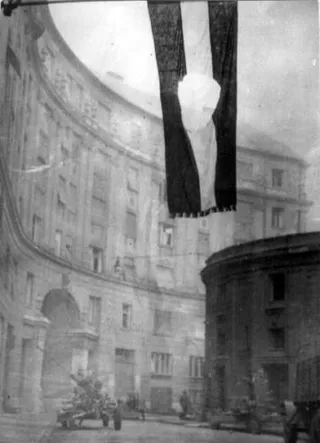
The Hungarian Revolution of 1956, or the Hungarian Uprising, was a nationwide revolution against the Hungarian People's Republic and its Soviet-imposed policies, lasting from 23 October until 10 November 1956. Leaderless when it first began, it was the first major threat to Soviet control since the Red Army drove Nazi Germany from its territory at the End of World War II in Europe.
Toward the end of World War II, the Soviet Army occupied Hungary, with the country coming under the Soviet Union's sphere of influence. Immediately after World War II, Hungary was a multiparty democracy, and elections in 1945 produced a coalition government under Prime Minister Zoltán Tildy.
The post-war Hungarian Economy Suffered From Multiple Challenges
event1946placeHungary
The post-war Hungarian economy suffered from multiple challenges. Hungary agreed to pay war reparations approximating US$300 million to the Soviet Union, Czechoslovakia, and Yugoslavia and to support Soviet garrisons. The Hungarian National Bank in 1946 estimated the cost of reparations as "between 19 and 22 per cent of the annual national income".
The Hungarian Currency Experienced Marked Depreciation
event1946placeHungary
In 1946, the Hungarian currency experienced marked depreciation, resulting in the highest historic rates of hyperinflation known. Hungary's participation in the Soviet-sponsored COMECON (Council of Mutual Economic Assistance) prevented it from trading with the West or receiving Marshall Plan aid.
The Communist Party merged With The Social Democratic Party
event1949placeHungary
The brief period of multi-party democracy came to an end when the Communist Party merged with the Social Democratic Party to become the Hungarian Working People's Party, which stood its candidate list unopposed in 1949. The People's Republic of Hungary was then declared.
Arresting The Leader of The Hungarian Catholic Church
event1949placeHungary
Russian language study and Communist political instruction were made mandatory in schools and universities nationwide. Religious schools were nationalized and church leaders were replaced by those loyal to the government. In 1949 the leader of the Hungarian Catholic Church, Cardinal József Mindszenty, was arrested and sentenced to life imprisonment for treason. Under Rákosi, Hungary's government was among the most repressive in Europe.
eventThursday Mar 5, 1953placeMoscow, Russian SFSR, Soviet Union (Now Russia)
On 5 March 1953, Joseph Stalin died, ushering in a period of moderate liberalization, when most European communist parties developed a reform wing. In Hungary, the reformist Imre Nagy replaced Rákosi, "Stalin's Best Hungarian Disciple", as Prime Minister. However, Rákosi remained General Secretary of the Party, and was able to undermine most of Nagy's reforms.
On 14 May 1955, the Soviet Union created the Warsaw Pact, binding Hungary to the Soviet Union and its satellite states in Central and Eastern Europe. Among the principles of this alliance were "respect for the independence and sovereignty of states" and "non-interference in their internal affairs".
Relations between Hungary and The United States began to Improve
event1956placeHungary
In the summer of 1956, relations between Hungary and the United States began to improve. At that time, the United States responded very favourably to Hungary's overtures about a possible expansion of bilateral trade relations. Hungary's desire for better relations was partly attributable to the country's catastrophic economic situation. Before any results could be achieved, however, the pace of negotiations was slowed by the Hungarian Ministry of Internal Affairs, which feared that better relations with the West might weaken Communist rule in Hungary.
Rákosi was deposed as General Secretary of The Hungarian Working People's Party
eventWednesday Jul 18, 1956placeHungary
After Khrushchev's "secret speech" of February 1956, which denounced Stalin and his protégés, Rákosi was deposed as General Secretary of the Party and replaced by Ernő Gerő on 18 July 1956.
On 6 October 1956, László Rajk, who had been executed by the Rákosi government, was reburied in a moving ceremony that strengthened the party opposition.
A large crowd gathered at the Radio Budapest building, which was heavily guarded by the ÁVH. The flash point was reached as a delegation attempting to broadcast their demands was detained and the crowd grew increasingly unruly as rumours spread that the protesters had been shot. Tear gas was thrown from the upper windows and the ÁVH opened fire on the crowd, killing many. The ÁVH tried to re-supply itself by hiding arms inside an ambulance, but the crowd detected the ruse and intercepted it. Hungarian soldiers sent to relieve the ÁVH hesitated and then, tearing the red stars from their caps, sided with the crowd. Provoked by the ÁVH attack, protesters reacted violently. Police cars were set ablaze, guns were seized from military depots and distributed to the masses and symbols of the Communist regime were vandalised.
During the night of 23 October, Hungarian Working People's Party Secretary Ernő Gerő requested Soviet military intervention "to suppress a demonstration that was reaching an ever greater and unprecedented scale". The Soviet leadership had formulated contingency plans for intervention in Hungary several months before.
eventTuesday Oct 23, 1956schedule09:30:00 PMplaceBudapest, Hungary
Angered by Gerő's hard-line rejection, some demonstrators decided to carry out one of their demands, the removal of Stalin's 30-foot-high (9.1 m) bronze statue that was erected in 1951 on the site of a church, which was demolished to make room for the monument. By 21:30, the statue was toppled and crowds celebrated by placing Hungarian flags in Stalin's boots, which was all that was left of the statue.
The Politburo discussed The Political Upheavals In Poland and Hungary
eventWednesday Oct 24, 1956placeMoscow, Russian SFSR
On 24 October, the Presidium of the Central Committee of the Communist Party of the Soviet Union (the Politburo) discussed the political upheavals in Poland and Hungary.
Soviet Tanks were stationed outside the Parliament
eventWednesday Oct 24, 1956placeBudapest, Hungary
By noon, on 24 October, Soviet tanks were stationed outside the Parliament, and Soviet soldiers guarded key bridges and crossroads. Armed revolutionaries quickly set up barricades to defend Budapest, and were reported to have already captured some Soviet tanks by mid-morning.
Imre Nagy Replaced András Hegedüs as Prime Minister
eventWednesday Oct 24, 1956placeBudapest, Hungary
On 24 October, Imre Nagy replaced András Hegedüs as Prime Minister. On the radio, Nagy called for an end to violence and promised to initiate political reforms that had been shelved three years earlier. The population continued to arm itself as sporadic violence erupted.
A mass of Protesters Gathered in Front of The Parliament Building
eventThursday Oct 25, 1956placeBudapest, Hungary
On 25 October, a mass of protesters gathered in front of the Parliament Building. ÁVH units began shooting into the crowd from the rooftops of neighbouring buildings. Some Soviet soldiers returned fire on the ÁVH, mistakenly believing that they were the targets of the shooting. Supplied by arms taken from the ÁVH or given by Hungarian soldiers who joined the uprising, some in the crowd started shooting back.
The Military Action Towards The demonstrations in Front of The Office of State Security and The Local Jail
eventFriday Oct 26, 1956placeKecskemét, Hungary
In the town of Kecskemét on 26 October, demonstrations in front of the office of State Security and the local jail led to military action by the Third Corps under the orders of Major General Lajos Gyurkó, in which seven protesters were shot and several of the organizers were arrested.
Hungarian general Béla Király, freed from a life sentence for political offences and acting with the support of the Nagy government, sought to restore order by unifying elements of the police, army and insurgent groups into a National Guard. A ceasefire was arranged on 28 October.
There Were 71 Cases of Armed Clashes between The Army and The Populace In Fifty Communities
eventMonday Oct 29, 1956placeHungary
From 24 to 29 October, however, there were 71 cases of armed clashes between the army and the populace in fifty communities, ranging from the defence of attacks on civilian and military objectives to fighting with insurgents depending on the commanding officer.
The Local Revolutionary Councils Had been Officially Sanctioned
eventTuesday Oct 30, 1956placeHungary
Local revolutionary councils formed throughout Hungary, generally without involvement from the preoccupied National Government in Budapest, and assumed various responsibilities of local government from the defunct Communist party. By 30 October, these councils had been officially sanctioned by the Hungarian Working People's Party, and the Nagy government asked for their support as "autonomous, democratic local organs formed during the Revolution".
Armed Protesters Attacked The ÁVH detachment Guarding The Budapest Hungarian Working People's Party Headquarters
eventTuesday Oct 30, 1956placeBudapest, Hungary
On 30 October, armed protesters attacked the ÁVH detachment guarding the Budapest Hungarian Working People's Party headquarters on Köztársaság tér (Republic Square), incited by rumours of prisoners held there and the earlier shootings of demonstrators by the ÁVH in the city of Mosonmagyaróvár.
Nagy Formally declared Hungary's Withdrawal From The Warsaw Pact
eventThursday Nov 1, 1956placeHungary
On 1 November, in a radio address to the Hungarian people, Nagy formally declared Hungary's withdrawal from the Warsaw Pact as well as Hungary's stance of neutrality.
The Soviet Forces Had Entered Hungary From The East
eventThursday Nov 1, 1956placeHungary
On 1 November, Imre Nagy received reports that Soviet forces had entered Hungary from the east and were moving towards Budapest. Nagy sought and received assurances (which proved false) from Soviet ambassador Yuri Andropov that the Soviet Union would not invade. The Cabinet, with János Kádár in agreement, declared Hungary's neutrality, withdrew from the Warsaw Pact, and requested assistance from the diplomatic corps in Budapest and Dag Hammarskjöld, UN Secretary-General, to defend Hungary's neutrality. Ambassador Andropov was asked to inform his government that Hungary would begin negotiations on the removal of Soviet forces immediately.
On 3 November, a Hungarian delegation led by the Minister of Defense Pál Maléter was invited to attend negotiations on Soviet withdrawal at the Soviet Military Command at Tököl, near Budapest. At around midnight that evening, General Ivan Serov, Chief of the Soviet Security Police (KGB) ordered the arrest of the Hungarian delegation, and the next day, the Soviet army again attacked Budapest.
eventSaturday Nov 3, 1956schedule09:30:00 PMplaceBudapest, Hungary
The second Soviet intervention, codenamed "Operation Whirlwind", was launched by Marshal Ivan Konev. And By 21:30 on 3 November, the Soviet Army had completely encircled Budapest.
eventSunday Nov 4, 1956schedule03:00:00 AMplaceBudapest, Hungary
At 03:00 on 4 November, Soviet tanks penetrated Budapest along the Pest side of the Danube in two thrusts: one up the Soroksári road from the south and the other down the Váci road from the north.
Armoured Units Crossed Into Buda and Fired The First Shots at The Army Barracks on Budaörsi Road
eventSunday Nov 4, 1956schedule04:25:00 AMplaceBudapest, Hungary
Thus before a single shot was fired, the Soviets had effectively split the city in half, controlled all bridgeheads, and were shielded to the rear by the wide Danube river. Armoured units crossed into Buda and at 04:25 fired the first shots at the army barracks on Budaörsi Road. Soon after, Soviet artillery and tank fire was heard in all districts of Budapest.
Imre Nagy Broadcast His Final Plea To The Nation and The World
eventSunday Nov 4, 1956schedule05:20:00 AMplaceHungary
At 05:20 on 4 November, Imre Nagy broadcast his final plea to the nation and the world, announcing that Soviet Forces were attacking Budapest and that the Government remained at its post.
János Kádár Proclaimed The "Hungarian Revolutionary Worker-Peasant Government"
eventSunday Nov 4, 1956schedule06:00:00 AMplaceSzolnok, Hungary
At 06:00, on 4 November, in the town of Szolnok, János Kádár proclaimed the "Hungarian Revolutionary Worker-Peasant Government". His statement declared "We must put an end to the excesses of the counter-revolutionary elements. The hour for action has sounded. We are going to defend the interest of the workers and peasants and the achievements of the people's democracy."
eventSunday Nov 4, 1956schedule08:00:00 AMplaceBudapest, Hungary
By 08:00 organised defense of the city evaporated after the radio station was seized, and many defenders fell back to fortified positions. During the same hour, the parliamentary guard laid down their arms, and forces under Major General K. Grebennik captured Parliament and liberated captured ministers of the Rákosi–Hegedüs government.
eventSunday Nov 4, 1956schedule08:07:00 AMplaceBudapest, Hungary
The radio station, Free Kossuth Rádió, stopped broadcasting at 08:07. An emergency Cabinet meeting was held in the Parliament but was attended by only three ministers. As Soviet troops arrived to occupy the building, a negotiated evacuation ensued, leaving Minister of State István Bibó as the last representative of the National Government remaining at his post. He wrote For Freedom and Truth, a stirring proclamation to the nation and the world.
The Establishment of The "Revolutionary Workers'-Peasants' Government of Hungary"
eventSunday Nov 4, 1956placeHungary
During the early hours of 4 November, Ferenc Münnich announced on Radio Szolnok the establishment of the "Revolutionary Workers'-Peasants' Government of Hungary".
The Councils decided To End The Nationwide Labour Strikes and Resume Work
eventMonday Nov 5, 1956placeBudapest, Hungary
In total there were approximately 2,100 local revolutionary and workers councils with over 28,000 members. These councils held a combined conference in Budapest, deciding to end the nationwide labour strikes and resume work on 5 November, with the more important councils sending delegates to the Parliament to assure the Nagy government of their support.
With most of Budapest under Soviet control by 8 November, Kádár became Prime Minister of the "Revolutionary Worker-Peasant Government" and General Secretary of the Hungarian Communist Party. Few Hungarians rejoined the reorganised Party, its leadership having been purged under the supervision of the Soviet Praesidium, led by Georgy Malenkov and Mikhail Suslov.
Imre Nagy along with Georg Lukács, Géza Losonczy, and László Rajk's widow, Júlia, took refuge in the Embassy of Yugoslavia as Soviet forces overran Budapest. Despite assurances of safe passage out of Hungary by the Soviets and the Kádár government, Nagy and his group were arrested when attempting to leave the embassy on 22 November and taken to Romania.
Representatives of The Soviet Union, Bulgaria, Hungary, and Romania met to Review Internal Developments in Hungary
eventJan, 1957placeBudapest, Hungary
In January 1957, representatives of the Soviet Union, Bulgaria, Hungary, and Romania met in Budapest to review internal developments in Hungary since the establishment of the Soviet-imposed government. A communiqué on the meeting "unanimously concluded" that Hungarian workers, with the leadership of the Kádár government and support of the Soviet army, defeated attempts "to eliminate the socialist achievements of the Hungarian people".
Nagy was executed, along with Pál Maléter and Miklós Gimes, after secret trials in June 1958. Their bodies were placed in unmarked graves in the Municipal Cemetery outside Budapest.