Birth
Ernesto Guevara was born to Ernesto Guevara Lynch and Celia de la Serna y Llosa, on June 14, 1928, in Rosario, Argentina.
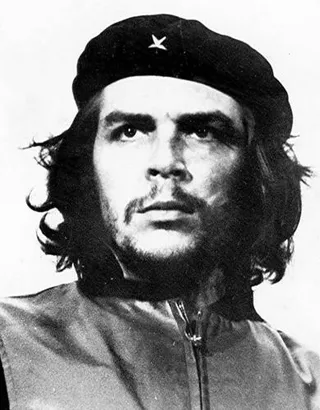
Thursday Jun 14, 1928 to Monday Oct 9, 1967
Cuba
Was an Argentine Marxist revolutionary, physician, author, guerrilla leader, diplomat and military theorist. A major figure of the Cuban Revolution, his stylized visage has become a ubiquitous countercultural symbol of rebellion and global insignia in popular culture.
Ernesto Guevara was born to Ernesto Guevara Lynch and Celia de la Serna y Llosa, on June 14, 1928, in Rosario, Argentina.
In 1948, Guevara entered the University of Buenos Aires to study medicine.
Completed his university education and passed his medical degree.
On July 7, 1953, Guevara set out, this time to Bolivia, Peru, Ecuador, Panama, Costa Rica, Nicaragua, Honduras and El Salvador.
On December 10, 1953, before leaving for Guatemala, Guevara sent an update to his Aunt Beatriz from San José, Costa Rica. In the letter Guevara speaks of traversing the dominion of the United Fruit Company, a journey which convinced him that the Company's capitalist system was a terrible one.
Decided to settle in Guatemala but was unable to find work as a Doctor so he had to take a variety of jobs to earn money. He was becoming increasingly convinced that Capitalism was responsible for the extreme poverty of South and Central America and became interested in the theories of Karl Marx.
American forces invaded Guatemala and President Arbenz was forced to resign.
Married Hilda Gadea who was pregnant with their child.
Left Guatemala and went to Mexico.
The first step in Castro's revolutionary plan was an assault on Cuba from Mexico via the Granma, an old, leaky cabin cruiser. They set out for Cuba on November 25, 1956. Attacked by Batista's military soon after landing, many of the 82 men were either killed in the attack or executed upon capture; only 22 found each other afterwards.
The first step in Castro's revolutionary plan was an assault on Cuba from Mexico via the Granma, an old, leaky cabin cruiser. They set out for Cuba on November 25, 1956. Attacked by Batista's military soon after landing, many of the 82 men were either killed in the attack or executed upon capture; only 22 found each other afterwards.
Guevara was instrumental in creating the clandestine radio station Radio Rebelde (Rebel Radio) in February 1958, which broadcast news to the Cuban people with statements by the 26th of July movement, and provided radiotelephone communication between the growing number of rebel columns across the island.
By March 1958, the continued atrocities carried out by Batista's forces led the United States to stop selling arms to the Cuban government.
At 3 am on January 1, 1959, upon learning that his generals were negotiating a separate peace with Guevara, Fulgencio Batista boarded a plane in Havana and fled for the Dominican Republic, along with an amassed "fortune of more than $300,000,000 through graft and payoffs".
On January 2, Guevara entered Havana to take final control of the capital.
Fidel Castro took six more days to arrive, as he stopped to rally support in several large cities on his way to rolling victoriously into Havana on January 8, 1959.
Along with ensuring "revolutionary justice", the other key early platform of Guevara was establishing agrarian land reform. Almost immediately after the success of the revolution, on January 27, 1959, Guevara made one of his most significant speeches where he talked about "the social ideas of the rebel army".
On June 2, 1959, he married Aleida March, a Cuban-born member of the 26th of July movement with whom he had been living since late 1958. Guevara returned to the seaside village of Tarara in June for his honeymoon with Aleida.
On June 12, 1959, Castro sent Guevara out on a three-month tour of 14 mostly Bandung Pact countries (Morocco, Sudan, Egypt, Syria, Pakistan, India, Sri Lanka, Burma, Thailand, Indonesia, Japan, Yugoslavia, Greece) and the cities of Singapore and Hong Kong.
Upon Guevara's return to Cuba in September 1959, it became evident that Castro now had more political power
At the end of 1960 he visited Czechoslovakia, the Soviet Union, North Korea, Hungary and East Germany and signed, for instance, a trade agreement in East Berlin on December 17, 1960.
On April 17, 1961, 1,400 U.S.-trained Cuban exiles invaded Cuba during the Bay of Pigs Invasion. Guevara did not play a key role in the fighting, as one day before the invasion a warship carrying Marines faked an invasion off the West Coast of Pinar del Río and drew forces commanded by Guevara to that region.
In December 1964, Che Guevara had emerged as a "revolutionary statesman of world stature" and thus traveled to New York City as head of the Cuban delegation to speak at the United Nations.
On December 11, 1964, during Guevara's hour-long, impassioned address at the UN, he criticized the United Nations' inability to confront the "brutal policy of apartheid" in South Africa, asking "Can the United Nations do nothing to stop this?"
Guevara traveled to Congo using the alias Ramón Benítez.
In Algiers, Algeria, on February 24, 1965, Guevara made what turned out to be his last public appearance on the international stage when he delivered a speech at an economic seminar on Afro-Asian solidarity.
Guevara, his second-in-command Víctor Dreke, and 12 other Cuban Expeditionaries arrived in Congo on April 24, 1965, and a contingent of approximately 100 Afro-Cubans joined them soon afterward.
Later that year, on November 20, 1965, suffering from dysentery and acute asthma, and disheartened after seven months of defeats, Guevara left Congo with the six Cuban survivors of his 12-man column.
As Guevara prepared for Bolivia, he secretly traveled back to Cuba on July 21, 1966 to visit Castro.
On November 3, 1966, Guevara secretly arrived in La Paz on a flight from Montevideo under the false name Adolfo Mena González, posing as a middle-aged Uruguayan businessman working for the Organization of American States.
On October 7, 1967, an informant apprised the Bolivian Special Forces of the location of Guevara's guerrilla encampment in the Yuro ravine.
On the morning of October 8, they encircled the area with two battalions numbering 1,800 soldiers and advanced into the ravine triggering a battle where Guevara was wounded and taken prisoner while leading a detachment with Simeón Cuba Sarabia.
October 9, Bolivian President René Barrientos ordered that Guevara be killed. The order was relayed to the unit holding Guevara by Félix Rodríguez reportedly despite the United States government's desire that Guevara be taken to Panama for further interrogation.