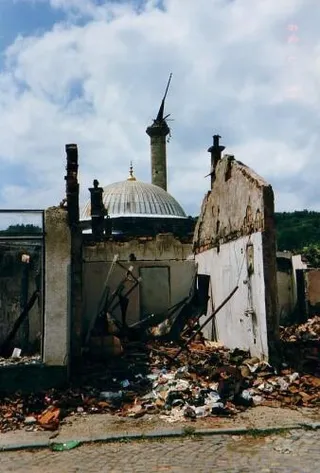
The Kosovo War was an armed conflict in Kosovo that started in late February 1998 and lasted until 11 June 1999. It was fought by the forces of the Federal Republic of Yugoslavia (i.e. Serbia and Montenegro), which controlled Kosovo before the war, and the Kosovo Albanian rebel group known as the Kosovo Liberation Army (KLA), with air support from the North Atlantic Treaty Organisation (NATO) from 24 March 1999, and ground support from the Albanian army, and some views argue that war stared 5 march 1998.
In 1974 Kosovo's political status improved further when a new Yugoslav constitution granted an expanded set of political rights. Along with Vojvodina, Kosovo was declared a province and gained many of the powers of a fully-fledged republic: a seat on the federal presidency and its own assembly, police force and national bank.
Provincial power was still exercised by the Communist Party, but now devolved mainly to ethnic Albanian communists. Tito's death on 4 May 1980 ushered in a long period of political instability, worsened by growing economic crisis and nationalist unrest.
In 1981 it was reported that some 4,000 Serbs moved from Kosovo to central Serbia after the Kosovo Albanian riots in March that resulted in several Serb deaths and the desecration of Serbian Orthodox architecture and graveyards.
It paid special attention to Kosovo, arguing that the Kosovo Serbs were being subjected to "physical, political, legal and cultural genocide" in an "open and total war" that had been ongoing since the spring of 1981.
The First major outbreak occurred in Kosovo's main city
eventSunday Mar 1, 1981placePristina, Kosovo
The first major outbreak occurred in Kosovo's main city, Pristina, when a protest of University of Pristina students over long queues in their university canteen rapidly escalated and in late March and early April 1981 spread throughout Kosovo, causing mass demonstrations in several towns. The disturbances were quelled by the Presidency of Yugoslavia proclaiming a state of emergency, sending in riot police and the army, which resulted in numerous casualties.
In February 1982 a group of priests from Serbia proper petitioned their bishops to ask "why the Serbian Church is silent" and why it did not campaign against "the destruction, arson and sacrilege of the holy shrines of Kosovo". Such concerns did attract interest in Belgrade. Stories appeared from time to time in the Belgrade media claiming that Serbs and Montenegrins were being persecuted.
The so-called SANU Memorandum, leaked in September 1986, was a draft document that focused on the political difficulties facing Serbs in Yugoslavia, pointing to Tito's deliberate hobbling of Serbia's power and the difficulties faced by Serbs outside Serbia proper.
In 1987 the growing ethnic tension in Yugoslavia and rising nationalism among Albanians in Kosovo and referred to the Paraćin massacre, where an ethnic Albanian soldier in the JNA killed four fellow soldiers.
In March 1989 Milošević (Later President of Serbia) announced an "anti-bureaucratic revolution" in Kosovo and Vojvodina, curtailing their autonomy as well as imposing a curfew and a state of emergency in Kosovo due to violent demonstrations, resulting in 24 deaths (including two policemen). Milošević and his government claimed that the constitutional changes were necessary to protect Kosovo's remaining Serbs against harassment from the Albanian majority.
Responsibility for public security was again assigned to Serbia
eventWednesday Apr 18, 1990placeKosovo
In early 1990 Kosovar Albanians held mass demonstrations against the special measures, which were lifted on 18 April 1990 and responsibility for public security was again assigned to Serbia.
On 16 or 17 July 1990 the League of Communists of Serbia (LCS) combined with the Socialist Alliance of Working People of Serbia to become the Socialist Party of Serbia (SPS), and Milošević became its first president.
Several amendments to the federal Socialist Federal Republic of Yugoslavia
eventWednesday Aug 8, 1990placeYugoslavia
On 8 August 1990 several amendments to the federal Socialist Federal Republic of Yugoslavia (SFRY), Constitution were adopted enabling the establishment of a multi-party election system.
The KLA (the Kosovo Liberation Army) , formed in the early 90's to fight against Serbian persecution of Kosovo Albanians, initiated its first campaign in 1995 when it launched attacks targeting Serbian law enforcement in Kosovo.
In 1997, the organization acquired a large amount of arms through weapons smuggling from Albania, following a rebellion in which weapons were looted from the country's police and army posts.
KLA attacks targeting Yugoslav authorities in Kosovo
event1998placeKosovo
In early 1998, KLA (Kosovo Liberation Army) attacks targeting Yugoslav authorities in Kosovo resulted in an increased presence of Serb paramilitaries and regular forces who subsequently began pursuing a campaign of retribution targeting KLA sympathizers and political opponents; this campaign killed 1,500 to 2,000 civilians and KLA combatants.
Despite some accusations of summary executions and killings of civilians, condemnations from Western capitals were not as voluble as they would become later. Serb police began to pursue Jashari (was one of the founders of the Kosovo Liberation Army (KLA)) and his followers in the village of Donje Prekaze. On March 5, 1998, a massive firefight at the Jashari compound led to the massacre of 60 Albanians, of which eighteen were women and ten were under the age of sixteen.
the only meeting between Milošević and Ibrahim Rugova happened on 15 May in Belgrade
eventFriday May 15, 1998placeBelgrade, Serbia
During this time, Yugoslav President Milošević reached an arrangement with Boris Yeltsin of Russia to stop offensive operations and prepare for talks with the Albanians, who refused to talk to the Serbian side throughout the crisis, but would talk with the Yugoslav government. In fact, the only meeting between Milošević and Ibrahim Rugova (first President of the Republic of Kosova) happened on 15 May in Belgrade, two days after Richard Holbrooke announced that it would take place. Holbrooke threatened Milošević that if he did not obey, "what's left of your country will implode". A month later, Holbrooke visited the border areas affected by the fighting in early June, where he was famously photographed with the KLA. The publication of these images sent a signal to the KLA, its supporters and sympathisers, and to observers in general, that the US was decisively backing the KLA and the Albanian population in Kosovo.
On May 31, 1998, the Yugoslav army and the Serb Ministry of the Interior police began an operation to clear the border of the KLA. NATO's response to this offensive was mid-June's Operation Determined Falcon, a NATO show of force over the Yugoslav borders.
On 9 June 1998, US President Bill Clinton declared a "national emergency" (state of emergency) due to the "unusual and extraordinary threat to the national security and foreign policy of the United States" imposed by Yugoslavia and Serbia over the Kosovo War.
The tide turned in mid-July when the KLA captured Orahovac. On 17 July 1998, two nearby villages, Retimlije and Opteruša, were also captured, while less systematic events took place in the larger Serb-populated village of Velika Hoča.
A new set of KLA attacks in mid-August triggered Yugoslavian operations
eventAug, 1998placeKosovo
A new set of KLA attacks in mid-August triggered Yugoslavian operations in south-central Kosovo, south of the Pristina-Peć road. This wound down with the capture of Klečka on August 23 and the discovery of a KLA-run crematorium in which some of their victims were found.
On 23 September 1998, acting under Chapter VII of the United Nations Charter, the UN Security Council adopted Resolution 1199. This expressed 'grave concern' at reports reaching the Secretary General that over 230,000 people had been displaced from their homes by 'the excessive and indiscriminate use of force by Serbian security forces and the Yugoslav Army', demanding that all parties in Kosovo and the Federal Republic of Yugoslavia cease hostilities and maintain a ceasefire.
On 24 September the North Atlantic Council (NAC) of NATO issued an "activation warning" taking NATO to an increased level of military preparedness for both a limited air option and a phased air campaign in Kosovo.
The North Atlantic Council issued activation orders
eventTuesday Oct 13, 1998placeKosovo
On 13 October 1998, the North Atlantic Council issued activation orders for the execution of both limited air strikes and a phased air campaign in Yugoslavia which would begin in approximately 96 hours.
On 15 October the NATO Kosovo Verification Mission (KVM) Agreement for a ceasefire was signed, and the deadline for withdrawal was extended to 27 October.
Operation Eagle Eye commenced on 30 October.
Operation Eagle Eye was part of the Kosovo Verification Mission during the Kosovo War using aircraft were contributed by France, Germany, Italy, Netherlands, the UK, and the USA.
The January to March 1999 phase of the war brought increasing insecurity in urban areas, including bombings and murders. Such attacks took place during the Rambouillet talks in February and as the Kosovo Verification Agreement unraveled in March.
the NATO Secretary General may authorize air strikes against targets on FRY territory
eventSaturday Jan 30, 1999placeKosovo
On 30 January 1999 NATO issued a statement announcing that the North Atlantic Council had agreed that "the NATO Secretary General may authorize air strikes against targets on FRY territory" to "[compel] compliance with the demands of the international community and [to achieve] a political settlement".
Also on 30 January 1999 the Contact Group issued a set of "non-negotiable principles" which made up a package known as "Status Quo Plus"—effectively the restoration of Kosovo's pre-1990 autonomy within Serbia, plus the introduction of democracy and supervision by international organisations.
eventSaturday Feb 6, 1999placeChâteau de Rambouillet, France
The Rambouillet talks began on 6 February 1999, with NATO Secretary-General Javier Solana negotiating with both sides.
They were intended to conclude by 19 February.
eventThursday Mar 18, 1999placeChâteau de Rambouillet, France
On 18 March 1999, the Albanian, US, and British delegations signed what became known as the Rambouillet Accords, while the Yugoslav and Russian delegations refused.
After the failure at Rambouillet and the alternative Yugoslav proposal, international monitors from the OSCE withdrew on 22 March, to ensure their safety ahead of the anticipated NATO bombing campaign.
The Serbian assembly accepted the principle of autonomy for Kosovo
eventTuesday Mar 23, 1999placeKosovo
On 23 March, the Serbian assembly accepted the principle of autonomy for Kosovo, as well as the non-military aspects of the agreement, but rejected a NATO troop presence.
eventTuesday Mar 23, 1999schedule09:30:00 PMplaceBrussels, Belgium
On 23 March 1999 at 21:30 UTC, Richard Holbrooke returned to Brussels and announced that peace talks had failed and formally handed the matter to NATO for military action.
This precipitated a mass expulsion of Kosovar Albanians as the Yugoslav forces continued to fight during the aerial bombardment of Yugoslavia (March–June 1999)
On May 7, NATO bombs hit the Chinese Embassy in Belgrade, killing three Chinese journalists and outraging Chinese public opinion. The United States and NATO later apologised for the bombing, saying that it occurred because of an outdated map provided by the CIA.
Milošević accepted the terms of an international peace plan
eventThursday Jun 3, 1999placeSerbia
On 3 June 1999, Milošević accepted the terms of an international peace plan to end the fighting, with the national parliament adopting the proposal amid contentious debate with delegates coming close to fistfights at some points.
The first NATO troops to enter Pristina on the 12th of June 1999 were Norwegian special forces from Forsvarets Spesialkommando (FSK) and soldiers from the British Special Air Service 22 S.A.S., although to NATO's diplomatic embarrassment Russian troops arrived first at the airport.
The NATO-led peacekeeping Kosovo Force (KFOR) began entering Kosovo
eventSaturday Jun 12, 1999placeKosovo
On 12 June, after Milošević accepted the conditions, the NATO-led peacekeeping Kosovo Force (KFOR) began entering Kosovo. KFOR had been preparing to conduct combat operations, but in the end, its mission was only peacekeeping. It was based upon the Allied Rapid Reaction Corps headquarters commanded by then Lieutenant General Mike Jackson of the British Army.
On 1 October 1999, approximately 150 paratroopers from Alpha Company, 1/508th Airborne Battalion Combat Team from Vicenza, Italy parachuted into Uroševac as part of Operation Rapid Guardian.
Staff Sergeant Joseph Suponcic of 3rd Battalion/10th Special Forces Group (Airborne) was killed
eventWednesday Dec 15, 1999placeKosovo
On 15 December 1999, Staff Sergeant Joseph Suponcic of 3rd Battalion/10th Special Forces Group (Airborne) was killed, when the HMMWV in which he was a passenger struck an anti-tank mine planted by Albanians and meant for the Russian contingent with which SSG Suponcic's team was patrolling in Kosovska Kamenica.
Arms trading relations between Russia and Yugoslavia were exposed
eventJun, 2000placeSerbia
In June 2000, arms trading relations between Russia and Yugoslavia were exposed, which led to retaliation and bombings of Russian checkpoints and area police stations.