
Born
Cameron was born in Marylebone, London, and raised at Peasemore in Berkshire.

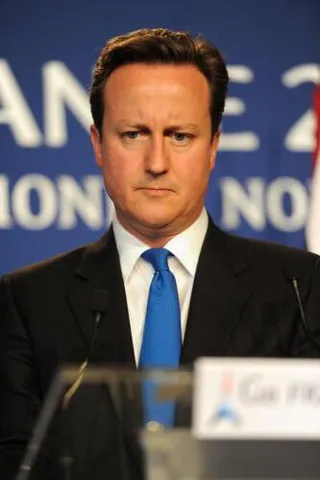
Sunday Oct 9, 1966 to Present
England
David William Donald Cameron is a British politician who served as Prime Minister of the United Kingdom from 2010 to 2016. He was the Member of Parliament (MP) for Witney from 2001 to 2016 and Leader of the Conservative Party from 2005 to 2016. He identifies as a one-nation conservative, and has been associated with both economically liberal and socially liberal policies.
Cameron was born in Marylebone, London, and raised at Peasemore in Berkshire.
After leaving Eton (school) in 1984, Cameron started a nine-month gap year, and in October 1985, Cameron began his Bachelor of Arts course in Philosophy, Politics and Economics (PPE) at Brasenose College, Oxford.
Cameron graduated in 1988 with a first-class honours BA degree (later promoted to an MA by seniority).
In 1991, Cameron was seconded to Downing Street to work on briefing John Major for the then twice-weekly sessions of Prime Minister's Questions. He became head of the political section of the Conservative Research Department. However, Cameron lost to Jonathan Hill, who was appointed in March 1992.
Cameron was rewarded with a promotion to Special Adviser to the Chancellor of the Exchequer, Norman Lamont.
After Lamont was sacked, Cameron remained at the Treasury for less than a month before being specifically recruited by Home Secretary Michael Howard. It was commented that he was still "very much in favour" and it was later reported that many at the Treasury would have preferred Cameron to carry on.
At the beginning of September 1993, Cameron applied to go on Conservative Central Office's list of prospective parliamentary candidates (PPCs).
In July 1994, Cameron left his role as Special Adviser to work as the Director of Corporate Affairs at Carlton Communications.
Cameron is married to Samantha Gwendoline Cameron (née Sheffield), the daughter of Sir Reginald Sheffield, 8th Baronet, and Annabel Lucy Veronica Jones (now Viscountess Astor). A Marlborough College school friend of Cameron's sister Clare, Samantha accepted Clare's invitation to accompany the Cameron family on holiday in Tuscany, Italy, after graduating from Bristol School of Creative Arts. It was then David and Samantha's romance started. They were married on 1 June 1996 at the Church of St Augustine of Canterbury, East Hendred, Oxfordshire, five years before Cameron was elected to parliament.
After graduation, Cameron worked for the Conservative Research Department in September 1988.
On 4 April 2000, Cameron was selected as PPC for Witney in Oxfordshire.
Cameron resigned as Director of Corporate Affairs in February 2001 in order to run for Parliament for a second time,after lossing in the first time in 1997.
In June 2003, Cameron was appointed a shadow minister in the Privy Council Office as a deputy to Eric Forth, then Shadow Leader of the House.
He also became a vice-chairman of the Conservative Party when Michael Howard took over the leadership in November 2003.
He was appointed Opposition frontbench local government spokesman in 2004, before being promoted to the Shadow Cabinet that June as head of policy co-ordination.
Cameron became Shadow Education Secretary in the post-election reshuffle.
Following the Labour victory in the May 2005 general election, Michael Howard announced his resignation as leader of the Conservative Party and set a lengthy timetable for the leadership election. Cameron announced on 29 September 2005 that he would be a candidate.
In the first ballot of Conservative MPs on 18 October 2005, Cameron came second, with 56 votes, slightly more than expected; David Davis had fewer than predicted at 62 votes; Liam Fox came third with 42 votes; and Kenneth Clarke was eliminated with 38 votes.
In the second ballot on 20 October 2005, Cameron came first with 90 votes; David Davis was second, with 57; and Liam Fox was eliminated with 51 votes. All 198 Conservative MPs voted in both ballots.
The next stage of the election process, between Davis and Cameron, was a vote open to the entire party membership. Cameron was elected with more than twice as many votes as Davis and more than half of all ballots issued; Cameron won 134,446 votes on a 78% turnout, to Davis's 64,398. Although Davis had initially been the favourite, it was widely acknowledged that his candidacy was marred by a disappointing conference speech.Cameron's election as the Leader of the Conservative Party and Leader of the Opposition was announced on 6 December 2005.
As is customary for an Opposition leader not already a member, upon election Cameron became a member of the Privy Council, being formally approved to join on 14 December 2005, and sworn of the Council on 8 March 2006.
The 2010 general election resulted in the Conservatives, led by Cameron, winning the largest number of seats (306). This was, however, 20 seats short of an overall majority and resulted in the nation's first hung parliament since February 1974.
Cameron outlined how he intended to "put aside party differences and work hard for the common good and for the national interest." As one of his first moves Cameron appointed Nick Clegg, the leader of the Liberal Democrats, as Deputy Prime Minister on 11 May 2010.
On 11 May 2010, following the resignation of Gordon Brown as Prime Minister and on his recommendation, Queen Elizabeth II invited Cameron to form a government. At age 43, Cameron became the youngest Prime Minister since Lord Liverpool in 1812, beating the record previously set by Tony Blair in May 1997.
At the end of May 2011, Cameron stepped down as patron of the Jewish National Fund, becoming the first British prime minister not to be patron of the charity in the 110 years of its existence.
In August 2013, Cameron lost a motion in favour of bombing Syrian armed forces in response to the Ghouta chemical attack, becoming the first prime minister to suffer such a foreign-policy defeat since 1782.
In March 2014, during his first visit to Israel as Prime Minister, Cameron addressed Israel's Knesset in Jerusalem, where he offered his full support for peace efforts between Israelis and Palestinians, hoping a two-state solution might be achieved.
Cameron supported Britain's close relationship with Saudi Arabia. In January 2015, Cameron travelled to the Saudi capital Riyadh to pay his respects following the death of the nation's King Abdullah.
On 7 May 2015, Cameron was re-elected UK Prime Minister with a majority in the Commons.
The Conservative Party's decisive win in the general election was as a surprise victory, as most polls and commentators predicted the outcome would be too close to call and result in a second hung parliament. Forming the first Conservative majority government since 1992, David Cameron became the first Prime Minister to be re-elected immediately after a full term with a larger popular vote share since Lord Salisbury at the 1900 general election.
Following the terrorist attacks on Paris in November 2015, for which Islamic State claimed responsibility, Cameron began pushing for a strategy for the Royal Air Force to bomb Syria in retaliation.Cameron set out his case for military intervention to Parliament on 26 November, telling MPs that it was the only way to guarantee Britain's safety and would be part of a "comprehensive" strategy to defeat IS.
As promised in the election manifesto, Cameron set a date for a referendum on whether the UK should remain a member of the European Union, and announced that he would be campaigning for Britain to remain within a "reformed EU". The terms of the UK's membership of the EU were re-negotiated. The referendum came to be known as Brexit (a portmanteau of "British" and "exit") and was held on 23 June 2016. The result was approximately 52% in favour of leaving the European Union and 48% against, with a turnout of 72%.
On 24 June, a few hours after the results became known, Cameron announced that he would resign the office of Prime Minister by the start of the Conservative Party Conference in October 2016.
Cameron announced he would hold a final cabinet meeting on 12 July and then following a final Prime Minister's Questions submit his resignation to the Queen on the afternoon of 13 July.
Although no longer serving as Prime Minister, Cameron originally stated that he would continue inside Parliament, on the Conservative backbenches. On 12 September, however, he announced that he was resigning his seat with immediate effect.
In October 2016, Cameron became chairman of the National Citizen Service Patrons.
In January 2017, he was appointed president of Alzheimer's Research UK to address misconceptions surrounding dementia and campaign for medical research funding to tackle the condition.
In a speech in Ankara in July 2010, Cameron stated unequivocally his support for Turkey's accession to the EU, citing economic, security and political considerations, and claimed that those who opposed Turkish membership were driven by "protectionism, narrow nationalism or prejudice".