
Born
Milošević was born in Požarevac, four months after the Axis invasion of the Kingdom of Yugoslavia, and raised during the Axis occupation of World War II.

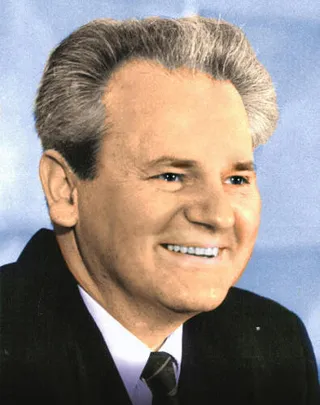
Wednesday Aug 20, 1941 to Saturday Mar 11, 2006
Serbia - Montenegro - Kosovo - Bosnia and Herzegovina - Croatia - Netherlands
Slobodan Milošević was a Yugoslav and Serbian politician who served as the President of Serbia (originally the Socialist Republic of Serbia, a constituent republic within the Socialist Federal Republic of Yugoslavia) from 1989 to 1997 and President of the Federal Republic of Yugoslavia from 1997 to 2000. He led the Socialist Party of Serbia from its foundation in 1990 and rose to power as Serbian President during efforts to reform the 1974 Constitution of Yugoslavia in response to the marginalization of Serbia and its political incapacity to deter Albanian separatist unrest in the Serbian province of Kosovo.
Milošević was born in Požarevac, four months after the Axis invasion of the Kingdom of Yugoslavia, and raised during the Axis occupation of World War II.
Milošević married his childhood friend, Mirjana Marković, with whom he had two children: Marko and Marija.
After Milošević graduation from the University of Belgrade's Law School in 1966, Milošević became an economic advisor to Mayor of Belgrade Branko Pešić.
In 1968, Milošević got a job at the Tehnogas company, where Stambolić was working.
Milošević became the Tehnogas company chairman in 1973.
By 1978, Stambolić's sponsorship had enabled Milošević to become the head of Beobanka, one of Yugoslavia's largest banks; his frequent trips to Paris and New York gave him the opportunity to learn English.
In the late 1980s, Milošević allowed the mobilization of Serb nationalist organizations to go unhindered by actions from the Serbian government, with Chetniks holding demonstrations, and the Serbian government embracing the Serbian Orthodox Church and restored its legitimacy in Serbia.
On 16 April 1984, Milošević was elected president of the Belgrade League of Communists City Committee.
On 21 February 1986, the Socialist Alliance of Working People unanimously supported him as presidential candidate for the SKJ's Serbian branch Central Committee.
Milošević was elected by a majority vote at the 10th Congress of the Serbian League of Communists on 28 May 1986.
Milošević emerged in 1987 as a force in Serbian politics after he declared support for Serbs in the Serbian autonomous province of Kosovo, who claimed they were being oppressed by the provincial government which was dominated by Kosovo's major ethnic group, ethnic Albanians.
As animosity between Serbs and Albanians in Kosovo deepened during the 1980s, Milošević was sent to address a crowd of Serbs at the historic Kosovo field on 24 April 1987. While Milošević was talking to the leadership inside the local cultural hall, demonstrators outside clashed with the local Kosovo-Albanian police force.
Starting in 1988, the anti-bureaucratic revolution led to the resignation of the governments of Vojvodina and Montenegro and to the election of officials allied with Milošević.
In February 1988, Stambolić's resignation was formalized, allowing Milošević to take his place as Serbia's president. Milošević then initiated a program of IMF-supported free-market reforms.
Milošević set up in May 1988 the "Milošević Commission" comprising Belgrade's leading neoliberal economists.
In August 1988, meetings by supporters of the Anti-Bureaucratic Revolution were held in many locations in Serbia and Montenegro, with increasingly violent nature, with calls being heard such as "Give us arms!", "We want weapons!", "Long live Serbia—death to Albanians!", and "Montenegro is Serbia!".
In Vojvodina, where 54 percent of the population was Serb, an estimated 100,000 demonstrators rallied outside the Communist Party headquarters in Novi Sad on 6 October 1988 to demand the resignation of the provincial leadership.
Milošević appealed to nationalist and populist passion by speaking of Serbia's importance to the world and in a Belgrade speech on 19 November 1988, he spoke of Serbia as facing battles against both internal and external enemies.
The constitutional commission worked for three years to harmonize its positions and in 1989 an amended Serbian constitution was submitted to the governments of Kosovo, Vojvodina and Serbia for approval.
Beginning in 1989, Milošević gave support to Croatian Serbs who were vouching for the creation of an autonomous province for Croatian Serbs, which was opposed by Croatian communist authorities.
Efforts to spread the cult of personality of Milošević into the republic of Macedonia began in 1989 with the introduction of slogans, graffiti, and songs glorifying Milošević.
By 1989, Milošević and his supporters controlled Central Serbia along with the autonomous provinces of Kosovo and Vojvodina, supporters in the leadership of Montenegro, and agents of the Serbian security service were pursuing efforts to destabilize the government in Bosnia & Herzegovina.
On 10 January 1989, the anti-bureaucratic revolution continued in Montenegro, which had the lowest average monthly wage in Yugoslavia, an unemployment rate of nearly 25 percent, and where one-fifth of the population lived below the poverty line. 50,000 demonstrators gathered in the Montenegrin capital of Titograd (now Podgorica) to protest the republic's economic situation and to demand the resignation of its leadership.
On 11 January 1989, Montenegro's state presidency tendered its collective resignation along with the Montenegrin delegates in the Yugoslav Politburo.
On 10 March 1989, the Vojvodina Assembly approved the constitutional amendments.
On 23 March 1989, the Kosovo Assembly approved the constitutional amendments.
On 28 March 1989, the Serbian Assembly approved the constitutional amendments.
On 8 May 1989, Milošević became The 7th President of the Presidency of the Socialist Republic of Serbia.
In 1990, after other republics abandoned the League of Communists of Yugoslavia and adopted democratic multiparty systems, Milošević's government quickly followed suit and the 1990 Serbian Constitution was created. The 1990 Constitution officially renamed the Socialist Republic of Serbia to the Republic of Serbia and abandoned the one-party communist system and created a democratic multiparty system.
Plans by Milošević to carve out territory from Croatia to the local Serbs had begun by June 1990, according to the diary of Borisav Jović.
Milošević rejected the independence of Croatia in 1991, and even after the formation of the Federal Republic of Yugoslavia (FRY), it too did not initially recognized Croatia's independence.
On 11 January 1991, Milošević became The 1st President of the Republic of Serbia.
Milošević's government exercised influence and censorship in the media. An example was in March 1991, when Serbia's Public Prosecutor ordered a 36-hour blackout of two independent media stations, B92 Radio and Studio B television to prevent the broadcast of a demonstration against the Serbian government taking place in Belgrade. The two media stations appealed to the Public Prosecutor against the ban but the Public Prosecutor failed to respond.
According to testimony by Krajina's former President Milan Babić, Milošević had abandoned plans of having "all Serbs in one state" by March 1991 in the secret Karađorđevo agreement with Croatian President Franjo Tuđman that discussed the partition of Bosnia.
Upon the Republic of Macedonia seceding in 1991, the FRY government declared Macedonia an "artificial nation" and it allied with Greece against the country, even suggesting a partition of the Republic of Macedonia between the FRY and Greece.
Serbia and Montenegro agreed to create the new Yugoslav federation called the Federal Republic of Yugoslavia in 1992, which dismantled the remaining communist infrastructure and created a federal democratic multiparty system of government.
Milošević denounced the declaration of independence of Bosnia and Herzegovina from Yugoslavia in 1992, and said that "Bosnia and Herzegovina was illegally proclaimed as an independent state and recognized.
Under heavy economic sanctions from the United Nations due to Milošević's perceived role in the Yugoslav wars, Serbia's economy began a prolonged period of economic collapse and isolation. The National Bank of FR Yugoslavia's war-related easy money policies contributed to hyperinflation which reached an alarming rate of 313 million percent in January 1994.
According to the World Bank, Serbia's economy contracted by 27.2 and 30.5 percent in 1992 and 1993 respectively. In response to the deteriorating situation, World Bank economist Dragoslav Avramović was nominated the governor of the National Bank of the FR Yugoslavia in March 1994.
In the wake of the Albanian boycott, supporters of Slobodan Milošević were elected to positions of authority by the remaining Serbian voters in Kosovo. The boycott soon included education on Albanian language in Kosovo which Milošević attempted to resolve by signing the Milošević-Rugova education agreement in 1996.
The Serbian economy began growing from the period of 1994–1998, at one point even reaching a growth rate of 10.1 percent in 1997.
On 4 February 1997, Milošević recognized the opposition victories in some local elections, after mass protests lasting 96 days.
On 23 July 1997, Milošević assumed the presidency of the Federation (The Federal Republic of Yugoslavia), though it had been understood he had held the real power for some time before then.
Milošević denies that he gave orders to massacre Albanians in 1998. He claims that the deaths were sporadic events confined to rural areas of West Kosovo committed by paramilitaries and by rebels in the armed forces. Those from the Serbian army or police who were involved were all, he claims, arrested and many were sentenced to long prison sentences.
Serbian police and military counter-action against the pro-Albanian separatist Kosovo Liberation Army in Serbia's previously autonomous province of Kosovo culminated in escalating armed conflict in 1998 and NATO air strikes against Yugoslavia between March and June 1999, ending in full withdrawal of Yugoslav security forces from the province and deployment of international civil and security forces.
Milošević was indicted on 24 May 1999 for war crimes and crimes against humanity committed in Kosovo, and he was standing trial, up until his death, at the International Criminal Tribunal for the Former Yugoslavia (ICTY). He asserted that the trial was illegal, having been established in contravention of the UN Charter.
Ironically, Milošević lost his grip on power by losing in elections he scheduled prematurely (that is, before the end of his mandate) and that he did not even need to win in order to retain power, which was centered in the parliaments that his party and its associates controlled. In the five-man presidential race held on 24 September 2000, Milošević was defeated in the first round by opposition leader Vojislav Koštunica, who won slightly more than 50% of the vote.
Milošević initially refused to acquiesce, claiming that no one had won a majority. The Yugoslav constitution called for a runoff between the top two candidates in the event that no candidate won more than 50% of the vote. Official results put Koštunica ahead of Milošević but at under 50 percent. The internationally financed CeSID claimed otherwise, though its story changed throughout the two weeks between 24 September and 5 October. This led to mass demonstrations in Belgrade on 5 October, known as the Bulldozer Revolution.
Milošević was forced to accept this when VJ commanders he had expected to support him had indicated that in this instance they would not, and would permit the violent overthrow of the Serbian government. On 6 October, Milošević met with Koštunica and publicly accepted defeat.
Koštunica finally took office as Yugoslav president on 7 October following Milošević's announcement.
Milošević was arrested by Yugoslav authorities on 1 April 2001, following a 36-hour armed standoff between police and Milošević's bodyguards at his Belgrade villa. Although no official charges were made, Milošević was suspected of abuse of power and corruption.
Following Milošević's arrest, the United States pressured the Yugoslav government to extradite Milošević to the ICTY or lose financial aid from the IMF and World Bank. On 28 June, Milošević was flown by helicopter from Belgrade to a U.S. air base in Tuzla, Bosnia and Herzegovina and from where he was then flown to The Hague, Netherlands.
Following Milošević's transfer, the original charges of war crimes in Kosovo were upgraded by adding charges of genocide in Bosnia and war crimes in Croatia. On 30 January 2002, Milošević accused the war crimes tribunal of an "evil and hostile attack" against him.
The trial began at The Hague on 12 February 2002, with Milošević defending himself.
In the summer of 2000, former Serbian President Ivan Stambolić was kidnapped; his body was found in 2003 and Milošević was charged with ordering his murder.
On 11 March 2006, Milošević was found dead in his prison cell in the UN war crimes tribunal's detention centre, located in the Scheveningen section of The Hague, Netherlands.
In June 2006, the Supreme Court of Serbia ruled that Milošević had ordered the murder of Stambolić, accepting the previous ruling of the Special Court for Organized Crime in Belgrade, which targeted Milošević as the main abettor of politically motivated murders in the 1990s.
In February 2007, the International Court of Justice cleared Serbia under Milošević's rule of direct responsibility for occurrences of crime committed during the Bosnian War. The president of the International Court of Justice (ICJ), however, did state that it was "'conclusively proved' that the Serbian leadership, and Milošević in particular, 'were fully aware ... that massacres were likely to occur'".