
Birth
Mercury was born Farrokh Bulsara in Stone Town in the British protectorate of Zanzibar (now part of Tanzania) on 5 September 1946.
Thursday Sep 5, 1946 to Sunday Nov 24, 1991
Tanzania, London, England, United Kingdom
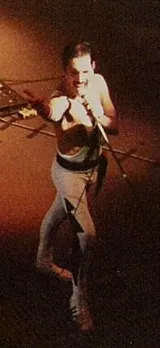
Freddie Mercury (born Farrokh Bulsara; 5 September 1946 – 24 November 1991) was a British singer, songwriter, record producer, and lead vocalist of the rock band Queen. Regarded as one of the greatest lead singers in the history of rock music, he was known for his flamboyant stage persona and four-octave vocal range.
Mercury was born Farrokh Bulsara in Stone Town in the British protectorate of Zanzibar (now part of Tanzania) on 5 September 1946.
Mercury spent most of his childhood in India where he began taking piano lessons at the age of seven while living with relatives.
In 1954, at the age of eight, Mercury was sent to study at St. Peter's School, a British-style boarding school for boys, in Panchgani near Mumbai.
At the age of 12, he formed a school band, the Hectics, and covered rock and roll artists such as Cliff Richard and Little Richard.
In February 1963 Mercury moved back to Zanzibar where he joined his parents at their flat.
In 1964, Mercury and his family fled from Zanzibar to escape the violence of the revolution against the Sultan of Zanzibar and his mainly Arab government, in which thousands of ethnic Arabs and Indians were killed. They moved into a small house at 22 Gladstone Avenue, Feltham, Middlesex, England. After first studying art at Isleworth Polytechnic in West London.
Mercury studied graphic art and design at Ealing Art College, graduating with a diploma in 1969.
Following graduation, Mercury joined a series of bands and sold second-hand clothes in Kensington Market in London with Roger Taylor. He also held a job as a baggage handler at Heathrow Airport. Friends from the time remember him as a quiet and shy young man with a great interest in music.
In 1969, he joined Liverpool-based band Ibex, later renamed Wreckage. He briefly lived in a flat above the Dovedale Towers, a pub close to Penny Lane in Liverpool's Mossley Hill district.
As Zanzibar was a British protectorate until 1963, Mercury was born a British subject, and on 2 June 1969 was registered a citizen of the United Kingdom and colonies after the family had emigrated to England.
In April 1970, Mercury teamed up with guitarist Brian May and drummer Roger Taylor, to become lead singer of their band Smile.
In the early 1970s, Mercury had a long-term relationship with Mary Austin, whom he met through guitarist Brian May. He lived with Austin for several years in West Kensington, London. By the mid-1970s, he had begun an affair with a male American record executive at Elektra Records.
They (Smile) were joined by bassist John Deacon in 1971. Despite the reservations of the other members and Trident Studios, the band's initial management, Mercury chose the name "Queen" for the new band.
His first solo effort goes back to 1972 under the pseudonym Larry Lurex, when Trident Studios' house engineer Robin Geoffrey Cable was working in a musical project, at the time when Queen were recording their debut album; Cable enlisted Mercury to perform lead vocals on the songs "I Can Hear Music" and "Goin' Back", both were released together as a single in 1973.
During the 1970s, Everett became advisor and mentor to Mercury and Mercury served as Everett's confidante.
Mercury also wrote six songs from Queen II which deal with multiple key changes and complex material. "Crazy Little Thing Called Love", on the other hand, contains only a few chords. Although Mercury often wrote very intricate harmonies, he claimed that he could barely read music.
Mercury's final home, Garden Lodge 1 Logan Place, a twenty-eight room Georgian mansion in Kensington set in a quarter-acre manicured garden surrounded by a high brick wall, was picked out by Austin.
Radio disc jockey Kenny Everett met Mercury in 1974, when he invited the singer onto his Capital London breakfast show.
He also wrote several songs about Austin, including "Love of My Life".
In December 1976, Mercury told Austin of his sexuality, which ended their romantic relationship.
In 1981–1983 Mercury recorded several tracks with Michael Jackson, including a demo of "State of Shock", "Victory", and "There Must Be More to Life Than This".
Mercury wrote 10 of the 17 songs on Queen's Greatest Hits album: "Bohemian Rhapsody", "Seven Seas of Rhye", "Killer Queen", "Somebody to Love", "Good Old-Fashioned Lover Boy", "We Are the Champions", "Bicycle Race", "Don't Stop Me Now", "Crazy Little Thing Called Love", and "Play the Game".
Throughout the early- to mid-1980s, Mercury and Everett continued to explore their homosexuality and experiment with drugs. Although they were never lovers, they did experience London nightlife together.
Mercury contributed to the Richard "Wolfie" Wolf remix of the song "Love Kills", used as the end title theme for National Lampoon's Loaded Weapon 1. The song was originally recorded in 1984, when it was included on the soundtrack for the restoration of the 1927 Fritz Lang film Metropolis. First written by Giorgio Moroder in collaboration with Mercury, and produced by Moroder and Mack, "Love Kills" debuted at the number 10 position in the UK Singles Chart.
By 1985, Mercury began another long-term relationship with Irish-born hairdresser Jim Hutton (1949–2010).
By 1985, Mercury and Everett had fallen out, and their friendship was further strained when Everett was outed in the autobiography of his ex-wife Lady Lee.
His first album, Mr. Bad Guy, debuted in the top ten of the UK Album Charts.
One of Mercury's most notable performances with Queen took place at Live Aid in 1985.
In 1986, Queen also played behind the Iron Curtain when they performed to a crowd of 80,000 in Budapest, in what was one of the biggest rock concerts ever held in Eastern Europe.
Mercury's final live performance with Queen took place on 9 August 1986 at Knebworth Park in England and drew an attendance estimated as high as 160,000.
In October 1986, the British press reported that Mercury had his blood tested for HIV/AIDS at a Harley Street clinic. A reporter for The Sun, Hugh Whittow, questioned Mercury about the story at Heathrow Airport as he was returning from Japan. Mercury denied he had the disease. According to his partner Jim Hutton, Mercury was diagnosed with AIDS in late April 1987. Around that time, Mercury claimed in an interview to have tested negative for HIV.
Mack also produced the 1987 single "Hold On", which Mercury recorded with actress Jo Dare for the German action drama Zabou.
His second album, Barcelona, recorded with Spanish soprano vocalist Montserrat Caballé, combines elements of popular music and opera. Many critics were uncertain what to make of the album; one referred to it as "the most bizarre CD of the year".
In 1989, with their health failing, Mercury and Everett were reconciled.
After the conclusion of his work with Queen in June 1991, Mercury retired to his home in Kensington, West London.
On 22 November 1991, Mercury called Queen's manager Jim Beach to his Kensington home to prepare a public statement, which was released the following day: Following the enormous conjecture in the press over the last two weeks, I wish to confirm that I have been tested HIV positive and have AIDS. I felt it correct to keep this information private to date to protect the privacy of those around me. However, the time has come now for my friends and fans around the world to know the truth and I hope that everyone will join with me, my doctors and all those worldwide in the fight against this terrible disease. My privacy has always been very special to me and I am famous for my lack of interviews. Please understand this policy will continue.
On the evening of 24 November 1991, about 24 hours after issuing the statement, Mercury died at the age of 45 at his home in Kensington. The cause of death was bronchial pneumonia resulting from AIDS. Mercury's close friend Dave Clark of the Dave Clark Five was at the bedside vigil when he died. Austin phoned Mercury's parents and sister to break the news, which reached newspaper and television crews in the early hours of 25 November.
A statue in Montreux, Switzerland, by sculptor Irena Sedlecká, was erected as a tribute to Mercury. It stands almost 10 feet (3 metres) high overlooking Lake Geneva and was unveiled on 25 November 1996 by Mercury's father and Montserrat Caballé, with bandmates Brian May and Roger Taylor also in attendance.
In 2012, Freddie Mercury: The Great Pretender, a documentary film directed by Rhys Thomas on Mercury's attempts to forge a solo career, premiered on BBC One.
The 2018 biopic of Mercury, Bohemian Rhapsody, received criticism for its portrayal of Mercury's sexuality, which was described as "sterilized" and "confused", and was even accused of being "dangerous".