
Birth
King was born on January 15, 1929, in Atlanta, Georgia, to the Reverend Martin Luther King Sr. and Alberta Williams King.

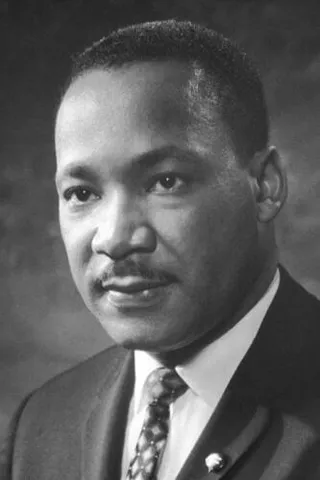
Monday Nov 5, 1928 to Thursday Apr 4, 1968
United States
Was an American Baptist minister and activist who became the most visible spokesperson and leader in the civil rights movement from 1955 until his assassination in 1968. Born in Atlanta, King is best known for advancing civil rights through nonviolence and civil disobedience, tactics his Christian beliefs and the nonviolent activism of Mahatma Gandhi helped inspire.
King was born on January 15, 1929, in Atlanta, Georgia, to the Reverend Martin Luther King Sr. and Alberta Williams King.
In 1948, King graduated at the age of 19 from Morehouse with a B.A. in sociology.
He then enrolled in Crozer Theological Seminary in Chester, Pennsylvania, from which he graduated with a B.Div. degree in 1951.
King married Coretta Scott on June 18, 1953, on the lawn of her parents' house in her hometown of Heiberger, Alabama.
At the age of 25 in 1954, King was called as pastor of the Dexter Avenue Baptist Church in Montgomery, Alabama.
March 1955, Claudette Colvin—a fifteen-year-old black schoolgirl in Montgomery—refused to give up her bus seat to a white man in violation of Jim Crow laws, local laws in the Southern United States that enforced racial segregation. King was on the committee from the Birmingham African-American community that looked into the case; E. D. Nixon and Clifford Durr decided to wait for a better case to pursue because the incident involved a minor.
King began doctoral studies in systematic theology at Boston University and received his Ph.D. degree on June 5, 1955
Nine months later on December 1, 1955, a similar incident occurred when Rosa Parks was arrested for refusing to give up her seat on a city bus.
In 1957, King, Ralph Abernathy, Fred Shuttlesworth, Joseph Lowery, and other civil rights activists founded the Southern Christian Leadership Conference (SCLC). The group was created to harness the moral authority and organizing power of black churches to conduct nonviolent protests in the service of civil rights reform. The group was inspired by the crusades of evangelist Billy Graham, who befriended King after he attended a 1957 Graham crusade in New York City.
The Albany Movement was a desegregation coalition formed in Albany, Georgia, in November 1961. In December, King and the SCLC became involved. The movement mobilized thousands of citizens for a broad-front nonviolent attack on every aspect of segregation within the city and attracted nationwide attention.
In April 1963, the SCLC began a campaign against racial segregation and economic injustice in Birmingham, Alabama. The campaign used nonviolent but intentionally confrontational tactics, developed in part by Rev. Wyatt Tee Walker. Black people in Birmingham, organizing with the SCLC, occupied public spaces with marches and sit-ins, openly violating laws that they considered unjust.
King, representing the SCLC, was among the leaders of the "Big Six" civil rights organizations who were instrumental in the organization of the March on Washington for Jobs and Freedom, which took place on August 28, 1963.
On February 6, 1964, King delivered the inaugural speech of a lecture series initiated at the New School called "The American Race Crisis".
In March 1964, King and the SCLC joined forces with Robert Hayling's then-controversial movement in St. Augustine, Florida. Hayling's group had been affiliated with the NAACP but was forced out of the organization for advocating armed self-defense alongside nonviolent tactics. However, the pacifist SCLC accepted them.
In December 1964, King and the SCLC joined forces with the Student Nonviolent Coordinating Committee (SNCC) in Selma, Alabama, where the SNCC had been working on voter registration for several months.
The Nobel Peace Prize 1964 was awarded to Martin Luther King Jr.
Acting on James Bevel's call for a march from Selma to Montgomery, King, Bevel, and the SCLC, in partial collaboration with SNCC, attempted to organize the march to the state's capital. The first attempt to march on March 7, 1965, was aborted because of mob and police violence against the demonstrators. This day has become known as Bloody Sunday and was a major turning point in the effort to gain public support for the civil rights movement.
King later stated and Abernathy wrote that the movement received a worse reception in Chicago than in the South. Marches, especially the one through Marquette Park on August 5, 1966, were met by thrown bottles and screaming throngs. Rioting seemed very possible. King's beliefs militated against his staging a violent event, and he negotiated an agreement with Mayor Richard J. Daley to cancel a march in order to avoid the violence that he feared would result.
During an April 4, 1967, appearance at the New York City Riverside Church—exactly one year before his death—King delivered a speech titled "Beyond Vietnam: A Time to Break Silence." He spoke strongly against the U.S.'s role in the war, arguing that the U.S. was in Vietnam "to occupy it as an American colony" and calling the U.S. government "the greatest purveyor of violence in the world today".
The plan to set up a shantytown in Washington, D.C., was carried out soon after the April 4 assassination. Criticism of King's plan was subdued in the wake of his death, and the SCLC received an unprecedented wave of donations for the purpose of carrying it out. The campaign officially began in Memphis, on May 2, at the hotel where King was murdered.