
Historydraft Logo
null
7 events on this timeline
  1. First meeting

    Saturday Aug 9, 1941Placentia Bay, Newfoundland

    On 9 August 1941, the British battleship HMS Prince of Wales steamed into Placentia Bay, with Churchill on board, and met the American heavy cruiser USS Augusta, where Roosevelt and members of his staff were waiting. On first meeting, Churchill and Roosevelt were silent for a moment until Churchill said "At long last, Mr. President", to which Roosevelt replied "Glad to have you aboard, Mr. Churchill". Churchill then delivered to the president a letter from King George VI and made an official statement which, despite two attempts, the movie sound crew present failed to record.

  2. Atlantic Conference

    Thursday Aug 14, 1941Newfoundland

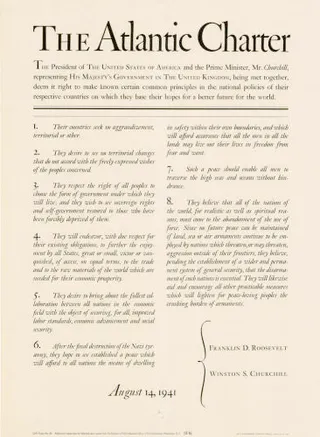
    US President, Franklin D. Roosevelt, and British Prime Minister, Winston Churchill, discussed what would become the Atlantic Charter in 1941 during the Atlantic Conference in Placentia Bay, Newfoundland. They made their joint declaration on 14 August 1941 from the US naval base in the bay, Naval Base Argentia, that had recently been leased from Britain as part of a deal that saw the US give 50 surplus destroyers to the UK for use against German U-boats (the US did not enter the war as a combatant until the attack on Pearl Harbour, four months later).

  3. The Charter's content

    Thursday Aug 21, 1941Washington D.C., U.S.

    No signed version ever existed. The document was threshed out through several drafts and the final agreed text was telegraphed to London and Washington. President Roosevelt gave Congress the Charter's content on 21 August 1941.

  4. The name Atlantic Charter

    Sunday Aug 24, 1941United Kingdom

    When it was released to the public, the Charter was titled "Joint Declaration by the President and the Prime Minister" and was generally known as the "Joint Declaration". The Labour Party newspaper Daily Herald coined the name Atlantic Charter, but Churchill used it in Parliament on 24 August 1941, and it has since been generally adopted.

  5. Subsequent meeting of the Inter-Allied Council

    Wednesday Sep 24, 1941London, England, United Kingdom

    The Allied nations and leading organisations quickly and widely endorsed the Charter. At the subsequent meeting of the Inter-Allied Council in London on 24 September 1941, the governments in exile of Belgium, Czechoslovakia, Greece, Luxembourg, the Netherlands, Norway, Poland, and Yugoslavia, as well as the Soviet Union, and representatives of the Free French Forces, unanimously adopted adherence to the common principles of policy set forth in the Atlantic Charter.

  6. Declaration by United Nations

    Thursday Jan 1, 1942U.S.

    On 1 January 1942, a larger group of nations, who adhered to the principles of the Atlantic Charter, issued a joint Declaration by United Nations stressing their solidarity in the defense against Hitlerism.

  7. Churchill argued for an interpretation of the charter in order to allow the Soviet Union to continue to control the Baltic states

    Mar, 1944U.S.

    During the war Churchill argued for an interpretation of the charter in order to allow the Soviet Union to continue to control the Baltic states, an interpretation rejected by the US until March 1944.