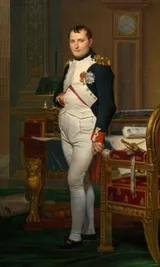
Napoleon Bonaparte was a French statesman and military leader who rose to prominence during the French Revolution and led several successful campaigns during the French Revolutionary Wars. He was Emperor of the French as Napoleon I from 1804 until 1814 and again briefly in 1815 during the Hundred Days. Napoleon dominated European and global affairs for more than a decade while leading France against a series of coalitions in the Napoleonic Wars. He won most of these wars and the vast majority of his battles, building a large empire that ruled over much of continental Europe before its final collapse in 1815.
The ancestors of Napoleon descended from minor Italian nobility of Tuscan origin who had come to Corsica from Liguria in the 16th century. Napoleon boasted of his Italian heritage saying "I am of the race that founds empires", and he referred to himself as "more Italian or Tuscan than Corsican".
eventTuesday Aug 15, 1769placeAjaccio, Corsica, Kingdom of France
Napoleon was born on 15 August 1769. His parents Carlo Maria di Buonaparte and Maria Letizia Ramolino maintained an ancestral home called "Casa Buonaparte" in Ajaccio. Napoleon was their fourth child and third son. A boy and girl were born first but died in infancy.
The father was an attorney who went on to be named Corsica's representative to the court of Louis XVI
event1777placeFrance
Napoleon's parents fought against the French to maintain independence even when Maria was pregnant with him. His father was an attorney who went on to be named Corsica's representative to the court of Louis XVI in 1777.
In his youth he was an outspoken Corsican nationalist and supported the state's independence from France. Like many Corsicans, Napoleon spoke and read Corsican (as his mother tongue) and Italian (as the official language of Corsica). Napoleon began learning French in school at around age 10.
Napoleon was routinely bullied by his peers for his accent
event1780placeFrance
Napoleon was routinely bullied by his peers for his accent, birthplace, short stature, mannerisms and inability to speak French quickly. Bonaparte became reserved and melancholy applying himself to reading.
At this time, Napoleon was a fervent Corsican nationalist, and wrote to Corsican leader Pasquale Paoli in May 1789, "As the nation was perishing I was born. Thirty thousand Frenchmen were vomited on to our shores, drowning the throne of liberty in waves of blood. Such was the odious sight which was the first to strike me".
Napoleon served in Valence and Auxonne until after the outbreak of the Revolution in 1789, and took nearly two years' leave in Corsica and Paris during this period.
He spent the early years of the Revolution in Corsica, fighting in a complex three-way struggle among royalists, revolutionaries, and Corsican nationalists. He was a supporter of the republican Jacobin movement, organizing clubs in Corsica, and was given command over a battalion of volunteers. Napoleon was promoted to captain in the regular army in July 1792, despite exceeding his leave of absence and leading a riot against French troops.
Bonaparte and his family fled to the French mainland
eventJun, 1793placeFrance
Napoleon came into conflict with Paoli, who had decided to split with France and sabotage the Corsican contribution to the Expédition de Sardaigne, by preventing a French assault on the Sardinian island of La Maddalena. Bonaparte and his family fled to the French mainland in June 1793 because of the split with Paoli.
In July 1793, Bonaparte published a pro-republican pamphlet entitled Le souper de Beaucaire (Supper at Beaucaire) which gained him the support of Augustin Robespierre, younger brother of the Revolutionary leader Maximilien Robespierre.
Napoleon adopted a plan to capture a hill where republican guns could dominate the city's harbour and force the British to evacuate. The assault on the position led to the capture of the city, but during it Bonaparte was wounded in the thigh. Napoleon was promoted to brigadier general at the age of 24. Catching the attention of the Committee of Public Safety, he was put in charge of the artillery of France's Army of Italy.
Napoleon spent time as inspector of coastal fortifications on the Mediterranean coast
event1793placeFrance
Napoleon spent time as inspector of coastal fortifications on the Mediterranean coast near Marseille while he was waiting for confirmation of the Army of Italy post.
He devised plans for attacking the Kingdom of Sardinia as part of France's campaign against the First Coalition. Augustin Robespierre and Saliceti were ready to listen to the freshly promoted artillery general.
eventThursday Apr 24, 1794placeSaorge, Alpes-Maritimes, France
The French army carried out Bonaparte's plan in the Battle of Saorgio in April 1794, and then advanced to seize Ormea in the mountains.
From Ormea, they headed west to outflank the Austro-Sardinian positions around Saorge. After this campaign, Augustin Robespierre sent Bonaparte on a mission to the Republic of Genoa to determine that country's intentions towards France.
In April 1795, Napoleon was assigned to the Army of the West, which was engaged in the War in the Vendée (a civil war and royalist counter-revolution) in Vendée, a region in west central France on the Atlantic Ocean.
Napoleon wrote the romantic novella Clisson et Eugénie, about a soldier and his lover, in a clear parallel to Bonaparte's own relationship with Désirée.
Napoleon ordered a young cavalry officer named Joachim Murat to seize large cannons and used them to repel the attackers on 5 October 1795 (13 Vendémiaire An IV in the French Republican Calendar); 1,400 royalists died and the rest fled.
Napoleon was romantically involved with Joséphine de Beauharnais, the former mistress of Barras. The couple married on 9 March 1796 in a civil ceremony.
The French then focused on the Austrians for the remainder of the war, the highlight of which became the protracted struggle for Mantua. The Austrians launched a series of offensives against the French to break the siege, but Napoleon defeated every relief effort, scoring victories at the battles of Castiglione, Bassano, Arcole, and Rivoli.
French forces had been defeated by the Archduke Charles
event1796placeSouthern Germany
The next phase of the campaign featured the French invasion of the Habsburg heartlands. French forces in Southern Germany had been defeated by the Archduke Charles in 1796, but the Archduke withdrew his forces to protect Vienna after learning about Napoleon's assault.
The decisive French triumph at Rivoli in January 1797 led to the collapse of the Austrian position in Italy. At Rivoli, the Austrians lost up to 14,000 men while the French lost about 5,000.
In the first encounter between the two commanders, Napoleon pushed back his opponent and advanced deep into Austrian territory after winning at the Battle of Tarvis in March 1797.
The Austrians were alarmed by the French thrust that reached all the way to Leoben, about 100 km from Vienna, and finally decided to sue for peace.
The Treaty of Leoben, followed by the more comprehensive Treaty of Campo Formio, gave France control of most of northern Italy and the Low Countries, and a secret clause promised the Republic of Venice to Austria. Bonaparte marched on Venice and forced its surrender, ending 1,100 years of independence. He also authorized the French to loot treasures such as the Horses of Saint Mark.
Napoleon decided on a military expedition to seize Egypt
event1798placeFrance
Bonaparte decided that France's naval power was not yet strong enough to confront the British Royal Navy. Napoleon decided on a military expedition to seize Egypt and thereby undermine Britain's access to its trade interests in India.
Bonaparte reached Malta on 9 June 1798, then controlled by the Knights Hospitaller. Grand Master Ferdinand von Hompesch zu Bolheim surrendered after token resistance, and Bonaparte captured an important naval base with the loss of only three men.
On 1 August 1798, the British fleet under Sir Horatio Nelson captured or destroyed all but two French vessels in the Battle of the Nile, defeating Bonaparte's goal to strengthen the French position in the Mediterranean.
Napoleon moved an army into the Ottoman province of Damascus
event1799placeSyria and Galilee
In early 1799, Napoleon moved an army into the Ottoman province of Damascus (Syria and Galilee). Bonaparte led these 13,000 French soldiers in the conquest of the coastal towns of Arish, Gaza, Jaffa, and Haifa.
eventSunday Mar 3, 1799placeJaffa, Sidon Eyalet, Ottoman Empire (Present Day Jaffa, Israel)
The attack on Jaffa was particularly brutal. Bonaparte discovered that many of the defenders were former prisoners of war, ostensibly on parole, so he ordered the garrison and 1,400 prisoners to be executed by bayonet or drowning to save bullets.
On 24 August 1799, Napoleon took advantage of the temporary departure of British ships from French coastal ports and set sail for France, despite the fact that he had received no explicit orders from Paris.
Despite the failures in Egypt, Napoleon returned to a hero's welcome. He drew together an alliance with director Emmanuel Joseph Sieyès, his brother Lucien, speaker of the Council of Five Hundred Roger Ducos, director Joseph Fouché, and Talleyrand, and they overthrew the Directory by a coup d'état on 9 November 1799 ("the 18th Brumaire" according to the revolutionary calendar), closing down the Council of Five Hundred.
Napoleon and his troops crossed the Swiss Alps into Italy
event1800placeItaly
In the spring of 1800, Napoleon and his troops crossed the Swiss Alps into Italy, aiming to surprise the Austrian armies that had reoccupied the peninsula when Napoleon was still in Egypt.
While one French army approached from the north, the Austrians were busy with another stationed in Genoa, which was besieged by a substantial force.
The fierce resistance of this French army, under André Masséna, gave the northern force some time to carry out their operations with little interference.
eventSaturday Jun 14, 1800placeAlessandria, Piedmont, Italy
After spending several days looking for each other, the two armies collided at the Battle of Marengo on 14 June. General Melas had a numerical advantage, fielding about 30,000 Austrian soldiers while Napoleon commanded 24,000 French troops.
The Battle of Marengo was fought on 14 June 1800 between French forces under the First Consul Napoleon Bonaparte and Austrian forces near the city of Alessandria, in Piedmont, Italy.
Late in the afternoon, a full division under Louis Desaix arrived on the field and reversed the tide of the battle. A series of artillery barrages and cavalry charges decimated the Austrian army, which fled over the Bormida River back to Alessandria, leaving behind 14,000 casualties.
eventSunday Jun 15, 1800placeAlessandria, Piedmont, Italy
The Austrian army agreed to abandon Northern Italy once more with the Convention of Alessandria, which granted them safe passage to friendly soil in exchange for their fortresses throughout the region.
The Conspiration des poignards (Daggers Conspiracy) or Complot de l'Opéra (Opera Plot) was an alleged assassination attempt against Napoleon Bonaparte. The members of the plot were not clearly established. Authorities at the time presented it as an assassination attempt on Napoleon at the exit of the Paris operahouse on 18 vendémiaire year IX (10 October 1800), which was prevented by the police force of Joseph Fouché. However, this version was questioned very early on.
eventWednesday Dec 3, 1800placeHohenlinden, east of Munich, (Present Day Germany)
Bonaparte gave orders to his general Moreau to strike Austria once more. Moreau and the French swept through Bavaria and scored an overwhelming victory at Hohenlinden in December 1800.
The Plot of the rue Saint-Nicaise, also known as the Machine infernale plot, was an assassination attempt on the life of the First Consul of France, Napoleon Bonaparte, in Paris on 24 December 1800. It followed the conspiration des poignards of 10 October 1800, and was one of many Royalist and Catholic plots. Though Napoleon and his wife Josephine narrowly escaped the attempt, five people were killed and twenty-six others were injured.
As a result, the Austrians capitulated and signed the Treaty of Lunéville in February 1801. The treaty reaffirmed and expanded earlier French gains at Campo Formio.
Toussaint Louverture installing himself as de facto dictator
event1801placeSaint-Domingue (Present Day Haiti)
The brief peace in Europe allowed Napoleon to focus on the French colonies abroad. Saint-Domingue had managed to acquire a high level of political autonomy during the Revolutionary Wars, with Toussaint Louverture installing himself as de facto dictator by 1801.
France and Britain signed the Treaty of Amiens in March 1802, bringing the Revolutionary Wars to an end. Amiens called for the withdrawal of British troops from recently conquered colonial territories as well as for assurances to curtail the expansionary goals of the French Republic.
In a new plebiscite during the spring of 1802, the French public came out in huge numbers to approve a constitution that made the Consulate permanent, essentially elevating Napoleon to dictator for life.
The peace with Britain proved to be uneasy and controversial.
Britain did not evacuate Malta as promised and protested against Bonaparte's annexation of Piedmont and his Act of Mediation, which established a new Swiss Confederation. Neither of these territories were covered by Amiens, but they inflamed tensions significantly.
The dispute culminated in a declaration of war by Britain in May 1803; Napoleon responded by reassembling the invasion camp at Boulogne.
Napoleon decided to sell the Louisiana Territory to the United States
event1803placeU.S.
Seeing the failure of his colonial efforts, Napoleon decided in 1803 to sell the Louisiana Territory to the United States, instantly doubling the size of the U.S. The selling price in the Louisiana Purchase was less than three cents per acre, a total of $15 million.
Napoleon sent an expedition under his brother-in-law General Leclerc to reassert control over Saint-Domingue. Although the French managed to capture Toussaint Louverture, the expedition failed when high rates of disease crippled the French army, and Jean-Jacques Dessalines won a string of victories, first against Leclerc, and when he died from yellow fever, then against Donatien-Marie-Joseph de Vimeur, vicomte de Rochambeau, whom Napoleon sent to relieve Leclerc with another 20,000 men. In May 1803, Napoleon acknowledged defeat, and the last 8,000 French troops left the island and the slaves proclaimed an independent republic that they called Haïti in 1804.
The main strategic idea involved the French Navy escaping from the British blockades of Toulon and Brest and threatening to attack the West Indies. In the face of this attack, it was hoped, the British would weaken their defense of the Western Approaches by sending ships to the Caribbean, allowing a combined Franco-Spanish fleet to take control of the channel long enough for French armies to cross and invade.
However, the plan unraveled after the British victory at the Battle of Cape Finisterre in July 1805. French Admiral Villeneuve then retreated to Cádiz instead of linking up with French naval forces at Brest for an attack on the English Channel.
eventWednesday Oct 16, 1805placeUlm, Electorate of Bavaria (Present Day Ulm, Germany)
Austrian commander Karl Mack had gathered the greater part of the Austrian army at the fortress of Ulm in Swabia. Napoleon swung his forces to the southeast and the Grande Armée performed an elaborate wheeling movement that outflanked the Austrian positions.
The Ulm Maneuver completely surprised General Mack, who belatedly understood that his army had been cut off. After some minor engagements that culminated in the Battle of Ulm, Mack finally surrendered after realizing that there was no way to break out of the French encirclement. For just 2,000 French casualties, Napoleon had managed to capture a total of 60,000 Austrian soldiers through his army's rapid marching.
The Ulm Campaign is generally regarded as a strategic masterpiece and was influential in the development of the Schlieffen Plan in the late 19th century.
eventMonday Dec 2, 1805placeAusterlitz, Moravia, Austrian Empire (Present Day Slavkov u Brna, Czech Republic)
At this critical juncture, both Tsar Alexander I and Holy Roman Emperor Francis II decided to engage Napoleon in battle, despite reservations from some of their subordinates. Napoleon sent his army north in pursuit of the Allies, but then ordered his forces to retreat so that he could feign a grave weakness.
At the Battle of Austerlitz, in Moravia on 2 December, he deployed the French army below the Pratzen Heights and deliberately weakened his right flank, enticing the Allies to launch a major assault there in the hopes of rolling up the whole French line.
eventThursday Dec 26, 1805placePressburg (Present Day Bratislava, Hungary)
The Allied disaster at Austerlitz significantly shook the faith of Emperor Francis in the British-led war effort. France and Austria agreed to an armistice immediately and the Treaty of Pressburg followed shortly after on 26 December.
Ottoman Emperor Selim III recognized Napoleon as Emperor
eventFeb, 1806placeOttoman Empire (Present Day Turkey)
In February 1806, Ottoman Emperor Selim III recognized Napoleon as Emperor. He also opted for an alliance with France, calling France "our sincere and natural ally".
That decision brought the Ottoman Empire into a losing war against Russia and Britain.
eventTuesday Oct 14, 1806placeJena and Auerstedt, Germany
Napoleon invaded Prussia with 180,000 troops, rapidly marching on the right bank of the River Saale. As in previous campaigns, his fundamental objective was to destroy one opponent before reinforcements from another could tip the balance of the war. Upon learning the whereabouts of the Prussian army, the French swung westwards and crossed the Saale with overwhelming force. At the twin battles of Jena and Auerstedt, fought on 14 October, the French convincingly defeated the Prussians and inflicted heavy casualties. With several major commanders dead or incapacitated, the Prussian king proved incapable of effectively commanding the army, which began to quickly disintegrate.
Following his triumph, Napoleon imposed the first elements of the Continental System through the Berlin Decree issued in November 1806. The Continental System, which prohibited European nations from trading with Britain, was widely violated throughout his reign.
A Franco-Persian alliance was also formed between Napoleon and the Persian Empire of Fat′h-Ali Shah Qajar. It collapsed in 1807, when France and Russia themselves formed an unexpected alliance.
eventWednesday Jun 10, 1807placeHeilsberg, East Prussia (Lidzbark Warmiński, Poland)
After a period of rest and consolidation on both sides (French forces and Russian forces), the war restarted in June with an initial struggle at Heilsberg that proved indecisive.
eventSunday Jun 14, 1807placeFriedland, Prussia (Present Day Pravdinsk, Russia)
On 14 June Napoleon obtained an overwhelming victory over the Russians at the Battle of Friedland, wiping out the majority of the Russian army in a very bloody struggle. The scale of their defeat convinced the Russians to make peace with the French.
Tsar Alexander sent an envoy to seek an armistice with Napoleon
eventFriday Jun 19, 1807placeTilsit (Present Day Sovetsk, Kaliningrad Oblast, Russia)
On 19 June, Tsar Alexander sent an envoy to seek an armistice with Napoleon. The latter assured the envoy that the Vistula River represented the natural borders between French and Russian influence in Europe. On that basis, the two emperors began peace negotiations at the town of Tilsit after meeting on an iconic raft on the River Niemen. The very first thing Alexander said to Napoleon was probably well-calibrated: "I hate the English as much as you do".
eventTuesday Jul 7, 1807placeTilsit (Present Day Sovetsk, Kaliningrad Oblast, Russia)
Moreover, Alexander's pretensions at friendship with Napoleon led the latter to seriously misjudge the true intentions of his Russian counterpart, who would violate numerous provisions of the treaty in the next few years. Despite these problems, the Treaties of Tilsit at last gave Napoleon a respite from war and allowed him to return to France, which he had not seen in over 300 days.
eventSaturday Oct 17, 1807placePyrenees mountains ( Spain, France and Andorra)
On 17 October 1807, 24,000 French troops under General Junot crossed the Pyrenees with Spanish cooperation and headed towards Portugal to enforce Napoleon's orders.
eventTuesday Oct 27, 1807placeFontainebleau, France
Unhappy with this change of policy by the Portuguese government, Napoleon negotiated a secret treaty with Charles IV of Spain and sent an army to invade Portugal.
Napoleon dictated very harsh peace terms for Prussia, despite the ceaseless exhortations of Queen Louise. Wiping out half of Prussian territories from the map, Napoleon created a new kingdom of 2,800 square kilometres (1,100 sq mi) called Westphalia and appointed his young brother Jérôme as its monarch. Prussia's humiliating treatment at Tilsit caused a deep and bitter antagonism which festered as the Napoleonic era progressed.
Napoleon announced that he would intervene to mediate between the rival political factions in the country
eventTuesday Feb 16, 1808placeSpain
Throughout the winter of 1808, French agents became increasingly involved in Spanish internal affairs, attempting to incite discord between members of the Spanish royal family.
On 16 February 1808, secret French machinations finally materialized when Napoleon announced that he would intervene to mediate between the rival political factions in the country.
Marshal Murat led 120,000 troops into Spain. The French arrived in Madrid on 24 March, where wild riots against the occupation erupted just a few weeks later.
The shocking French defeat at the Battle of Bailén in July gave hope to Napoleon's enemies and partly persuaded the French emperor to intervene in person.
Before going to Iberia, Napoleon decided to address several lingering issues with the Russians. At the Congress of Erfurt in October 1808, Napoleon hoped to keep Russia on his side during the upcoming struggle in Spain and during any potential conflict against Austria.
The two sides reached an agreement, the Erfurt Convention, that called upon Britain to cease its war against France, that recognized the Russian conquest of Finland from Sweden, and that affirmed Russian support for France in a possible war against Austria "to the best of its ability".
Napoleon then returned to France and prepared for war. The Grande Armée, under the Emperor's personal command, rapidly crossed the Ebro River in November 1808 and inflicted a series of crushing defeats against the Spanish forces.
eventMonday Jan 16, 1809placeCorunna, Galicia, Spain
Napoleon then unleashed his soldiers against Moore and the British forces. The British were swiftly driven to the coast, and they withdrew from Spain entirely after a last stand at the Battle of Corunna in January 1809.
Imperial Government secretly decided on another confrontation against the French
eventWednesday Feb 8, 1809placeAustria
After four years on the sidelines, Austria sought another war with France to avenge its recent defeats. Austria could not count on Russian support because the latter was at war with Britain, Sweden, and the Ottoman Empire in 1809.
Although Archduke Charles warned that the Austrians were not ready for another showdown with Napoleon, a stance that landed him in the so-called "peace party", he did not want to see the army demobilized either.
On 8 February 1809, the advocates for war finally succeeded when the Imperial Government secretly decided on another confrontation against the French.
Napoleon never returned to Spain after the 1808 campaign
event1809placeSpain
Napoleon would end up leaving Iberia in order to deal with the Austrians in Central Europe, but the Peninsular War continued on long after his absence. He never returned to Spain after the 1808 campaign. Several months after Corunna, the British sent another army to the peninsula under the future Duke of Wellington. The war then settled into a complex and asymmetric strategic deadlock where all sides struggled to gain the upper hand. The highlight of the conflict became the brutal guerrilla warfare that engulfed much of the Spanish countryside. Both sides committed the worst atrocities of the Napoleonic Wars during this phase of the conflict.
Napoleon arrived at Donauwörth on 17 April to find the Grande Armée in a dangerous position, with its two wings separated by 120 km (75 mi) and joined together by a thin cordon of Bavarian troops.
Charles pressed the left wing of the French army and hurled his men towards the III Corps of Marshal Davout. In response, Napoleon came up with a plan to cut off the Austrians in the celebrated Landshut Maneuver.
Napoleon realigned the axis of his army and marched his soldiers towards the town of Eckmühl. The French scored a convincing win in the resulting Battle of Eckmühl, forcing Charles to withdraw his forces over the Danube and into Bohemia.
On 13 May, Vienna fell for the second time in four years, although the war continued since most of the Austrian army had survived the initial engagements in Southern Germany.
Charles kept the bulk of his troops several kilometres away from the river bank in hopes of concentrating them at the point where Napoleon decided to cross
eventWednesday May 17, 1809placeAustria
By 17 May, the main Austrian army under Charles had arrived on the Marchfeld. Charles kept the bulk of his troops several kilometres away from the river bank in hopes of concentrating them at the point where Napoleon decided to cross.
eventSunday May 21, 1809placeLobau, Vienna, Austria
On 21 May, the French made their first major effort to cross the Danube, precipitating the Battle of Aspern-Essling. The Austrians enjoyed a comfortable numerical superiority over the French throughout the battle.
On the first day, Charles disposed of 110,000 soldiers against only 31,000 commanded by Napoleon. By the second day, reinforcements had boosted French numbers up to 70,000.
It was the first defeat Napoleon suffered in a major set-piece battle, and it caused excitement throughout many parts of Europe because it proved that he could be beaten on the battlefield.
From 30 June to the early days of July, the French recrossed the Danube in strength, with more than 180,000 troops marching across the Marchfeld towards the Austrians. Charles received the French with 150,000 of his own men.
In the ensuing Battle of Wagram, which also lasted two days, Napoleon commanded his forces in what was the largest battle of his career up until then.
Napoleon finished off the battle with a concentrated central thrust that punctured a hole in the Austrian army and forced Charles to retreat.
The French were too exhausted to pursue the Austrians immediately, but Napoleon eventually caught up with Charles at Znaim and the latter signed an armistice on 12 July.
In the Kingdom of Holland, the British launched the Walcheren Campaign to open up a second front in the war and to relieve the pressure on the Austrians. The British army only landed at Walcheren on 30 July, by which point the Austrians had already been defeated.
The Walcheren Campaign was characterized by little fighting but heavy casualties thanks to the popularly dubbed "Walcheren Fever". Over 4000 British troops were lost in a bungled campaign, and the rest withdrew in December 1809.
Napoleon turned his focus to domestic affairs after the war. Empress Joséphine had still not given birth to a child from Napoleon, who became worried about the future of his empire following his death. Desperate for a legitimate heir, Napoleon divorced Joséphine on 10 January 1810 and started looking for a new wife.
eventSunday Mar 11, 1810placeAugustinian Church, Vienna, Austria
Napoleon married the Marie Louise, Duchess of Parma, daughter of Francis II on March 11, 1810 at the Augustinian Church, Vienna, who was 18 years old at the time.
On 20 March 1811, Marie Louise gave birth to a baby boy, whom Napoleon made heir apparent and bestowed the title of King of Rome. His son never actually ruled the empire, but given his brief titular rule and cousin Louis-Napoléon's subsequent naming himself Napoléon III, historians often refer to him as Napoleon II.
Napoleon expanded his Grande Armée to more than 450,000 men
event1812placeFrance
By 1812, advisers to Alexander suggested the possibility of an invasion of the French Empire and the recapture of Poland. On receipt of intelligence reports on Russia's war preparations, Napoleon expanded his Grande Armée to more than 450,000 men.
Napoleon prepared for an offensive campaign against Russia
eventWednesday Jun 24, 1812placeFrance
Napoleon ignored repeated advice against an invasion of the Russian heartland and prepared for an offensive campaign; on 24 June 1812 the invasion commenced.
eventSunday Aug 16, 1812placeSmolensk, Russian Empire
The Russians avoided Napoleon's objective of a decisive engagement and instead retreated deeper into Russia. A brief attempt at resistance was made at Smolensk in August; the Russians were defeated in a series of battles, and Napoleon resumed his advance.
The Russians eventually offered battle outside Moscow on 7 September: the Battle of Borodino resulted in approximately 44,000 Russian and 35,000 French dead, wounded or captured, and may have been the bloodiest day of battle in history up to that point in time.
Although the French had won, the Russian army had accepted, and withstood, the major battle Napoleon had hoped would be decisive. Napoleon's own account was: "The most terrible of all my battles was the one before Moscow. The French showed themselves to be worthy of victory, but the Russians showed themselves worthy of being invincible".
Napoleon and his army left. In early November Napoleon got concerned about loss of control back in France after the Malet coup of 1812. His army walked through snow up to their knees, and nearly 10,000 men and horses froze to death on the night of 8/9 November alone.
The French suffered in the course of a ruinous retreat, including from the harshness of the Russian Winter. The Armée had begun as over 400,000 front line troops, with fewer than 40,000 crossing the Berezina River in November 1812. The Russians had lost 150,000 in battle and hundreds of thousands of civilians.
After the Battle of Berezina Napoleon managed to escape but had to abandon much of the remaining artillery and baggage train. On 5 December, shortly before arriving in Vilnius, Napoleon left the army in a sledge.
eventThursday Aug 26, 1813placeDresden, Kingdom of Saxony (Present Day Germany)
There was a lull in fighting over the winter of 1812–13 while both the Russians and the French rebuilt their forces; Napoleon was able to field 350,000 troops.
Heartened by France's loss in Russia, Prussia joined with Austria, Sweden, Russia, Great Britain, Spain, and Portugal in a new coalition. Napoleon assumed command in Germany and inflicted a series of defeats on the Coalition (Austria, Russia and Prussia) culminating in the Battle of Dresden in August 1813.
The Allies offered peace terms in the Frankfurt proposals in November 1813. Napoleon would remain as Emperor of France, but it would be reduced to its "natural frontiers". That meant that France could retain control of Belgium, Savoy and the Rhineland (the west bank of the Rhine River), while giving up control of all the rest, including all of Spain and the Netherlands, and most of Italy and Germany. Metternich told Napoleon these were the best terms the Allies were likely to offer; after further victories, the terms would be harsher and harsher. Metternich's motivation was to maintain France as a balance against Russian threats, while ending the highly destabilizing series of wars.
Napoleon, expecting to win the war, delayed too long and lost this opportunity; by December the Allies had withdrawn the offer. When his back was to the wall in 1814 he tried to reopen peace negotiations on the basis of accepting the Frankfurt proposals. The Allies now had new, harsher terms that included the retreat of France to its 1791 boundaries, which meant the loss of Belgium. Napoleon would remain Emperor, however he rejected the term. The British wanted Napoleon permanently removed, and they prevailed, but Napoleon adamantly refused.
Napoleon withdrew back into France, his army reduced to 70,000 soldiers and little cavalry; he faced more than three times as many Allied troops.The French were surrounded: British armies pressed from the south, and other Coalition forces positioned to attack from the German states.
Napoleon won a series of victories in the Six Days' Campaign, though these were not significant enough to turn the tide. The leaders of Paris surrendered to the Coalition in March 1814.
eventFriday Apr 1, 1814placeLuxembourg Palace, Paris, France
On 1 April, Alexander addressed the Sénat conservateur. Long docile to Napoleon, under Talleyrand's prodding it had turned against him. Alexander told the Sénat that the Allies were fighting against Napoleon, not France, and they were prepared to offer honorable peace terms if Napoleon were removed from power.
eventSaturday Apr 2, 1814placeLuxembourg Palace, Paris, France
The Sénat passed the Acte de déchéance de l'Empereur ("Emperor's Demise Act"), which declared Napoleon deposed. Napoleon had advanced as far as Fontainebleau when he learned that Paris was lost. When Napoleon proposed the army march on the capital, his senior officers and marshals mutinied.
On 4 April, led by Michel Ney, they confronted Napoleon. Napoleon asserted the army would follow him, and Ney replied the army would follow its generals. While the ordinary soldiers and regimental officers wanted to fight on, without any senior officers or marshals any prospective invasion of Paris would have been impossible.
Napoleon was then forced to announce his unconditional abdication
eventWednesday Apr 6, 1814placeFrance
Bowing to the inevitable, on 4 April Napoleon abdicated in favor of his son, with Marie Louise as regent. However, the Allies refused to accept this under prodding from Alexander, who feared that Napoleon might find an excuse to retake the throne. Napoleon was then forced to announce his unconditional abdication only two days later.
eventMonday Apr 11, 1814placeFontainebleau, France
In the Treaty of Fontainebleau, the Allies exiled Napoleon to Elba, an island of 12,000 inhabitants in the Mediterranean, 20 km (12 mi) off the Tuscan coast. They gave him sovereignty over the island and allowed him to retain the title of Emperor. Napoleon attempted suicide with a pill he had carried after nearly being captured by the Russians during the retreat from Moscow. Its potency had weakened with age, however, and he survived to be exiled, while his wife and son took refuge in Austria.
eventSunday May 29, 1814placeRueil-Malmaison, Kingdom of France
A few months into his exile, Napoleon learned that his ex-wife Josephine had died in France. He was devastated by the news, locking himself in his room and refusing to leave for two days.
Napoleon escaped from Elba, in the brig Inconstant on 26 February 1815 with 700 men. Two days later, he landed on the French mainland at Golfe-Juan and started heading north.
The 5th Regiment was sent to intercept Napoleon and made contact just south of Grenoble on 7 March 1815. Napoleon approached the regiment alone, dismounted his horse and, when he was within gunshot range, shouted to the soldiers, "Here I am. Kill your Emperor, if you wish".
The soldiers quickly responded with, "Vive L'Empereur!".
Ney, who had boasted to the restored Bourbon king, Louis XVIII, that he would bring Napoleon to Paris in an iron cage, affectionately kissed his former emperor and forgot his oath of allegiance to the Bourbon monarch. The two then marched together towards Paris with a growing army. The unpopular Louis XVIII fled to Belgium after realizing he had little political support.
On 13 March, the powers at the Congress of Vienna declared Napoleon an outlaw. Four days later, Great Britain, Russia, Austria, and Prussia each pledged to put 150,000 men into the field to end his rule.
eventSunday Jun 18, 1815placeWaterloo (Present Day Waterloo, Belgium)
Napoleon's forces fought two Coalition armies, commanded by the British Duke of Wellington and the Prussian Prince Blücher, at the Battle of Waterloo on 18 June 1815. Wellington's army withstood repeated attacks by the French and drove them from the field while the Prussians arrived in force and broke through Napoleon's right flank.
Napoleon returned to Paris and found that both the legislature and the people had turned against him. Realizing his position was untenable, he abdicated on 22 June in favor of his son.
Napoleon left Paris three days later and settled at Josephine's former palace in Malmaison (on the western bank of the Seine about 17 kilometres (11 mi) west of Paris). Even as Napoleon traveled to Paris, the Coalition forces swept through France (arriving in the vicinity of Paris on 29 June), with the stated intent of restoring Louis XVIII to the French throne.
Napoleon surrendered to Captain Frederick Maitland
eventSaturday Jul 15, 1815placeRochefort, France
Napoleon heard that Prussian troops had orders to capture him dead or alive, he fled to Rochefort, considering an escape to the United States. British ships were blocking every port. Napoleon surrendered to Captain Frederick Maitland on HMS Bellerophon on 15 July 1815.
The British kept Napoleon on the island of Saint Helena in the Atlantic Ocean, 1,870 km (1,162 mi) from the west coast of Africa. They also took the precaution of sending a garrison of soldiers to uninhabited Ascension Island, which lay between St. Helena and Europe.
Napoleon was moved to Longwood House on Saint Helena in December 1815; it had fallen into disrepair, and the location was damp, windswept and unhealthy.
eventSaturday May 5, 1821placeLongwood House, Saint Helena
In February 1821, Napoleon's health began to deteriorate rapidly, and he reconciled with the Catholic Church. He died on 5 May 1821, after confession, Extreme Unction and Viaticum in the presence of Father Ange Vignali. His last words were, France, l'armée, tête d'armée, Joséphine ("France, the army, head of the army, Joséphine").
In 1840, Louis Philippe I obtained permission from the British to return Napoleon's remains to France. On 15 December 1840, a state funeral was held. The hearse proceeded from the Arc de Triomphe down the Champs-Élysées, across the Place de la Concorde to the Esplanade des Invalides and then to the cupola in St Jérôme's Chapel, where it remained until the tomb designed by Louis Visconti was completed.