
Born
Mandela was born on 18 July 1918 in the village of Mvezo in Umtata, then part of South Africa's Cape Province. Given the forename Rolihlahla,

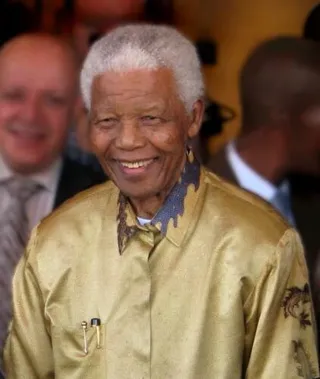
Thursday Jul 18, 1918 to Thursday Dec 5, 2013
South Africa
Nelson Rolihlahla Mandela was a South African anti-apartheid revolutionary, political leader, and philanthropist who served as President of South Africa from 1994 to 1999. He was the country's first black head of state and the first elected in a fully representative democratic election. His government focused on dismantling the legacy of apartheid by tackling institutionalised racism and fostering racial reconciliation. Ideologically an African nationalist and socialist, he served as President of the African National Congress (ANC) party from 1991 to 1997.
Mandela was born on 18 July 1918 in the village of Mvezo in Umtata, then part of South Africa's Cape Province. Given the forename Rolihlahla,
Despite his friendships with non-blacks and communists, Mandela embraced Lembede's views, believing that black Africans should be entirely independent in their struggle for political self-determination.Deciding on the need for a youth wing to mass-mobilise Africans in opposition to their subjugation, Mandela was among a delegation that approached ANC President Alfred Bitini Xuma on the subject at his home in Sophiatown; the African National Congress Youth League (ANCYL) was founded on Easter Sunday 1944 in the Bantu Men's Social Centre, with Lembede as President and Mandela as a member of its executive committee.
At Sisulu's house, Mandela met Evelyn Mase, a trainee nurse and ANC activist from Engcobo, Transkei. Entering a relationship and marrying in October 1944, they initially lived with her relatives until moving into a rented house in the township of Orlando in early 1946.
Mandela took Xuma's place on the ANC national executive in March 1950,and that same year was elected national president of the ANCYL.
In April 1952, Mandela began work at the H.M. Basner law firm, which was owned by a communist.
At Durban rally on 22 June, Mandela addressed an assembled crowd of 10,000, initiating the campaign protests, for which he was arrested and briefly interned in Marshall Square prison.
In July 1952, Mandela was arrested under the Suppression of Communism Act and stood trial as one of the 21 accused—among them Moroka, Sisulu, and Yusuf Dadoo—in Johannesburg. Found guilty of "statutory communism", a term that the government used to describe most opposition to apartheid, their sentence of nine months' hard labour was suspended for two years. In December, Mandela was given a six-month ban from attending meetings or talking to more than one individual at a time, making his Transvaal ANC presidency impractical, and during this period the Defiance Campaign petered out.
In August 1953, Mandela and Tambo opened their own law firm, Mandela and Tambo, operating in downtown Johannesburg. The only African-run law firm in the country, it was popular with aggrieved blacks, often dealing with cases of police brutality. Disliked by the authorities, the firm was forced to relocate to a remote location after their office permit was removed under the Group Areas Act; as a result, their clientele dwindled.
In September 1953, Andrew Kunene read out Mandela's "No Easy Walk to Freedom" speech at a Transvaal ANC meeting; the title was taken from a quote by Indian independence leader Jawaharlal Nehru, a seminal influence on Mandela's thought. The speech laid out a contingency plan for a scenario in which the ANC was banned. This Mandela Plan, or M-Plan, involved dividing the organisation into a cell structure with a more centralised leadership.
In December 1956, Mandela was arrested alongside most of the ANC national executive, and accused of "high treason" against the state. Held in Johannesburg Prison amid mass protests, they underwent a preparatory examination before being granted bail.
Initiating divorce proceedings in May 1956, she claimed that Mandela had physically abused her; he denied the allegations, and fought for custody of their children. She withdrew her petition of separation in November, but Mandela filed for divorce in January 1958; the divorce was finalised in March, with the children placed in Evelyn's care.
During the divorce proceedings, he began courting a social worker, Winnie Madikizela, whom he married in Bizana in June 1958. She later became involved in ANC activities, spending several weeks in prison.
On 29 March 1961, six years after the Treason Trial began, the judges produced a verdict of not guilty, ruling that there was insufficient evidence to convict the accused of "high treason", since they had advocated neither communism nor violent revolution; the outcome embarrassed the government.
On 5 August 1962, police captured Mandela along with fellow activist Cecil Williams near Howick.
On 12 June 1964, justice De Wet found Mandela and two of his co-accused guilty on all charges; although the prosecution had called for the death sentence to be applied, the judge instead condemned them to life imprisonment.Mandela and his co-accused were transferred from Pretoria to the prison on Robben Island, remaining there for the next 18 years.
Although considering Mandela a dangerous "arch-Marxist",in February 1985 Botha offered him a release from prison if he "unconditionally rejected violence as a political weapon". Mandela spurned the offer, releasing a statement through his daughter Zindzi stating, "What freedom am I being offered while the organisation of the people remains banned? Only free men can negotiate. A prisoner cannot enter into contracts."
Leaving Victor Verster Prison on 11 February, Mandela held Winnie's hand in front of amassed crowds and the press; the event was broadcast live across the world.Driven to Cape Town's City Hall through crowds, he gave a speech declaring his commitment to peace and reconciliation with the white minority, but made it clear that the ANC's armed struggle was not over, and would continue as "a purely defensive action against the violence of apartheid". He expressed hope that the government would agree to negotiations, so that "there may no longer be the need for the armed struggle", and insisted that his main focus was to bring peace to the black majority and give them the right to vote in national and local elections.
In September 1991, a national peace conference was held in Johannesburg at which Mandela, Buthelezi and de Klerk signed a peace accord, though the violence continued.
Their marriage was increasingly strained as he learned of her affair with Dali Mpofu, but he supported her during her trial for kidnapping and assault. He gained funding for her defence from the International Defence and Aid Fund for Southern Africa and from Libyan leader Muammar Gaddafi, but in June 1991 she was found guilty and sentenced to six years in prison, reduced to two on appeal. On 13 April 1992, Mandela publicly announced his separation from Winnie.
Mandela and de Klerk were jointly awarded the Nobel Peace Prize in Norway.
The newly elected National Assembly's first act was to formally elect Mandela as South Africa's first black chief executive. His inauguration took place in Pretoria on 10 May 1994, televised to a billion viewers globally. The event was attended by four thousand guests, including world leaders from a wide range of geographic and ideological backgrounds. Mandela headed a Government of National Unity dominated by the ANC—which had no experience of governing by itself—but containing representatives from the National Party and Inkatha.
In 1995, Mandela stopped to talk to street children in Cape Town, and was inspired to found organisation.So he founded Nelson Mandela Children's Fund.
Mandela stepped down as ANC President at the party's December 1997 conference. He hoped that Ramaphosa would succeed him, believing Mbeki to be too inflexible and intolerant of criticism, but the ANC elected Mbeki regardless.
Mandela's relationship with Machel had intensified; in February 1998, he publicly stated that he was "in love with a remarkable lady", and under pressure from Tutu, who urged him to set an example for young people, he organised a wedding for his 80th birthday, in July that year.The following day, he held a grand party with many foreign dignitaries.
Although the 1996 constitution allowed the president to serve two consecutive five-year terms, Mandela had never planned to stand for a second term in office. He gave his farewell speech to Parliament on 29 March 1999 when it adjourned prior to the 1999 general elections, after which he retired in June 1999.
After suffering from a prolonged respiratory infection, Mandela died on 5 December 2013 at the age of 95, at around 20:50 local time (UTC+2) at his home in Houghton, surrounded by his family. And Zuma publicly announced his death on television, proclaiming ten days of national mourning.