

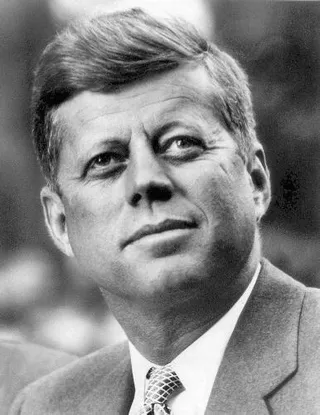
1Birth
John Fitzgerald Kennedy was born on May 29, 1917, at 83 Beals Street in suburban Brookline, Massachusetts, U.S.
2Baptized
Kennedy lived in Brookline for the first ten years of his life and attended the local St. Aidan's Church, where he was baptized on June 19, 1917.
3Europe tour
In 1939 Kennedy toured Europe, the Soviet Union, the Balkans, and the Middle East in preparation for his Harvard senior honors thesis. He then went to Czechoslovakia and Germany before returning to London on September 1, 1939, the day that Germany invaded Polandto mark the beginning of World War II.
4Graduated
In 1940 Kennedy graduated from Harvard with a Bachelor of Arts in government, concentrating on international affairs.
5Harvard College
In September 1936, Kennedy enrolled at Harvard College.
6Joined the United States Naval Reserve
On September 24, 1941, with the help of the director of the Office of Naval Intelligence (ONI)—who was the former naval attaché to Joseph Kennedy—Kennedy joined the United States Naval Reserve.
7PT-109
On April 24, he took command of PT-109, which was based at the time on Tulagi Island in the Solomons.
8First Command
His first command was PT-101 from December 7, 1942, until February 23, 1943
9Lieutenant junior grade
On October 10, he was promoted to lieutenant junior grade.
10Older brother killed
On August 12, 1944, Kennedy's older brother, Joe Jr., a navy pilot, was killed while volunteering for a special and hazardous air mission. His explosive-laden plane blew up when the plane's bombs detonated prematurely while the aircraft was flying over the English Channel.
11Kennedy Retired
On March 1, 1945, Kennedy retired from the Navy Reserve on physical disability and was honorably discharged with the full rank of lieutenant.
12Presidential Nomination Announcement
On January 2, 1960, Kennedy announced his candidacy for the Democratic presidential nomination.
13Saint Anselm College Speech
Kennedy gave a speech at Saint Anselm College on May 5, 1960, regarding America's conduct in the emerging Cold War. The address detailed how the American foreign policy should be conducted towards African nations, noting a hint of support for modern African nationalism by saying, "For we, too, founded a new nation on revolt from colonial rule".
14A President
John F. Kennedy was sworn in as the 35th president at noon on January 20, 1961.
15Final Invasion Plan
The Eisenhower administration had created a plan to overthrow Fidel Castro's regime in Cuba. Led by the Central Intelligence Agency (CIA), with help from the U.S. military, the plan was for an invasion of Cuba by a counter-revolutionary insurgency composed of U.S.-trained, anti-Castro Cuban exiles led by CIA paramilitary officers. The intention was to invade Cuba and instigate an uprising among the Cuban people, hoping to remove Castro from power. Kennedy approved the final invasion plan on April 4, 1961.
16Bay of Pigs
The Bay of Pigs Invasion began on April 17, 1961.
17Bay of Pigs Negotiations
By April 19, 1961, the Cuban government had captured or killed the invading exiles, and Kennedy was forced to negotiate for the release of the 1,189 survivors. Twenty months later, Cuba released the captured exiles in exchange for $53 million worth of food and medicine.
18Khrushchev meeting
On June 4, 1961, the president met with Khrushchev in Vienna and left the meetings angry and disappointed that he had allowed the premier to bully him, despite the warnings he had received.
19Soviets' construction of intermediate-range ballistic missile sites in Cuba
On October 14, 1962, CIA U-2 spy planes took photographs of the Soviets' construction of intermediate-range ballistic missile sites in Cuba. The photos were shown to Kennedy on October 16; a consensus was reached that the missiles were offensive in nature and thus posed an immediate nuclear threat.
20Soviet ships arriving off Cuba
The U.S. Navy would stop and inspect all Soviet ships arriving off Cuba, beginning October 24.
21Dismantle the missile sites
On October 28, Khrushchev agreed to dismantle the missile sites, subject to UN inspections.
22Assassination
President Kennedy was assassinated in Dallas, Texas, at 12:30 pm Central Standard Time on Friday, November 22, 1963.
23Withdraw 1,000 troops
After Kennedy's assassination, President Johnson signed NSAM 273 on November 26, 1963. It reversed Kennedy's decision to withdraw 1,000 troops and reaffirmed the policy of assistance to the South Vietnamese.
24Committed the first combat troops to Vietnam
On March 8, 1965, his successor, President Lyndon Johnson, committed the first combat troops to Vietnam and greatly escalated U.S. involvement, with forces reaching 184,000 that year and 536,000 in 1968.