
Ptolemy IV Philopator was the fourth pharaoh of Ptolemaic Egypt
Ptolemy IV Philopator was the fourth pharaoh of Ptolemaic Egypt from 221 to 204 BC.

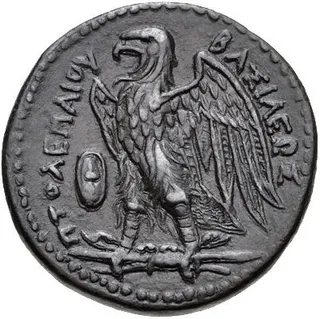
305 BC to 30 BC
Egypt
The Ptolemaic Kingdom was an Ancient Greek state based in Egypt during the Hellenistic Period. It was founded in 305 BC by Ptolemy I Soter, a companion of Alexander the Great, and lasted until the death of Cleopatra VII in 30 BC. Ruling for nearly three centuries, the Ptolemies were the longest and most recent Egyptian dynasty of ancient origin.
Ptolemy IV Philopator was the fourth pharaoh of Ptolemaic Egypt from 221 to 204 BC.
Alexander III of Macedon, commonly known as Alexander the Great, was a king of the ancient Greek kingdom of Macedon.
In 332 BC, Alexander the Great, King of Macedon, invaded Egypt, which at the time was a satrapy of the Achaemenid Empire known as the Thirty-first Dynasty under Emperor Artaxerxes III.
Following Alexander's death in Babylon in 323 BC, a succession crisis erupted among his generals. Initially, Perdiccas ruled the empire as regent for Alexander's half-brother Arrhidaeus, who became Philip III of Macedon.
A major Mediterranean port of Egypt, in ancient times and still today, Alexandria was founded in 331 BC by Alexander the Great.
Alexander founded a new Greek city, Alexandria and Early in 331 BC he was ready to depart and led his forces away to Phoenicia. He left Cleomenes of Naucratis as the ruling nomarch to control Egypt in his absence. Alexander never returned to Egypt.
Alexandria became the capital of the Hellenized Egypt of King Ptolemy I (reigned 323–283 BC).
Ptolemy I, perhaps with advice from Demetrius of Phalerum, founded the Library of Alexandria.
Perdiccas appointed Ptolemy, one of Alexander's closest companions, to be satrap of Egypt. Ptolemy ruled Egypt from 323 BC, nominally in the name of the joint kings Philip III and Alexander IV.
Ptolemy successfully defended Egypt by consolidated his position in Egypt and the surrounding areas during the Wars of the Diadochi (322–301 BC).
Ptolemy successfully defended Egypt against an invasion by Perdiccas in 321 BC.
Ptolemy occupied Corinth and other parts of Greece, although he lost Cyprus after a naval battle in 306 BC.
Ptolemy I Soter made himself king of Egypt, he created a new god, Serapis, to garner support from both Greeks and Egyptians.
Ptolemy I Soter, was a Greek general, historian, and companion of Alexander the Great of the Kingdom of Macedon in northern Greece who became ruler of Egypt, part of Alexander's former empire. Ptolemy was the pharaoh of Ptolemaic Egypt from 305/304 BC.
In 305 BC, Ptolemy took the title of King. As Ptolemy I Soter ("Saviour"), he founded the Ptolemaic dynasty that was to rule Egypt for nearly 300 years.
Ptolemaic art was produced during the reign of the Ptolemaic Rulers (304–30 BC) and was concentrated primarily within the bounds of the Ptolemaic Empire.
Thereafter Ptolemy tried to stay out of land wars, but he retook Cyprus in 295 BC.
Feeling the kingdom was now secure, Ptolemy shared rule with his son Ptolemy II by Queen Berenice in 285 BC.
Ptolemy II Philadelphus, who succeeded his father as the pharaoh of Egypt in 283 BC, was a peaceful and cultured pharaoh, though unlike his father was no great warrior.
During Alexandria's brief literary golden period, c. 280–240 BC, the Library subsidized three poets—Callimachus, Apollonius of Rhodes, and Theocritus—whose work now represents the best of Hellenistic literature.
Gold coin with the visage of Arsinoe II wearing divine diadem.
In the 270s BC, Ptolemy II defeated the Kingdom of Kush in war, gaining the Ptolemies free access to Kushite territory and control of important gold deposits south of Egypt known as Dodekasoinos.
Ptolemaic control or influence over Cyrenaica, Coele-Syria, and Cyprus, as well as over cities in Anatolia, southern Thrace, the Aegean islands, and Crete.
Ptolemy III Euergetes abandoned his predecessors' policy of keeping out of the wars of the other Macedonian successor kingdoms and plunged into the Third Syrian War (246–241 BC) with the Seleucid Empire of Syria.
Ptolemy III Euergetes was the third pharaoh of the Ptolemaic dynasty in Egypt from 246 to 222 BC.
Ptolemy III had introduced an important innovation in 238 BC by holding a synod of all the priests of Egypt at Canopus.
Egyptian nationalism reached a peak in the reign of Ptolemy IV Philopator (221–205 BC), when a succession of native self-proclaimed "Pharoah" gained control over one district.
In 221 BC, Ptolemy III died and was succeeded by his son Ptolemy IV Philopator, a weak king whose rule precipitated the decline of the Ptolemaic Kingdom.
Ptolemy IV continued this tradition by holding his own synod at Memphis in 217 BC, after the victory celebrations of the Fourth Syrian War.
The result of this synod was the Raphia Decree, issued on 15 November 217 BC and preserved in three copies.
Misrule by the Pharoah in Alexandria led to a nearly successful revolt, led by a priest named Hugronaphor. He proclaimed himself Pharoah in 205 BC.
Ptolemy V Epiphanes Eucharistos was the King of Ptolemaic Egypt from July or August 204 BC until his death in 180 BC.
Philip seized several islands and places in Caria and Thrace, while the battle of Panium in 200 BC transferred Coele-Syria from Ptolemaic to Seleucid control.
Ankhmakis forces nearly drove the Ptolomys out of the country. The revolutionary dynasty was finally defeated in 185.
Ptolemy VI Philometor was a king of Ptolemaic Egypt who reigned from 180 to 164 BC and from 163 to 145 BC.
Cleopatra II was a queen of Ptolemaic Egypt who ruled from 175 to 116 BC.
In 170 BC, Antiochus IV Epiphanes invaded Egypt and captured Philometor, installing him at Memphis as a puppet king.
The Statuette of Arsinoe II has created c. 150–100 BC, well after her death, as a part of her own specific posthumous cult which was started by her husband Ptolemy II.
Philometor was killed in the Battle of Antioch.
Ptolemy VIII Euergetes II Tryphon was a king of the Ptolemaic dynasty in Egypt. He was the younger son of Ptolemy V Epiphanes and Cleopatra I Syra. His reign was characterized by fierce political and military conflict with his older brother Ptolemy VI Philometor and his sister Cleopatra II.
Ptolemy VII Neos Philopatorwas an Egyptian king of the Ptolemaic period. His reign is controversial, and it is possible that he did not reign at all, but was only granted royal dignity posthumously.
Cleopatra III was the queen of Egypt. She ruled at first with her mother Cleopatra II and husband Ptolemy VIII from 142 to 131 BC.
Far up the Nile at Ombi a gymnasium of the local Greeks was found in 136–135 BC, which passed resolutions and corresponded with the king.
Ptolemy VIII soon proved himself a cruel tyrant. On his death, in 116 BC he left the kingdom to his wife Cleopatra III and her son Ptolemy IX Philometor Soter II.
Ptolemy IX Soter II was twice King of Ptolemaic Egypt. He was the son of Ptolemy VIII and Cleopatra III.
The young king was driven out by his mother in 107 BC, who reigned jointly with Euergetes's youngest son Ptolemy X Alexander I.
PtolAlexander II of Egypt was Pharaoh of Egypt from 107 BC till his death in 88 BC.
In 88 BC Ptolemy IX again returned to the throne and retained it until his death in 80 BC.
Berenice III was also known as Cleopatra, lived between 91 and 88 BC. Modern scholars studying Berenice III refer to her sometimes as Cleopatra Berenice.
Alexander III of Egypt, ruling as Ptolemy XI, was a member of the Ptolemaic dynasty who ruled Egypt for a few days in 80 BC.
In 58 BC Auletes was driven out by the Alexandrian mob, but the Romans restored him to power three years later.
Cleopatra VI Tryphaena was a queen of Ptolemaic Egypt who ruled alongside Berenice IV, who was either her sister or daughter.
Cleopatra VI Tryphaena or Cleopatra Tryphaena II was a queen of Ptolemaic Egypt who ruled alongside Berenice IV, who was either her sister or daughter.
Cleopatra VII Philopator 69 BC – 10 August 30 BC was Queen of the Ptolemaic Kingdom of Egypt, and its last active ruler.
Julius Caesar left Rome for Alexandria in 48 BC in order to quell the looming civil war, as the war in Egypt, which was one of Rome's greatest suppliers of grain and other expensive goods, would have had a detrimental effect on trade with Rome, especially on Rome's working-class citizens.
In 45 BC, Cleopatra and Caesarion left Alexandria for Rome, where they stayed in a palace built by Caesar in their honor.
In 44 BC, Caesar was murdered in Rome by several Senators. With his death, Rome split between supporters of Mark Antony and Octavian.
Ptolemy XV Caesar, nicknamed Caesarion, was the last pharaoh of ancient Egypt, reigning with his mother Cleopatra from 2 September 44 BC until her death by 12 August 30 BC.