
Vietnam Independence day
Vietnam had just declared independence in September 1945.

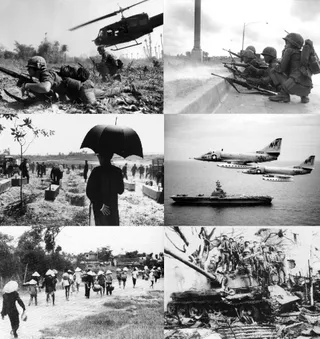
Tuesday Nov 1, 1955 to Wednesday Apr 30, 1975
Vietnam, Laos, Cambodia
The Vietnam War , also known as the Second Indochina War, and in Vietnam as the Resistance War Against America or simply the American War, was an undeclared war in Vietnam, Laos, and Cambodia from 1 November 1955 to the fall of Saigon on 30 April 1975. It was the second of the Indochina Wars and was officially fought between North Vietnam and South Vietnam. North Vietnam was supported by the Soviet Union, China, and other communist allies; South Vietnam was supported by the United States, South Korea, the Philippines, Australia, Thailand and other anti-communist allies. The war is considered a Cold War-era proxy war from some US perspectives. It lasted some 19 years with direct U.S. involvement ending in 1973 following the Paris Peace Accords, and included the Laotian Civil War and the Cambodian Civil War, resulting in all three countries becoming communist states in 1975.
Vietnam had just declared independence in September 1945.
The outbreak of the Korean War in June 1950 convinced many Washington policymakers that the war in Indochina was an example of communist expansionism directed by the Soviet Union.
Military advisors from the People's Republic of China (PRC) began assisting the Viet Minh ((League for the Independence of Vietnam) was a national independence coalition formed at Pác Bó by Hồ Chí Minh on May 19, 1941) in July 1950.
In September 1950, the United States created a Military Assistance and Advisory Group (MAAG) to screen French requests for aid, advise on strategy, and train Vietnamese soldiers. By 1954, the United States had spent US$1 billion in support of the French military effort, shouldering 80 percent of the cost of the war.
According to the Pentagon Papers, however, from 1954 to 1956 "Ngô Đình Diệm really did accomplish miracles" in South Vietnam: "It is almost certain that by 1956 the proportion which might have voted for Ho—in a free election against Diệm—would have been much smaller than eighty percent."
On 7 May 1954, the French garrison at Dien Bien Phu surrendered. The defeat marked the end of French military involvement in Indochina. At the Geneva Conference, the French negotiated a ceasefire agreement with the Viet Minh, and independence was granted to Cambodia, Laos, and Vietnam.
The south, meanwhile, constituted the State of Vietnam, with Bảo Đại as Emperor and Ngô Đình Diệm (appointed in July 1954) as his prime minister. Neither the United States government nor Ngô Đình Diệm's State of Vietnam signed anything at the 1954 Geneva Conference.
Prince Norodom Sihanouk had proclaimed Cambodia neutral since 1955, but permitted the NVA/Viet Cong to use Cambodia as a staging ground for the Sihanouk Trail.
From April to June 1955, Diệm eliminated any political opposition in the south by launching military operations against two religious groups: the Cao Đài and Hòa Hảo of Ba Cụt. The campaign also focused on the Bình Xuyên organized crime group, which was allied with members of the communist party secret police and had some military elements. As broad-based opposition to his harsh tactics mounted, Diệm increasingly sought to blame the communists.
In a referendum on the future of the State of Vietnam on 23 October 1955, Diệm rigged the poll supervised by his brother Ngô Đình Nhu and was credited with 98.2 percent of the vote, including 133% in Saigon. His American advisors had recommended a more modest winning margin of "60 to 70 percent." Diệm, however, viewed the election as a test of authority.
The last French soldiers were to leave Vietnam in April 1956.
Beginning in the summer of 1955, Diệm launched the "Denounce the Communists" campaign, during which suspected communists and other anti-government elements were arrested, imprisoned, tortured, or executed. He instituted the death penalty against any activity deemed communist in August 1956.
Between 1954 and 1957, there was large-scale but disorganized dissidence in the countryside, which the Diệm government succeeded in quelling. In early 1957, South Vietnam enjoyed its first peace in over a decade.
In May 1957, Diệm undertook a ten-day state visit to the United States. President Eisenhower pledged his continued support, and a parade was held in Diệm's honor in New York City. Although Diệm was publicly praised, Secretary of State John Foster Dulles conceded in private that Diệm had been selected because there were no better alternatives.
Between 1956 and 1959, 4 Americans were killed.
In 1960, 5 Americans and 2,223 Vietnamese were killed.
In 1961, 16 Americans and 4,004 Vietnamese were killed.
On 23 July 1962, fourteen nations, including China, South Vietnam, the Soviet Union, North Vietnam and the United States, signed an agreement promising to respect the neutrality of Laos.
In 1962, 53 Americans and 4457 Vietnamese were killed.
The inept performance of the South Vietnamese army was exemplified by failed actions such as the Battle of Ap Bac on 2 January 1963, in which a small band of Viet Cong won a battle against a much larger and better-equipped South Vietnamese force, many of whose officers seemed reluctant even to engage in combat.
President Kennedy was assassinated on November 22, 1963.
Vice President Lyndon B. Johnson had not been heavily involved with policy toward Vietnam; however, upon becoming president, Johnson immediately focused on the war. On 24 November 1963, he said, "the battle against communism ... must be joined ... with strength and determination".
In 1963, 122 Americans and 5665 Vietnamese were killed.
On 2 August 1964, USS Maddox, on an intelligence mission along North Vietnam's coast, allegedly fired upon and damaged several torpedo boats that had been stalking it in the Gulf of Tonkin.
The second "attack" led to retaliatory air strikes, and prompted Congress to approve the Gulf of Tonkin Resolution on 7 August 1964.
In 1964, 216 Americans and 7457 Vietnamese were killed.
The National Security Council recommended a three-stage escalation of the bombing of North Vietnam. Following an attack on a U.S. Army base in Pleiku on 7 February 1965, a series of air strikes was initiated.
Operation Rolling Thunder and Operation Arc Light expanded aerial bombardment and ground support operations.
On 8 March 1965, 3,500 U.S. Marines were unilaterally dispatched to South Vietnam.
In 1965, 1928 Americans and 11242 Vietnamese were killed.
In 1966, 6350 Americans and 11953 Vietnamese were killed.
In late 1967, the NVA lured American forces into the hinterlands at Đắk Tô and at the Marine Khe Sanh combat base in Quảng Trị Province, where the U.S. engaged in a series of battles known as The Hill Fights. These actions were part of a diversionary strategy meant to draw US forces towards the Central Highlands.
In 1967, 11,363 Americans and 12,716 Vietnamese were killed.
The Tet Offensive began on 30 January 1968, as over 100 cities were attacked by over 85,000 enemy troops, including assaults on key military installations, headquarters, and government buildings and offices, including the U.S. Embassy in Saigon.
On 10 May 1968, peace talks began between the United States and North Vietnam in Paris. Negotiations stagnated for five months, until Johnson gave orders to halt the bombing of North Vietnam. At the same time, Hanoi realized it could not achieve a "total victory" and employed a strategy known as "talking while fighting, fighting while talking", in which military offensives would occur concurrently with negotiations.
In 1968, 16,899 Americans and 27,915 Vietnamese were killed.
U.S. president Richard Nixon began troop withdrawals in 1969.
In September 1969, Ho Chi Minh died at age seventy-nine.
On 15 October 1969, the Vietnam Moratorium attracted millions of Americans.
On 27 October 1969, Nixon had ordered a squadron of 18 B-52s loaded with nuclear weapons to race to the border of Soviet airspace to convince the Soviet Union, in accord with the madman theory, that he was capable of anything to end the Vietnam War ("Operation Giant Lance").
In 1969, 11,780 Americans and 21,833 Vietnamese were killed.
In 1970 Nixon announced the withdrawal of an additional 150,000 American troops, reducing the number of Americans to 265,500.
In March 1970, Prince Sihanouk was deposed by his pro-American prime minister Lon Nol, who demanded that North Vietnamese troops leave Cambodia or face military action.
In 1970, 6,173 Americans and 23,346 Vietnamese were killed.
In 1971, 2,414 Americans and 22,738 Vietnamese were killed.
In 1972, 759 Americans and 39,587 Vietnamese were killed.
On 15 January 1973, all U.S. combat activities were suspended. Lê Đức Thọ and Henry Kissinger, along with the Provisional Revolutionary Government (PRG, the Viet Cong's government) Foreign Minister Nguyễn Thị Bình and a reluctant President Thiệu, signed the Paris Peace Accords on 27 January 1973.
In the lead-up to the ceasefire on 28 January, both sides attempted to maximize the land and population under their control in a campaign known as the War of the flags, fighting continued after the ceasefire, this time without US participation and continued throughout the year.
All US forces personnel were completely withdrawn by March 1973.
On 15 March 1973, Nixon implied the US would intervene again militarily if the North launched a full offensive, and Secretary of Defense James Schlesinger re-affirmed this position during his June 1973 confirmation hearings.
In 1973, 68 Americans and 27,901 Vietnamese were killed.
After two clashes that left 55 South Vietnamese soldiers dead, President Thieu announced on 4 January 1974, that the war had restarted and that the Paris Peace Accord was no longer in effect. This was despite there being over 25,000 South Vietnamese casualties during the ceasefire period.
On 13 December 1974, North Vietnamese forces attacked Route 14 in Phước Long Province. Phuoc Binh, the provincial capital, fell on 6 January 1975.
In 1974, only one American and 31,219 Vietnamese were killed.
On 10 March 1975, General Dung launched Campaign 275, a limited offensive into the Central Highlands, supported by tanks and heavy artillery. The target was Buôn Ma Thuột, in Đắk Lắk Province.
The ARVN proved incapable of resisting the onslaught, and its forces collapsed on 11 March.
On 20 March, Thieu reversed himself and ordered Huế, Vietnam's third-largest city, be held at all costs, and then changed his policy several times. As the North Vietnamese launched their attack, panic set in, and ARVN resistance withered.
On 22 March, the NVA opened the siege of Huế. Civilians flooded the airport and the docks hoping for any mode of escape.
By 28 March, 35,000 NVA troops were poised to attack the suburbs.
By 30 March 100,000 leaderless ARVN troops surrendered as the NVA marched victoriously through Da Nang. With the fall of the city, the defense of the Central Highlands and Northern provinces came to an end.
On 7 April, three North Vietnamese divisions attacked Xuân Lộc, 40 miles (64 km) east of Saigon. For two bloody weeks, severe fighting raged as the ARVN defenders made a last stand to try to block the North Vietnamese advance.
On 21 April, however, the exhausted garrison was ordered to withdraw towards Saigon. An embittered and tearful president Thieu resigned on the same day, declaring that the United States had betrayed South Vietnam. In a scathing attack, he suggested U.S. Secretary of State Henry Kissinger had tricked him into signing the Paris peace agreement two years earlier, promising military aid that failed to materialize.
President Gerald Ford had given a televised speech on 23 April, declaring an end to the Vietnam War and all U.S. aid. Frequent Wind continued around the clock, as North Vietnamese tanks breached defenses on the outskirts of Saigon.
Having transferred power to Trần Văn Hương, he left for Taiwan on 25 April.
On 27 April, 100,000 North Vietnamese troops encircled Saigon. The city was defended by about 30,000 ARVN troops. To hasten a collapse and foment panic, the NVA shelled the airport and forced its closure. With the air exit closed, large numbers of civilians found that they had no way out.
Schlesinger announced early in the morning of 29 April 1975 the evacuation from Saigon by helicopter of the last U.S. diplomatic, military, and civilian personnel. Frequent Wind was arguably the largest helicopter evacuation in history.
In the early morning hours of 30 April, the last U.S. Marines evacuated the embassy by helicopter, as civilians swamped the perimeter and poured into the grounds. Many of them had been employed by the Americans and were left to their fate.
On 30 April 1975, NVA troops entered the city of Saigon and quickly overcame all resistance, capturing key buildings and installations. A tank from the 324th Division crashed through the gates of the Independence Palace at 11:30 am local time and the Viet Cong flag was raised above it. President Dương Văn Minh, who had succeeded Huong two days earlier, surrendered to Colonel Bùi Tín.
In 1975, 62 Americans were killed.