Born
Hồ Chí Minh was born as Nguyễn Sinh Cung in 1890 in the village of Hoàng Trù, his mother's village.
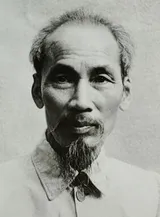
Monday May 19, 1890 to Tuesday Sep 2, 1969
Vietnam - Russia - France - Thailand - China
Hồ Chí Minh was a Vietnamese revolutionary and politician. He served as Prime Minister of North Vietnam from 1945 to 1955 and then its President from 1945 to 1969. Ideologically a Marxist-Leninist, he served as Chairman and First Secretary of the Workers' Party of Vietnam.
Hồ Chí Minh was born as Nguyễn Sinh Cung in 1890 in the village of Hoàng Trù, his mother's village.
He worked as a kitchen helper on a French steamer, the Amiral de Latouche-Tréville while using the alias Văn Ba.
The steamer departed on 5 June 1911 and arrived in Marseille, France on 5 July 1911. The ship then left for Le Havre and Dunkirk, returning to Marseille in mid-September. There, he applied for the French Colonial Administrative School, but his application was rejected and he instead decided to begin traveling the world by working on ships and visited many countries from 1911 to 1917.
While working as the cook's helper on a ship in 1912, Thành (Ho) traveled to the United States. From 1912 to 1913, he may have lived in New York City (Harlem) and Boston, where he claimed to have worked as a baker at the Parker House Hotel.
From 1919 to 1923, Thành (Ho) began to show an interest in politics while living in France, being influenced by his friend and Socialist Party of France comrade Marcel Cachin. Thành claimed to have arrived in Paris from London in 1917, but the French police only had documents recording his arrival in June 1919.
In December 1920, Quốc (Ho) became a representative to the Congress of Tours of the Socialist Party of France, voted for the Third International and was a founding member of the French Communist Party. Taking a position in the Colonial Committee of the party, he tried to draw his comrades' attention towards people in French colonies including Indochina, but his efforts were often unsuccessful.
He began to write journal articles and short stories as well as running his Vietnamese nationalist group. In May 1922, he wrote an article for a French magazine criticizing the use of English words by French sportswriters.
In 1923, Quốc (Ho) left Paris for Moscow carrying a passport with the name Chen Vang, a Chinese merchant, where he was employed by the Comintern, studied at the Communist University of the Toilers of the East.
Quốc (Ho) participated in the Fifth Comintern Congress in June 1924.
Quốc (Ho) arrived in Canton (present-day Guangzhou), China in November 1924 using the name Ly Thuy.
In 1925–1926, he organized "Youth Education Classes" and occasionally gave socialist lectures to Vietnamese revolutionary young people living in Canton at the Whampoa Military Academy. These young people would become the seeds of a new revolutionary, pro-communist movement in Vietnam several years later. According to William Duiker.
He lived with a Chinese woman, Zeng Xueming (Tăng Tuyết Minh), whom he married on 18 October 1926.
After Chiang Kai-shek's 1927 anti-Communist coup, Quốc (Ho) left Canton again in April 1927 and returned to Moscow, spending part of the summer of 1927 recuperating from tuberculosis in Crimea.
Quốc (Ho) returned to Paris once more in November 1927.
Ho returned to Asia by way of Brussels, Berlin, Switzerland and Italy, where he sailed to Bangkok, Thailand, arriving in July 1928.
Quốc (Ho) remained in Thailand, staying in the Thai village of Nachok until late 1929, when he moved on to India and then Shanghai.
In Hong Kong in early 1930, he chaired a meeting with representatives from two Vietnamese Communist parties in order to merge them into a unified organization, the Communist Party of Vietnam.
In June 1931, he was arrested in Hong Kong.
To reduce French pressure for extradition of Quốc (Ho), he was reported as dead in 1932.
The British quietly released him in January 1933. He moved to the Soviet Union and in Moscow studied and taught at the Lenin Institute.
On 31 March 1935, Hồ Chí Minh became Member of the Politburo
In 1938, Quốc (Ho) returned to China and served as an advisor to the Chinese Communist armed forces. He was also the senior Comintern agent in charge of Asian affairs.
Around 1940, he began regularly using the name Hồ Chí Minh, a Vietnamese name combining a common Vietnamese surname (Hồ, 胡) with a given name meaning "He Who has been enlightened" .
In 1941, Hồ Chí Minh returned to Vietnam to lead the Việt Minh independence movement.
In April 1945, he met with the OSS agent Archimedes Patti and offered to provide intelligence to the allies provided that he could have "a line of communication with the allie". The OSS agreed to this and later sent a military team of OSS members to train his men and Hồ Chí Minh himself was treated for malaria and dysentery by an OSS doctor.
Ho Chi Minh's Việt Minh (League for the Independence of Vietnam) launched revolution against French colonial rule in Vietnam, on August 14, 1945.
In September 1945, a force of 200,000 Republic of China Army troops arrived in Hanoi to accept the surrender of the Japanese occupiers in northern Indochina.
Following Emperor Bảo Đại's abdication on 2 September 1945, Hồ Chí Minh read the Declaration of Independence of Vietnam under the name of the Democratic Republic of Vietnam.
Following the August Revolution (1945) organized by the Việt Minh, Hồ Chí Minh became Chairman of the Provisional Government (Premier of the Democratic Republic of Vietnam) and issued a Proclamation of Independence of the Democratic Republic of Vietnam.
After the August Revolution, Ho Chi Minh became the 1st President of the Democratic Republic of Vietnam
In Saigon, with violence between rival Vietnamese factions and French forces increasing, the British commander, General Sir Douglas Gracey, declared martial law. On 24 September, the Việt Minh leaders responded with a call for a general strike.
In the final days of 1946, after a year of diplomatic failure and many concessions in agreements, such as the Dalat and Fontainebleau conferences, the Democratic Republic of Vietnam government found that war was inevitable.
When Chiang forced the French to give the French concessions in Shanghai back to China in exchange for withdrawing from northern Indochina, he had no choice but to sign an agreement with France on 6 March 1946 in which Vietnam would be recognized as an autonomous state in the Indochinese Federation and the French Union. The agreement soon broke down.
The bombardment of Haiphong by French forces at Hanoi only strengthened the belief that France had no intention of allowing an autonomous, independent state in Vietnam. The bombardment of Haiphong reportedly killed more than 6000 Vietnamese civilians. French forces marched into Hanoi, now the capital city of the Socialist Republic of Vietnam.
On 19 December 1946, after the Haiphong incident, Ho Chi Minh declared war against the French Union, marking the beginning of the Indochina War.
In February 1950, after the successful removal of the French border blockade, he met with Joseph Stalin and Mao Zedong in Moscow after the Soviet Union recognized his government. They all agreed that China would be responsible for backing the Việt Minh. Mao Zedong's emissary to Moscow stated in August that China planned to train 60,000–70,000 Viet Minh in the near future.
On 19 February 1951, Hồ Chí Minh became the Chairman of the Central Committee of the Workers' Party of Vietnam.
The 1954 Geneva Accords concluded between France and the Việt Minh, allowing the latter's forces to regroup in the North whilst anti-Communist groups settled in the South.
In 1954, after the crushing defeat of French Union forces at Battle of Dien Bien Phu, 2300 French soldiers died during the Battle of Dien Bien Phu more than 10000 french soldiers have surrendered to Vieth Minh. France gave up its fight against the Việt Minh, losing 70,000 soldiers from the eight years of the First Indochina War.
By the afternoon of 20 July, the remaining outstanding issues were resolved as the parties agreed that the partition line should be at the 17th parallel and the elections for a reunified government should be held in July 1956, two years after the ceasefire.
As early as June 1956 the idea of overthrowing the South Vietnamese government was presented at a politburo meeting.
On 1 November 1956, Hồ Chí Minh became the First Secretary of the Central Committee of the Workers' Party of Vietnam.
At the end of 1959, conscious that the national election would never be held and that Diem intended to purge opposing forces (mostly ex Việt Minh) from the South Vietnamese government, Hồ Chí Minh informally chose Lê Duẩn to become the next party leader.
In 1959, Hồ Chí Minh began urging the Politburo to send aid to the Việt Cộng in South Vietnam and a "people's war" on the South was approved at a session in January 1959 and this decision was confirmed by the Politburo in March.
North Vietnam invaded Laos in July 1959 aided by the Pathet Lao and used 30,000 men to build a network of supply and reinforcement routes running through Laos and Cambodia that became known as the Hồ Chí Minh trail. It allowed the North to send manpower and materiel to the Việt Cộng with much less exposure to South Vietnamese forces, achieving a considerable advantage.
Lê Duẩn was officially named party leader in 1960, leaving Hồ to function in a secondary role as head of state and member of the Politburo. He nevertheless maintained considerable influence in the government.
To counter the accusation that North Vietnam was violating the Geneva Accord, the independence of the Việt Cộng was stressed in Communist propaganda. North Vietnam created the National Liberation Front of South Vietnam in December 1960 as a "united front", or political branch of the Viet Cong intended to encourage the participation of non-Communists.
In July 1967, Hồ Chí Minh and most of the Politburo of the Communist Party met in a high-profile conference where they concluded the war had fallen into a stalemate.
With Hồ Chí Min's permission, the Việt Cộng planned a massive Tet Offensive that would commence on 31 January 1968, with the aim of taking much of the South by force and administering a heavy blow to the American military. The offensive was executed at great cost and with heavy casualties on Việt Cộng's political branches and armed forces.
With the outcome of the Vietnam War still in question, Hồ Chí Minh died of heart failure at his home in Hanoi at 9:47 on the morning of 2 September 1969; he was 79 years old.
A week of mourning for his death was decreed nationwide in North Vietnam from 4 to 11 September 1969.